Cool@Hoole

April 15, 1865 – A Tale of Two Cities

headline2

It was the best of times, it was the worst of times. 

Englishman Charles Dickens wrote that in 1859, just two years before England’s former colonies began a long and bloody civil war. I wonder if that quote came to the minds of any Americans during the week of April 9-15, 1865. Depending on what perspective one had about the state of national politics, that one week entailed both a triumphant victory and a crushing defeat.

On Sunday April 9, Confederate General Robert E. Lee surrendered, signaling the beginning of the end for the Confederacy and the Civil War. On Friday April 14, President Lincoln, who had been determined to keep the country together, was assassinated, dying the next morning.

In the process of digitizing a collection of newspaper clippings that had little to do with either the Civil War or Lincoln, we ran across what must’ve been a treasured copy of the New York Herald from April 15, 1865. We thought we’d share some clippings from it.

The Death of a President

Beyond the details of the tragedy, perhaps the most interesting thing about this news story is the insight it gives us on how newspaper reporting was done in the middle of the nineteenth century. Much of the news is presented as “dispatches,” first-person observations sent by telegraph or messenger. As with modern news stories, newer information was often tacked on to older information, to give a sense of how things have developed.

The April 15 edition repeated the earliest dispatches from Washington, from the night before:

april14Just after midnight, more news began coming in. At first, there was no talk of the president’s fate, as no one had apparently heard the doctor’s prognosis. Instead, the focus is on the crime’s perpetrators, and on the city waiting and fearing:

april15_1am-1

When the news did come in, it wasn’t good, as evidenced in the reactions of those at Lincoln’s bedside:

april15_1am-2 april15_1am-3

Sometime in the wee hours of the morning, a dispatch came from Edwin Stanton, the Secretary of War, who was on hand at the scene:

april15_9am

By 7:30 a.m., the Herald was able to pronounce that the assassination had ultimately been successful:

april15_730am

This was just the beginning of the story, fleshed out in editions to come.

The End of a War

The Dickens quote above comes from his novel A Tale of Two Cities, the cities in question being London and Paris. But the two cities most in the minds of Herald readers were likely the fractured country’s two capitals: Washington, D.C., and Richmond, Virginia, just over 100 miles apart.

It’s also where our two stories meet, in a way. During the week before the surrender at Appomattox Courthouse and the assassination, Lincoln toured the newly fallen Confederate stronghold himself. He must’ve felt that the war’s end was near.

News from Richmond was slow to come to the Herald — it was apparently gleaned almost entirely second-hand, from southern newspapers — so some of what was reported in the April 15 edition stretched back to before the surrender.

News from April 5, the day after the fall of Richmond, brings the “first rebel account of how the city was abandoned”:

civilwar_april5b

“We have no doubt that a considerable portion of the brave city has been laid in ashes and a number of its people insulted, outraged, robbed, and massacred.”

From that same day came report of a plea by Confederate President Jefferson Davis. Viewing the situation in hindsight, the Herald editors were able to label it “Jeff. Davis’ last proclamation.” It was one that called on southerners’ “unconquered and unconquerable hearts”:

civilwar_april5a

“It is for us, my countrymen, to show by our bearing under reverses how wretched has been the self-deception of those who have believed us less able to endure misfortune with fortitude than to encounter dangers with courage.”

In a dispatch from April 11, the fall of Richmond was reported in greater detail, including the response of the Union army and the continued advance of Confederate General Johnston, who did not give up until a few days after this edition was published:

civilwar_april11

Johnston’s refusal to back down is also mentioned here, with the report of April 14:

civilwar_april14

The following are all second-hand reports from southern newspapers on April 13. They include details of the surrender as well as an exhortation to southerners — taken from a Richmond newspaper — to “dismiss rancor from their hearts” and make peace:

civilwar_april13

And they did make peace. Was one of the costs of that peace the death of the wartime President? We’ll never quite know the answer to that question. What we do know is this tale of two cities gripped the nation, making it one of the most eventful and momentous weeks of newspaper reporting the country has ever seen.

It just goes to show how much a single item from an archive can tell you!
 

Interview with Alex Goolsby, Division of Special Collections Graduate Assistant

By: Alex Goolsby, University of Alabama MLIS student

Editor’s Note: Hoole Special Collections Library will be closed for inventory from Monday, May 5, through Friday, May 16. Questions? Email archives@ua.edu.

Hello! Thank you for agreeing to talk to us about your role at in the Division of Special Collections.

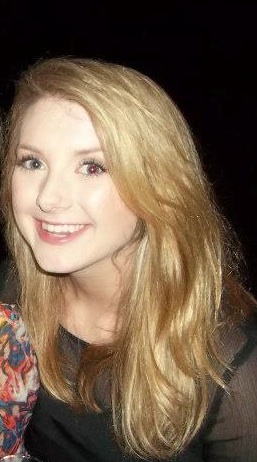
Alex Goolsby

Alex Goolsby

First off, how did you get started in this field?

During my undergraduate work here at UA, I strongly was encouraged to consider pursuing graduate work in library and information studies. Over the last year and a half, I have learned so much about the field, and I’ve become very passionate about it. This field gives you constant opportunities to learn and grow and, as a librarian, you get to learn a little about a lot. As a naturally inquisitive person, I love finding to new topics to research and read about. Similarly, I enjoy helping patrons, whether it’s explaining a particular resource or developing better search strategies.

What previous roles have you had in the Division of Special Collections?

In 2010 during my junior year of undergrad, I started working as a page in the special collections library under Allyson Holliday. It was my first time working in a library since my elementary school days as a library aide, and it was my first experience with archival materials. As Hoole is a non-circulating, closed-stack library, I was responsible for retrieving items that patrons in the reading room requested. This included items like books, manuscripts, university records, maps, sheet music, and more. I also fulfilled photocopy requests for patrons and interlibrary loan (ILL). It was a great way to learn more about the collections and types of materials at Hoole, as well as to learn about what makes special collections libraries so ‘special.’ Ultimately, I worked as a page for two years, and my time at Hoole definitely encouraged me to pursue a Master’s in Library and Information Studies. In May 2014, I will graduate with an MLIS, and I’m so thankful for the experience and encouragement that I’ve received over the last four years from all of the Hoole staff.

Starting in July 2013, I began working as volunteer to answer outside reference requests under Kevin Ray. Outside reference simply refers to any patron request that isn’t made in the reading room; these are often sent via email or telephone. Working with outside reference is exciting and challenging, mainly because you never know what new questions you’ll be asked. We do everything from helping patrons who are conducting research about their genealogy or for their new book to explaining how to use the collections, including how to search Acumen and the digitized finding aids. People from around the United States and overseas contact the special collections library to learn more about the unique items it houses. I love connecting those people with the information here, especially because I get to be a part of their research journey as they mine the treasure trove that is Hoole.

Continue reading

Confronting the Holocaust: Alabama Responses to Dachau, Part I

By: Allyson Holliday, W.S. Hoole Library Complex Copy-Cataloguer

This post is one of a two-part series in recognition of Holocaust remembrance week April 27–May 4, 2014. The theme designated by the United States Holocaust Memorial Museum for the 2014 observance is Confronting the Holocaust: American Responses. Part I of this series features testimony from Joe Sacco and James Chancy. Part II, to be posted on May 9, 2014, will feature the story of William Denson, an Alabama lawyer who prosecuted Nazi war criminals in proceedings at Dachau.

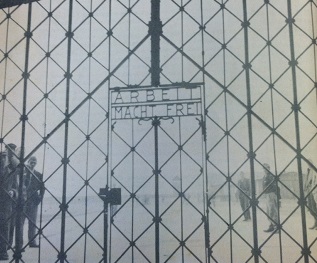
Photograph of Dachau's front gates

Photograph of Dachau’s front gates

Dachau was the first concentration camp built by Nazi Germany in World War II. Dachau held 8,000 to 10,000 prisoners. Most camp records were destroyed weeks before Allied soldiers arrived. Records that were pieced together showed that more than 228,000 prisoners were processed there between 1933 and 1945. At its peak in 1944, Dachau held as many as 60,000-80,000 prisoners. It was a disposal site for persons killed elsewhere as well as a site for the murders of tens of thousands of Czechs, Russians, Poles, Jews, Gypsies, and other Germans. At the time of liberation, there were about 32,000 prisoners left in Dachau. The surviving prisoners suffered from starvation, exhaustion, and various diseases due to malnutrition, poor sanitation, and lack of medical care. The following experiences spotlight Hoole library items and the thoughts of two Alabama soldiers who participated in the liberation of Dachau.

Joe Sacco

Where the Birds Never Sing, is a tale of the horrifying but triumphant story of American soldiers in World War II. The story is told through the eyes of Joe Sacco, a farm boy from Birmingham, Alabama who survived the landing at Normandy and the terrors of the Battle of the Bulge. As part of the 92nd Signal Battalion and General Patton’s Third Army, Joe Sacco and his fellow soldiers found themselves on the frontlines of the Allied movement through Europe. Even after more than a year of battles, nothing could have prepared him for the horrors the battalion discovered behind the walls of Nazi Germany’s Dachau. The 92nd Signal Battalion were among the first American troops into the camp and it was there that they faced the ultimate importance of the Allied mission – stopping Hitler’s Holocaust. They liberated the surviving prisoners at Dachau and gained an even deeper appreciation for the value of human life and were appalled at the barbarous inhumanity of Hitler’s Germany. Joe Sacco’s transformation from an Alabama farm boy to a courageous soldier and liberator are a testament to the strength and resiliency of ordinary soldiers.

Joe Sacco wrote on April 29, 1945:

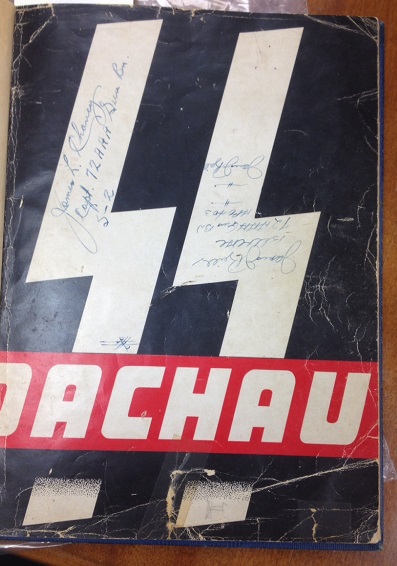
Cover of Dachau report

Cover of Dachau report signed by James Chancy

“The gun battle didn’t last long. In about 15 or 20 minutes, it was all over…all the men got real quiet as we crossed the threshold into the camp. The smell that had caught our attention as we approached the wall was now overwhelming. Within a few steps, we all came to a stop and looked around in disbelief. I had seen carnage at Normandy. I had seen my buddies die right in front of me and whole towns get blown to hell. But I had never seen anything like this. Nothing could have prepared any of us for the horror laid before our eyes. No one said a word. It was as if everything slipped into slow motion, where every second took an hour to pass, where every minute was filled with such incredible sorrow that it seemed it would never end. I was nauseated, dizzy, confused. My brain couldn’t comprehend what my eyes were seeing.” (Where the Birds Never Sing, 2-3)

James Chancy

Former Tuscaloosa Public Safety Commissioner, James Chancy, was a captain in the 72nd Anti-Aircraft Battalion. His unit also helped to liberate the gruesome Dachau death camp. Hoole Library holds his copy of the official U.S. Army report of Dachau completed on site after the war. An undated newspaper clipping from the Tuscaloosa News laid in the report quotes James Chancy:

Newspaper

Laid-in Tuscaloosa News article

“The human mind has the ability to cast aside things you don’t particularly want to remember. That, I guess, is the thing that has saved the people involved who were prisoners in the death camps and the soldiers who encountered the horrors while liberating them” (Tuscaloosa News).

The foreword of the Army report states that Dachau “will stand for all time as one of history’s most gruesome symbols of inhumanity. There our troops found sights, sounds and stenches horrible beyond belief, cruelties so enormous as to be incomprehensible to the human mind. Dachau and death were synonymous” (Army Report, 2). The full Army report is available online through the University of Wisconsin, although viewers should be aware that there are graphic images contained within the report.


Family Connections

With a collection as regional as the one at the W. S. Hoole Special Collections Library, it’s not surprising to find some occasional overlap.

The Wynne Family Papers and the Meriwether Family Papers come together with the Coleman family, as you can see in this family tree (click to view a larger version):

WynneColemanMeriwether


When Alice Coleman Meriwether’s brother Bestor married a Wynne girl (Laura), it meant their families — and family papers — were inextricably entangled, for better or worse.

What’s in a Name

While having more information about each family makes relationships easier to figure out, it sometimes also adds to the confusion. Compounding this problems is the tendency of women in the 19th century south to give their maiden names to their children, usually as first names. For example, Bestor Wynne Coleman carries three family names, including one that goes back to his paternal grandmother’s family in Connecticut.

Some women apparently also named their daughters after themselves, much like men might name their sons. When Alice Coleman married John Meriwether, she became Alice Coleman Meriwether, the same name her daughter carried until her own marriage.

Frances Laura Anderson Wynne gave her name to her daughter, although, luckily for us, she called herself simply Laura. (She became Laura Wynne Coleman.) There’s a good bet her daughter, Fannie Coleman, was also a Frances herself. To add to the confusion, there’s also a picture of an infant labeled Fannie Julia Scott — which means Julia Wynne Scott must have named her daughter after her mother (and herself!), too.

Of course, the really interesting thing about the extended Wynne-Coleman-Meriwether family is the breadth of their combined collections. These two sets of papers include letters and other documents that span most of the 19th century, an important period of growth and change in America.

From the Meriwether Collection

From the Meriwether collection, we’ve already highlighted yankee Juliet Bestor’s long journey to Alabama to get married in the 1830s. As Coleman family matriarch, she was deeply mourned at her passing:

eulogy for Juliet Coleman

In addition to Juliet’s papers, the Meriwether collection mainly consists of letters between Alice Coleman Meriwether and her husband, John, as he served in the Alabama Infantry during the Civil War. Included in the collection is a map of the Battle of Vicksburg which John drew by hand:

hand drawn map of battle of vicksburg

The rest of Alice’s correspondence pops up in the Wynne collection, as letters to and from Laura Coleman. Use this link to see those items.

From the Wynne Collection

On the Wynne side, we have pictures of all the siblings:

William was a lawyer. Among several legal documents in the collection (see Wynne/Miscellaneous Documents) is this contract:

marriage agreement signed by W. A. Wynne

Apparently, William approached everything, even a good-natured personal bet, with a legal eye. Did he end up having to pay up? Unless the other two remained bachelors, he would’ve been one of the losers of the bet, as he never married.

Neither did his brother Thomas. Thomas is rarely in family correspondence, but he seems to have had a close relationship with Julia. Read this letter from Julia to Thomas (1867) and this from Thomas to Julia (1869) to get a sense of the relationship between these youngest Wynne siblings. The two oldest Wynne siblings were apparently also close, given the number of letters between them, like these examples from 1852: Martha to William (April) and William to Martha (August).

Like Thomas, William was not a big letter writer, judging from the evidence we have. However, the rest of the Wynne siblings were apparently frequent correspondents, as this assortment shows:

Much of the Wynne collection, however, originates with Laura Wynne Coleman, especially letters to and from her daughter Fannie and her son B. W., called Wynne. In the finding aid, see Wynne/Correspondence, especially the 1870s and 1880s.

What’s Not in a Name

There’s a lot one can glean from looking at changing names over decades of correspondence. However, some family connections remain a mystery without deeper digging:

  • Who is Julia Coleman McLemore? Perhaps a sister or cousin or niece of James Cobb Coleman? She conversed regularly with Laura and Wynne Coleman, as early as the 1840s.
  • Who is Mattie T. Wynne? She calls Laura Wynne Coleman “cousin,” so she’s probably not Martha (Mattie) Ann Wynne Sturdivant. And is she the same person as Mattie Webster, who is also “cousin” to Laura?
  • Did Thomas O. Wynne work at Webster and Wilson? Is this the same Webster that married his sister Elizabeth?

New Possibilities for Special Collections in Digital Scholarship at the University of Alabama

By: Emma Wilson, English and Alabama Digital Humanities Center Postdoctoral Fellow & Christa Vogelius, CLIR Postdoctoral Fellow

IMG_8503

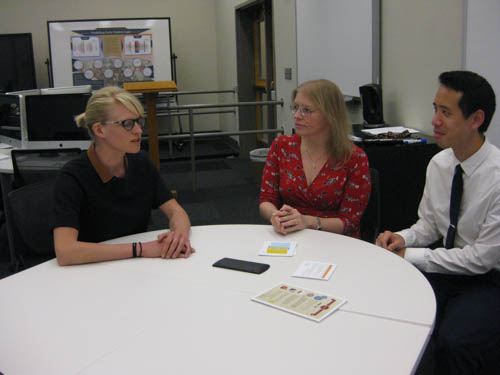
Christa Vogelius receives a digital humanities consultation from Emma Wilson and Muzel Chen at the Alabama Digital Humanities Center (ADHC)

The Alabama Digital Humanities Center (ADHC) at the University of Alabama, located in Gorgas Library Room 109, provides support for innovative digital research and pedagogy within the university community.  The mission of the ADHC overlaps in interesting ways with a central goal of the Division of Special Collections: to increase access to archival materials. At the ADHC, faculty and graduate students can meet with Postdoctoral Fellow Emma Annette Wilson and Technology Specialist Muzel Chen to discuss their ideas for digital research and pedagogy, including projects such as scholarly websites or digital exhibits; textual analysis; data visualization through maps, charts, or diagrams; and incorporating the digital humanities into their teaching. Some of these projects depend closely on the digitization of archival materials, and this blog post records an initial consultation at the ADHC between CLIR Postdoctoral Fellow Christa Vogelius from the Division of Special Collection’s A.S. Williams III Americana Collection and Emma Wilson. It showcases both the kind of support the ADHC provides for digital projects, and the ways that the University of Alabama’s archival community benefits from this resource.

Emma Wilson: Christa, first, thanks for coming in. Perhaps you could tell me a bit more about the collection that you’re working with at the moment and the kind of digital project that you foresee?

IMG_8483

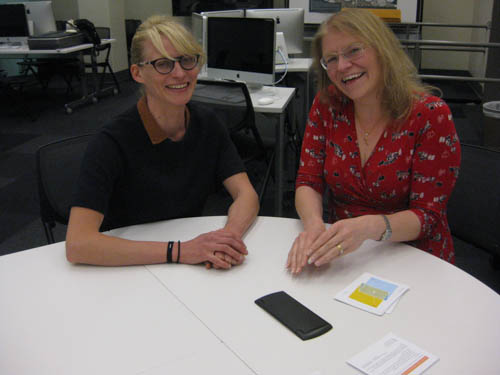
Christa Vogelius and Emma Wilson collaborate on using Williams Collection materials in digital humanities projects with help from the ADHC

Christa Vogelius: At the Williams Collection now, we’re working with digital services to digitize a collection of 21 binders of carte de visite portrait photographs from Southern photography studios. Cartes de visite were small, inexpensive photographs mounted on cardstock that was typically only about 2 1/2  by 4 inches—about the size of a visiting or business card. They were extremely popular in the second half of the nineteenth century, and cheap enough that most people could afford to have many portraits taken in the course of their lifetimes. The images in this collection are interesting because of the number of Southern portrait studios that are represented. We want to be able to show visually the geographic range of the studios represented, and so once digital services finishes photographing the images, and I finish the metadata with the studio information for each photograph, we hope to create a map showing the collection’s studio locations.

Continue reading

The Day the Campus Burned

Five days later, and it might not have happened at all.

Five days later, Robert E. Lee was surrendering at Appomattox Courthouse, and the Civil War was irreversibly moving toward its end. Five days later, Brigadier General John T. Croxton might’ve had less reason to cripple Tuscaloosa by destroying everything of value, including an academic institution turned makeshift military academy. Maybe, but probably not. Lee’s was not the only force in the CSA. Down in Montgomery, Lieutenant General Nathan Bedford Forrest’s cavalry units were biding their time, waiting to strike back after their defeat at Selma on April 2.

What did the “West Point of the Confederacy” look like back then? Here’s an illustration, from the campus’s first decade (1839):

UA campus 1839

On the left is Franklin Hall, with Madison Hall on the right. In the center is the rotunda, which housed the school’s library, with the Lyceum in the background.

Here’s a photo from 1861:

ua campus 1861

However idyllic these images look, all was not peaceful at the school, even before the war. The students were rowdy and disobedient, prompting President Garland to implement a system of military discipline in 1860. In some ways, this was lucky for the students — they and their compatriots around the state would need this training once the war came.

*

On April 3, 1865, Union troops met UA cadets at River Hill, at a bridge over the Black Warrior River. In a 1990 article on the subject (see References, below), Clark Center, former Curator of the W. S. Hoole Special Collections Library, recounted the decision facing the group:

As the Corps waited in position, President Garland held a conference with Commandant Murfee and Captain James S. Carpenter, a confederate officer. Carpenter informed Garland and Murfee of the overwhelming odds facing the small force of three hundred boys. Not only were the cadets outnumbered, but the Federal troops were armed with repeating rifles. And to rub salt into the wound, the Corps’ own field pieces, captured before they could be brought into play, were now trained on the bridge and its approaches from the Northport side.

Garland made his decision. Unwilling to commit the Corps to useless sacrifice, he marched the boys back to the campus. Once there, they quickly gathered their overcoats, blankets, and haversacks, which they filled with hard-tack from the commissary stores, and fell back into ranks.

By two o’clock in the morning the Corps and many of the faculty were marching east along the Huntsville Road, away from Tuscaloosa and the University.

Not all the faculty left, however. The next day, when Colonel Thomas M. Johnston and the Second Michigan Cavalry came onto the campus, they were met by Andre Deloffre, a Frenchman who taught French and Spanish…

Andrew De Loffre 1859

…and William Wyman (bottom), who taught Latin and Greek.

William Wyman

Deloffre, who served as the University librarian, was reportedly the one who begged Johnston not to destroy the rotunda, which housed some 7,000 volumes, in addition to the school’s natural history collection.

While Center’s piece provides a historical account of the events of April 9, 1865, another version of events, by early 20th century Tuscaloosa historian James A. Anderson, takes a more artistic approach. Here’s Anderson’s dramatization of that moment, from The Destruction of the University of Alabama Library: An Episode of the Civil War, written in the 1930s:

AndersonScript

Facing a plea that might’ve been much like this once, Johnston relented, at least enough to send a messenger to Croxton, asking what he might do. But the reply wasn’t good. Croxton had no choice: all public buildings must be destroyed. And so they were.

Lyceum ruins drawing

(Drawing, ruins of the Lyceum)

*

What was the heart of campus then is still the heart of campus now. If you stand at the stone monument on the Quad, facing the steps of Gorgas Library…

Plaque

…then you’re standing about where the rotunda used to be. If you were there amid the rubble in the late 1860s, looking across more rubble where the Lyceum once stood (round about Clark Hall), you’d have a view of the newly built Woods Hall:

Ruins

You’d also be looking at bricks from the original campus structures, salvaged and incorporated into Woods and other subsequent buildings.

So, was anything left standing? Yes, and those four campus buildings are still here today:

  1. the guardhouse, now known as the Round House, which sits next to Gorgas Library
  2. Gorgas House, located next to Morgan Hall on the northwest corner of the Quad
  3. the President’s Mansion, across University Boulevard from Denny Chimes
  4. the old Observatory, now known as Maxwell Hall, across from Bruno Library on the west side of campus

map

Other traces of the old campus still remain. There on the shady side of the Quad where Franklin Hall used to be is The Mound, which has come to play its own important part in UA’s more recent past and present, serving as the location for “tappings” on Honors Day.

Franklin1 Franklin2

On the sunny side of the Quad, a brick plinth marks the spot where Madison Hall once stood.

Madison

Long after the original campus’s destruction, its architectural styles influenced the rebuilding and continuing growth of the campus, and inspired those who perhaps never even saw the buildings, like the amateur artist who made this drawing of the rotunda (side view) in the 1880s:

rotunda_drawing

Five days before the first major surrender of the war, the campus of the University of Alabama was forever changed. In the decades after the war, the ersatz military training facility became a real military college. Eventually, though, it shed its martial past to become a co-ed institution of higher learning, with its own societal conflicts and, thankfully, more peaceful resolutions.

*

Reference:

Center, Clark. “The Burning of the University of Alabama.” Alabama Heritage 16 (Spring 1990): 30-45.

Birmingham, Brierfield Iron Works, and Josiah Gorgas

By: Evan Ward, University of Alabama M.A. student in History

Today, Evan Ward shares a selection from his research on changing attitudes toward industrial work in Alabama after the Civil War. If you are a graduate student working on resources from the Division of Special Collections and you would like to share a selection from your work on Cool@Hoole, please contact editor Amy Chen at ahchen@ua.edu. 

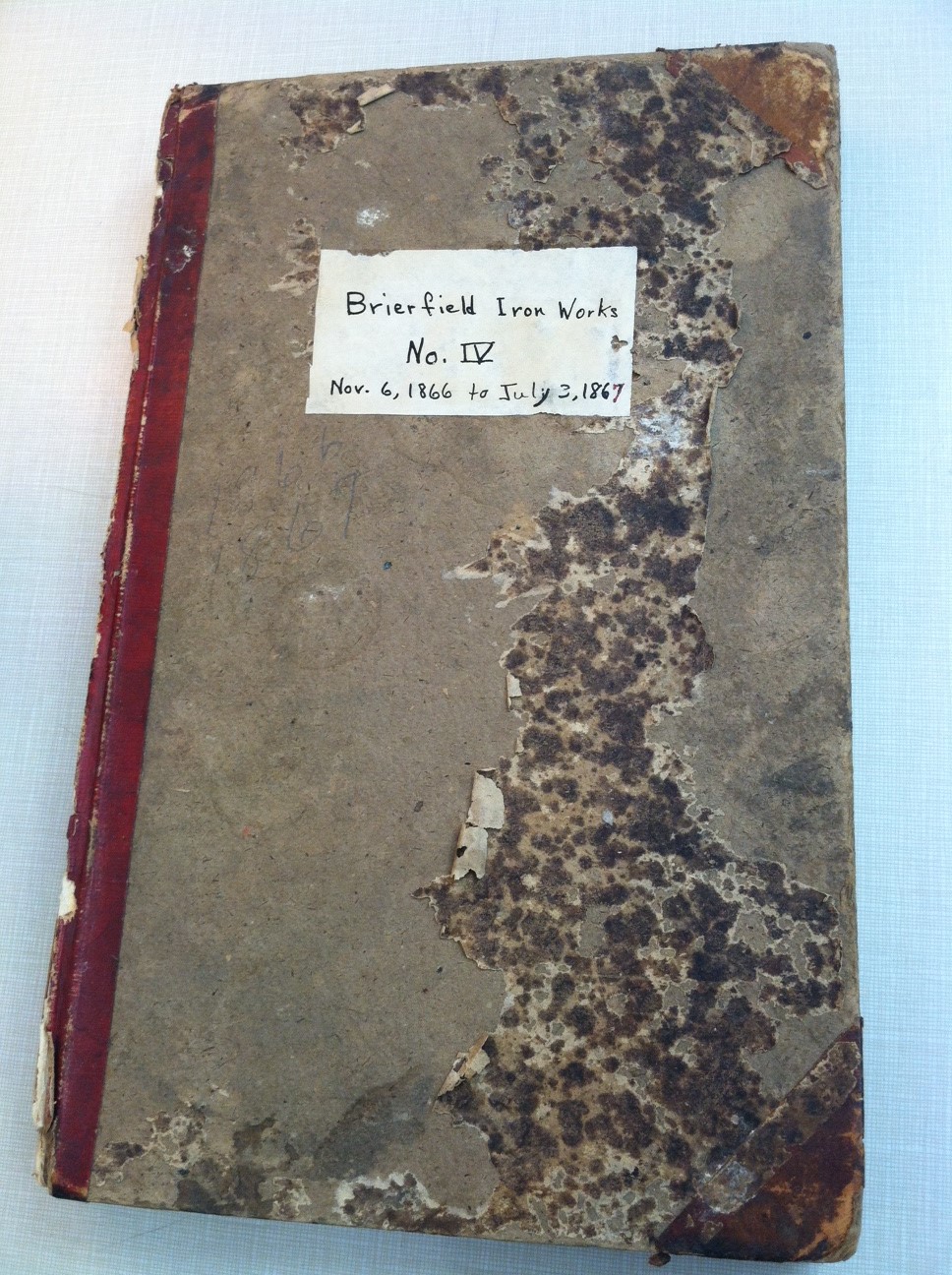
Brierfield-1

Brierfield Iron Works records, volume IV November 6, 1866-July 3, 1867

Alabama, more than perhaps any former Confederate state, was suited for nineteenth century industry. “No place on earth, other than the Birmingham District,” writes historian W. David Lewis, “contained within a thirty-mile radius all three raw materials required for iron production.” [1] Those three raw materials were red and brown hematite, also known as iron ore; limestone, commonly used in smelting; and coal, used to fire the state’s blast furnaces. The state’s potential for industry was widely known, thanks to the many geological surveys that had been conducted throughout the pre-war and post war periods. Alabama’s industrial capacity had even been tested during the Civil War, an event that spurred the firing of new forges and the laying of new railroads. After the war, state industrialists and advocates for a ‘New South’ saw a bright future for Alabama, whose mineral resources would surely elevate her to the same status as northern industrial giants. They brashly named the state’s emerging industrial center Birmingham, after Britain’s main industrial hub. But, after the war, industrial development languished. Many iron forges and coal mines wrecked by Union forces were not reopened for years – and those that survived often struggled to stay in operation.

Continue reading

The Kindred of the Wild

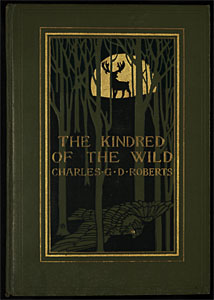
pba02876f01r

The Kindred of the Wild (1902)

By: Tina Colvin, PhD candidate in English at Emory University

In 1902, the “father of Canadian literature,” Charles G.D. Roberts, published his book-length collection of wild animal stories, The Kindred of the Wild: A Book of Animal Life. Roberts’s collection emerged at a time when the readership for stories about the lives, deaths, and struggles of wild animals had blossomed, and the popular success of The Kindred of the Wild cemented Roberts’s status as one of the most prominent authors of the period. In keeping with the genre of the animal story, Roberts’s collection depicts animals such as rabbits, eagles, moose, wolves, foxes, and owls as they evade predators, stalk prey, protect their young, play in the snow, and try to avoid the guns, snares, nets, and other dangers posed by humans. The Richard Minsky Collection holds the first edition of the book, one of the versions that also contains illustrations by Charles Livingston Bull who provided dramatic portraits of the wildlife described by Roberts’s prose.

According to Roberts’s appraisal of modern wild animal stories, his own Kindred of the Wild does not suffer from several major mistakes committed by other writers of animal tales. As Roberts explains in his introduction to Kindred, the modern animal story is uniquely engaged with the then-emergent realization that animals possess diverse mental functions, behaviors, and importantly, emotions. The writers who take up this unmapped terrain of animal psychology, Roberts explains, “may be regarded as explorers of this unknown world, absorbed in charting its topography.” Despite their pathbreaking efforts, however, writers of animal stories risk humanizing the animals whose inner lives they endeavor to capture: for instance, Roberts cites Marshall Saunders’s Beautiful Joe and Anna Sewell’s Black Beauty as guilty of creating an overly humanized, and by extension overly sentimentalized, representation of animal existence.

To avoid turning his own animals into humans-in-disguise, Roberts’s stories focus on how animals survive or perish in the face of everyday encounters with their environment, humans, and other animals. In Kindred, an orphaned fawn falls prey to a hungry wildcat, a goose travels across lakes and sky in search of a mate, and a wolf dies in the snow, “kicking dumbly,” from a hunter’s bullet in his neck. Despite Roberts’s attempt to offer “realistic” portrayals of animal life, however, traces of the very humanization he disavows creep into his characterizations of animals. A kingly eagle “takes tribute” from a lesser raptor, and a lynx glares with “exultant pride” after killing a mink. More than humanization alone, too, Roberts projects his own values onto animals: he consistently depicts all his most triumphant, daring, and praiseworthy animals as male, thereby betraying his gender bias and patriarchal thinking.

Keeping these issues in mind, what can Roberts’s work teach us about our relationship with wild animals over 100 years after the publication of this first edition? Despite its flaws, Roberts’s collection reveals that depicting animals in all their nonhuman complexity present an ongoing challenge to those humans who venture to write stories about them. Even more importantly, Roberts’s stories endeavor to show that animals are far from simple, machine-like creatures who act according to an invariable, fixed set of behaviors. Instead, Roberts insists that animals have a diversity of personality and emotion. His tales provided an important precursor to contemporary studies of animal behavior that increasingly confirm many animals’ capacity for not only complex responses to problems, but also a wide range of emotions including grief, joy, and empathy. Ultimately, Roberts’s The Kindred of the Wild and the work of several other writers of wild animal stories marked a growing shift in popular attitudes toward animals, a shift from viewing them as passive automatons to recognizing their varied needs and desires as worthy of human attention.

Miniature Books

By: Amy Chen, CLIR Postdoctoral Fellow

Isreal

A miniature book from Israel. The book is curled up inside the earthenware jar!

Please see Cool@Hoole’s previous post on the Kate Webb Memorial Miniature Book exhibition.

The history of miniature books is both long and international. Scholars date the appearance of the duodecimo (small size) book to the beginning in the fourteenth century, although miniature books originate with the use of clay tablets by Babylonians around 1750 BC. As early as 900 AD, the Japanese created tiny wood block prints on scrolls. Peter Schoffer, Johann Gutenberg’s protégé, assembled the first miniature book using movable type in Germany in 1468. William Secker published the first American miniature book, A Wedding Ring, in 1690.

However, miniature books did not become widespread until the eighteenth and nineteenth centuries. Napoleon, a collector and reader of miniature books, helped contribute to the rise of the art form in continental Europe. In the United States, settlers moving westward chose to convert Bibles, hymnals, almanacs, and other reference volumes into tiny editions to make them more portable for their journey.

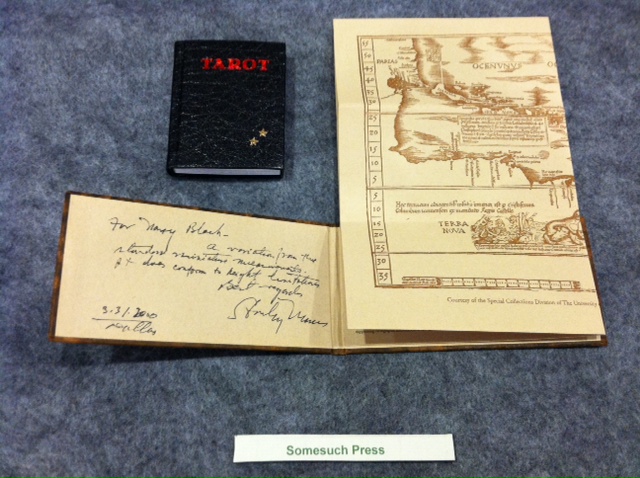
Somesuch

Somesuch Press miniature books

By the twentieth century, tourists bought miniature books as keepsakes. Visitors to the 1904 Chicago World’s Fair purchased miniature books encapsulated in walnut shells as souvenirs. Queen Mary commissioned a doll’s house in 1920 on behalf of the people of the United Kingdom. To fill the doll house’s library, 200 miniature books with blank pages were mailed to the most prominent writers of the era. Now, Queen Mary’s doll’s house is a popular attraction within Windsor Castle.

The majority of contemporary miniature books are printed as artists’ books. Artists’ books are created to be works of art and are generally hand-made in limited editions. Miniature artists’ books may resemble conventional books, but they also can be made into fold-up or pop-up styles to surprise and delight readers.

Miniature Book exhibitions on display in Gorgas

By: Amy Chen, CLIR Postdoctoral Fellow

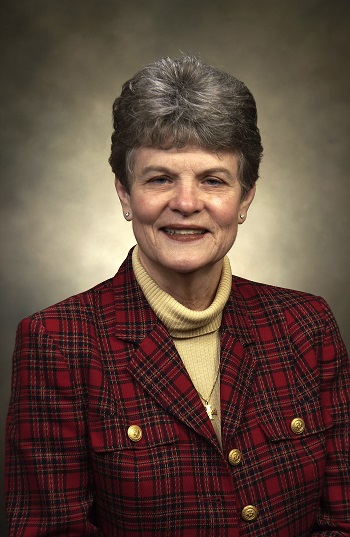
Kate Ragsdale

Kate Ragsdale

This April and May, two miniature book exhibitions will be on display simultaneously in the Pearce Lobby of the Amelia Gayle Gorgas Library: the Kate Webb Ragsdale Memorial Miniature Book Collection and the Miniature Book Society’s traveling exhibition.

The Kate W. Ragsdale Memorial Miniature Book Collection contains a diverse selection of ninety-six items representing the diminutive art form. Placed in chronological order, the collection spans nearly 230 years, beginning with The Bible in miniature: or a Concise History of the Old & New Testament (1780) and ending on Sidney E. Berger’s Wine by a nose at the finish (2008). A wide variety of American presses, including Somesuch Press from Dallas, Texas and Sunflower Press from Mill Valley, California, represent the art of miniature book during the late twentieth century. However, the Kate W. Ragsdale Memorial Miniature Book Collection does not just contain American books; it also includes an assortment of volumes from Europe, eleven books of which are written in Hungarian. A series of miniature editions of Shakespeare and a number of British and American almanacs from the early twentieth century are additional emphasis areas within the collection.
Continue reading