Cool@Hoole

Emmett Dendy WWII Air Mission Diary

One of our newest collections was donated by Emmett Dendy, a ball turret gunner in World War II. In the spring of 1945, he recorded 22 air missions in an Air Force Souvenir Handybook. Below is a typical entry:

DendyDiary_mission10

This government-issued blank book also contains pre-printed pages for dates and for names and addresses as well as sections with titles like “Rail Distances between Large Cities,” “Facts on Uniform Care,” and “Correct Cover in the Field.” These reflections of WWII military culture provide context for Dendy’s missions.

DendyDiary_MilitarySlang

DendyDiary_Safety

DendyDiary_Signs

Dendy’s mission diary once stopped at number 22, but years later, he crossed out the words “last mission,” because he took to the skies again:

DendyDiary_FastForward

DendyDiary_mission23

The collection also includes this portrait of some of the men from the 467th Army Air Forces Bombardment Group around 1945:

Dendy_photo

Covered Bridges of Alabama and Georgia

While they’re not extinct yet, covered bridges are getting rarer and rarer. Here’s a look into our rural southern past, courtesy of our Digital Collections.

Most of these images are from the Roland McMillan Harper photo collection, but you can click on any of them to access their collection information — as well as a zoomable image — in Acumen.

covered bridge

covered bridge

covered bridge

covered bridge

Are you a covered bridge enthusiast? Some of these are still standing.

This Clarke County, Georgia, bridge is probably the Elder’s Mill Bridge, near Athens.

covered bridge

This bridge is in Sumter County, Alabama. It is likely the Alamuchee or Bellamy Bridge, which has since been moved to other locations in the county. It now sits on the University of West Alabama campus.

covered bridge

This bridge is in Blount County, Alabama. It is probably the Easley/Rosa Bridge.

covered bridge

The bridge in these last two pictures is in Early County, Georgia. It is probably the Coheelee Creek Bridge.

covered bridge

covered bridge

Hidden Gem: Travelogue of Juliet Bestor Coleman, 1833

While we have a lot of large, impressive digital collections in Acumen, sometimes the most interesting things come in small packages.

In 1833, about thirty years before the Civil War, 24-year-old Juliet Bestor traveled from her home in Connecticut to La Grange, Alabama, to get married.

map of eastern US

A nine page travelogue, part of the Meriwether Family Papers, details this three-week journey, on road and river. Here are some highlights:

JulietBestorColeman001

Traveling by boat: “Took the boat Robert Morris for New Castle on Sunday morning at 6 o’clock & proceeded down the Deleware river – the scenery on this river is delightful having Jersey on the left & Penn. on the right…”

JulietBestorColeman002

Riding without rest: “…arrived at Baltimore at 9 o’clock P.M. & finding we could take no stage-line for Wheeling without waiting 2 days we jumped in the stage for Washington City (without either dinner or rest) where we arrived about 1/2 past 10 on Sunday evening having left Phil. the same morning!”

JulietBestorColeman003

At the hot springs: “…then passed the warm and hot springs – this water is from 96 to 107 in temperature & feels very warm & is strongly sulphurous – we next came to the white sulphur springs – these are very clear – cold & taste strong of sulphur…”

JulietBestorColeman004

Crossing the Blue Ridge (Virginia): “…began to ascend the blue Ridge – the air on these mountains is very clean & cold – then descending came to a little village called Wainsborough where we stopped to change horses & made till 2 then dined then till 7 & spent the night.”

JulietBestorColeman005

Stopping at a bluff: “…we got out of our carriage & were obliged to walk some distance to look over the tremendous precipice said to be 1000 feel in depth at the foot of which runs New river which looked like a very small creek from its distance. The huge oaks beneath us appeared like shrubbery – Such a truly sublime & awful prospect I never witnessed…”

JulietBestorColeman006

In Louisville (Kentucky): “…here we found a good publick house which seemed quite refreshing after such a dreary trip of 300 miles on the river. – walked out about a mile next morning to see the town…”

JulietBestorColeman007

Journey’s end: “I met his family waiting my arrival. – Then I enjoyed for the first time for three weeks that unmolested rest which I so much needed – yet notwithstanding all the fatigues of journeying I must say I am passionately fond of it.”

The second wife of James Cobb Coleman, Juliet had six children over the course of ten years in Alabama. She died in 1850, at the age of 41.

Wish You Were Here: A Century of Postcards

It’s summer, and you know what that means: prime vacation time.

Our ways of traveling have changed in the last century or so, along with our means of communicating with our loved ones back home, but one thing has never changed much: we love to send postcards to show people just what they’re missing!

Here are some from trips within the U.S.:

New Orleans 1945
(New Orleans, Louisiana, 1945)

Chicago 1945
(Lakeshore Drive, Chicago, Illinois, 1945)

Ranier Ntnl Park 1940s
(Ranier National Park, Washington, 1940s)

San Francisco 1949
(San Francisco, California, 1949)

Here are some from folks abroad in Europe:

London 1969
(London, U.K., 1969 — notice the big sign for Tom Jones!)

Nice, France, 1914
(Nice, France, 1914; sent from Paris)

Switzerland 1915
(Lake Lugano, Switzerland/Italy border, 1915)

Rome 1903
(Rome, Italy, 1903)

Salzburg 1969
(Salzburg, Austria, 1969)

Abroad in the middle east and the far east:

u0003_0000581_0000409_0002_2048
(Port Said, Egypt, 1902; sent from Cairo)

Tokyo 1903
(Tokyo, Japan, 1903)

Peking 1936
(Peking, China, 1936)

Browse the collections below to discover a variety of postcards:

Or take a look at these small collections of postcards:

The Zip Code’s 50th Anniversary

It’s hard to believe, but the zip code, that five-digit number that helps your mail get to the right place, has been around for just fifty years. The Zone Improvement Plan was, however, built on the foundation of earlier attempts to make our mail system more automatable.

In 1943, the amount of mail being sent was growing steadily and many of the experienced postal staff were going off to fight in WWII. To help make things easier on the new employees, the largest cities in the country were given one- or two-digit postal zone codes, to be included in the address after the city and state. These zone codes “faced little opposition and caught on quickly with businesses and the American public” (source). Two decades later, on July 1, 1963, the post office tacked that number onto the end of a three-digit sorting facility number to create the zip code we know today. This time the change didn’t exactly catch on like wildfire. Why?

According to the National Postal Museum website, “With fear of Communism still strong in Cold War America, some people feared that the creation of ZIP Code was a conspiracy to depersonalize or dehumanize them.” Others were simply annoyed that, on the heels of having to learn to use area codes with their telephones, they now had to know not just their own five-digit zip code, but also the code of anyone they had to send mail to! (source).

Today, we dip into the collections in Acumen to see how letters were addressed in the years before the advent of the zip code, and just how long it took for people to get the hang of it!

This post(al) card from 1882 doesn’t seem so strange:

address 1882

Apparently, though, a street address or even a place of business wasn’t necessary:

address 1889

And you could put the details of the address wherever you wanted:

address 1894

You might include the county as well as the city and state. Notice that we’re still not big on street addresses yet — and why should we be, if there was no local mail delivery.

address 1896

Sending local mail didn’t require much explanation…

address 1897

…even as late as 1937!

address 1937

This card in 1917 shows the postal address becoming more standardized:

address 1917

Or was it?

address 1917

We were moving toward familiarity in the 1920s-1950s:

address 1921

address 1938

address 1943

address 1954

Then came the zip code! In the decade of its introduction, its use was pretty sporadic, if the Pauline Jones Gandrud Papers are any indication.

Here is Mrs. Gandrud’s address, including zip code, in 1965:

address 1965

Here is mail addressed to her from 1966-1968 with no zip code:

address 1966

address 1967

address 1968

By the 1970s, though, more of Pauline’s letters were coming in with a zip code, including this one, with the zip code emphasized:

address 1970

For a lot more history of the zip code, including a discussion of the zip code campaign’s mascot, Mr. Zip, see the Smithsonian National Postal Museum website.

Our Muse, the Moon

Did you catch a glimpse of yesterday’s “supermoon”? While I was checking out the amazing images popping up on the internet today, I started to think about the role the moon plays in our culture, especially its effect on our art. You can see it pretty clearly in these pieces of sheet music — depicting different subjects and emotions, but all somehow inspired by the moon.

Click on any of the thumbnails below to see the full image.

Pale Yellow Moon, tell me soon / What the south wind whispers to the rose / Pale Yellow Moon, there's a croon / In the treetops that nobody knows

Pale Yellow Moon, tell me soon / What the south wind whispers to the rose / Pale Yellow Moon, there’s a croon / In the treetops that nobody knows

I’m sure you’ve heard tell of the man in the moon:

How about the woman in the moon?

If I should ever go to heaven / I'll sit right on the moon / And keep my eyes on you / I'll see that you won't flirt / I'll see that you won't hurt / Another heart so true

If I should ever go to heaven / I’ll sit right on the moon / and keep my eyes on you / I’ll see that you won’t flirt / I’ll see that you won’t hurt / Another heart so true

The southern states are well represented in our sheet music collections, and it’s no surprise that the moon makes for an especially picturesque backdrop.

Sweet and low I hear the breeze / a-singing Dixie melodies / Crooning it seems, songs of my dreams / As the shadows softly fall / My golden memories recall / Olden scenes of the land that I love

Sweet and low I hear the breeze / a-singing Dixie melodies / Crooning it seems, songs of my dreams / As the shadows softly fall / My golden memories recall / Olden scenes of the land that I love

When the moon begins to shine / Through the pines of Carolin' / That's when my heart starts to pine for you / In the night when all is still / As I stroll across a hill / I start in to dream of my little queen, that's you

When the moon begins to shine / Through the pines of Carolin’ / That’s when my heart starts to pine for you / In the night when all is still / As I stroll across a hill / I start in to dream of my little queen, that’s you

There are songs about nearby rivers…

…and songs about more exotic locales…

…but so many of our moon songs are about the South:

Somewhere there's a Dixie moon a-shining / Shining down the trail we used to go / Somewhere there's a lonely heart a-pining / Pining for the love we used to know / Dixie moon, the years have all been dreary / And the world to me seems out of tune / So tell her with you beams, she's ever in my dreams / Dear old Dixie moon

Somewhere there’s a Dixie moon a-shining / Shining down the trail we used to go / Somewhere there’s a lonely heart a-pining / Pining for the love we used to know / Dixie moon, the years have all been dreary / And the world to me seems out of tune / So tell her with you beams, she’s ever in my dreams / Dear old Dixie moon

For more on the recent “supermoon,” see this blog entry at Scientific American, which includes a video Q&A with NASA astronomer Michelle Thaller.

Campus Rewind: Morgan Hall

Morgan Hall has been sitting in its corner of the UA Quad for about 100 years, and various Digital Collections in Acumen document its use over the years.

According to the University website, Morgan Hall was named for John Tyler Morgan. A Tennessee native, Morgan moved to Alabama as a child, and he eventually became a skilled lawyer and speaker, serving as Brigadier General in the Confederate army and as a post-war U.S. Senator. Morgan Hall hosts the department of English and houses Morgan Auditorium.

Long before there was a Morgan Hall, the Gorgas House stood nearby, along with the mighty Gorgas Oak. Here it is, casting its shade on the building, in the 1910s or 1920s…

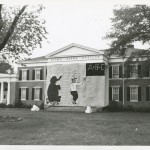
image of Morgan Hall

…and in the late 1960s:

image of Morgan Hall

Morgan Hall has been photographed many times, as an example of the Beaux-Arts style of architecture. It was built as a mirror image of Smith Hall, on the opposite side of the quad. (Use this link to find images of Smith Hall.)

image of Morgan Hall

image of Morgan Hall

The beauty of the building made it an ideal place to take formal group portraits like these, circa 1918:

image of Morgan Hall

image of Morgan Hall

Morgan Hall has presided over a lot of student activity.

Around 1950:

image of Morgan Hall

Late 1970s:

image of Morgan Hall

image of Morgan Hall

But this is probably the most shocking image of the building: parking at the door!

image of Morgan Hall

Marking the 50th Anniversary of Desegregation at The University of Alabama

CW_9June1963_img3

Fifty years ago tomorrow, James Hood and Vivian Malone made history as the first African-Americans to successfully enroll at the University of Alabama. Though initially blocked from entry by Governor George Wallace — during his infamous “Stand in the Schoolhouse Door,” brought to an end after President Kennedy mobilized the Alabama National Guard — they were allowed to register on June 11, 1963.

Vivian Malone eventually earned a Bachelor’s degree in business management. James Hood did not complete his undergraduate degree at Alabama, but he returned for graduate school in 1997, earning a PhD in interdisciplinary studies.

***

Among our Digital Collections in Acumen are a number of editions of the Crimson-White, our campus newspaper. Those discussing Hood/Malone registration include

June 9, 1963
covering preparations for the day of entry; see

  • history of the case (“Tuesday Will See…”), pg 2
  • “Girl ‘Quiet’; Boy ‘Congenial’ Students Say of Negroes,” pg 2
  • security measures on campus (“All-Out Peace Effort”), pg 1
  • curfew and “Ground Rules” for conduct, pg 1
  • a note on appropriate behavior (“In Our Interest”), pg 3
  • admonition to accept the court ruling (“Our Own Back”), pg 3

June 13, 1963
covering aftermath of the day of entry, including many photographs (pgs 1-2, 7-8); see especially

  • “UA Can Be Model For Nation Hood Says After Peaceful Entry,” pg 1
  • “No Easy Life for Troopers on UA Campus,” pg 2
  • Editorials page, with letters to the editor in Vox Populi section, pg 4
  • report of comments by Wallace prior to the event (“Wallace Tells North…”), pg 6

June 27, 1963
covering continued fallout; see especially

  • guest editorial by James Hood, pg 4
  • letters to the editor in Vox Populi section, pg 4
  • “Letters to the Student Body,” pg 5

July 11, 1963
letters in response to Hood’s guest editorial in Vox Populi section, pgs 4-5

July 18, 1963
letters to the editor in Vox Populi section, pgs 4-5

***

In the wake of the “Stand,” letters poured in from all over the country — and the world. Some lamented the situation, but the majority printed in the campus newspaper praised UA students for their conduct.

This excerpt from a letter in the June 27 issue is from a southerner now living in the north:

CW_27June1963_img3

The letter is signed James F. Gould, Philadelphia, Pa.

This letter (also from June 27) is from an Auburn grad living overseas, giving an international perspective:

CW_27June1963_img2


***

If you’re looking for more on the  integration of southern universities, Acumen contains Crimson-White issues discussing

  • the failed entry of Autherine Lucy at UA, 1956: Feb. 7Feb. 14, and Feb. 21
  • the failed entry of James Meredith at Ole Miss, 1962: Sept. 27 editorial in support of Meredith, pg 4; and Oct. 11 follow-up editorial addressing criticism of support, pg 4

***

Finally, on the eve of the “Stand,” the C-W (9 June 1963) printed a letter from William Faulkner, the late Nobel and Pulitzer prize-winning author. It was written in 1956, in response to a former student’s inquiry during the failed entry of Autherine Lucy.

CW_9June1963_img1

CW_9June1963_img2


***

The University of Alabama is hosting a series of events surrounding this important anniversary, culminating in a program on June 11, 5:30-7:00 p.m., at Foster Auditorium. See the website Through the Doors for program details and for more history of the Civil Rights Movement at UA.

Audio Digitization: a look at the Rohlig process

Audio Digitization is a completely different type of mole hill than Image Digitization. There are different concerns, such as playback speeds, distortion, clipping, etc. There are also different types of technical metadata needed, such as track begin and end times. If done by hand, the digitization process for audio can be slow and tedious. Thankfully, the process is greatly benefited by the use of custom scripts.

Take the Rohlig collection for instance (a collection of organ music performed by Harald Rohlig). The original reel tapes are digitized into master wav files. These master wav files are then digitally optimized (volume leveled, extraneous silence removed, etc.). Then the master wav files are split into sub-item tracks. Finally these sub-item tracks are converted from wav to mp3 format. After initially preforming this process manually for several items, I decided to create a script to do the bulk of this work, thus speeding up the process and removing the possibility of human error.

I started by researching technical metadata standards for audio. I came across something called a cue sheet. It’s the type of metadata that might be hidden on a music cd so your media player could use it to determine where tracks begin and end. This type of file appealed to me because it was easy to read, easy to parse, and easy to create since it is basically a text file with a .cue file extension.

After studying up on cue sheet structure, I created a script (CueMaker) that would take a text file I supplied with track begin and end times, and use it to generate a cue file for each item. Once this was working, I created another script (CueSplitter) that would pick-up the generated cue file and split the master wav file into sub-item tracks. Once split, the script converts the sub-item tracks from wav to mp3 format and renames them correctly. Then I created a graphic user interface (Cue GUI) that could launch both scripts with the push of a button. Later, I added a script that can level the audio volume as well.

ScreenShot001

This is still an experimental process, but so far the results have been great. Last month we were able to upload 18 new items to the Rohlig collection, consisting of 207 audio tracks. There are more items still in the pipeline for Rohlig; we hope to have those online in the near future as well. You can listen to the Rohlig collection on Acumen HERE.

-Austin Dixon, Digitization Technologist | Hoole Library

Temperance to Prohibition

From 1920 to 1933, the United States was officially a “dry” nation. The 18th Amendment made the sale, production, and transportation of alcohol illegal. But the first steps toward ridding the U.S. of alcohol began in the century before, with the Temperance Movement.

Today, we look at the temperance debate, as seen in a variety of materials in several collections in Acumen.

The Wade Hall sheet music collection features several songs that highlight our country’s mixed feelings about the idea of prohibition. Take, for example, this 1912 song which admonishes its audience to “vote the old state dry, boys”:

Sheet music, pro-prohibition, 1912This item, from the Manly Family papers, gives an overview of the “misjudged” and “misunderstood” Prohibition Party, circa the turn of the century.

Prohibition Party pamphelet, circa 1900From the same collection, we reach back into the 19th century, to 1878. Here are handwritten notes (probably for a sermon or other speech) by Charles Manly, a Baptist minister. (Click the image to look at a larger version in Acumen.)

Manly sermon notes, Intemperance, 1870sFrom roughly the same period, this newspaper article from the Woodward Family papers talks of the Temperance Movement in West Virginia.

Women often had a strong voice in the Temperance Movement, even at a time when their voices were otherwise not always heard. For example, Katie McLauchlin wrote a paper in 1881 that begins, “Intemperance is one of the greatest evils of our Country”:

McLauchlin temperance paper, 1881Another writer we know only as Carrie, but she details the work of the women’s temperance movement in Ohio in an 1874 letter to a friend.

In 1896, “I can drink or let it alone” was published, a song which seems to be okay with drinking, but look closely at the lyrics on this page:

u0004_0000002_0001906_0003

In 1919, in the months before the vote on the 18th Amendment, another song wondered what life would be like without alcohol:

sheet music, anti-prohibition, 1919
Ev’rybody seems to talk of prohibition,
And what they’ll drink when everything is dry,
How’re you goin’ to get around this new condition,
And keep a happy twinkle in your eye?
It’s very easy now to get a drink,
But tell me did you ever stop and think?

How are you goin’ to wet your whistle,
When the whole darn world goes dry?
What are you goin’ to do in the morning,
When you need a nip to open up your eye?
Now what of the wedding and the christening,
And the wake when your dear friends die,
Oh, How are you goin’ to wet your whistle,
When the whole darn world goes dry?

After Prohibition passed in 1920, this last song wondered if it would spell the end for music and fun:

sheet music, don't take away those blues, 1920I must admit I’m a JazzboFor every place that I go,
They play that Jazz razz-a-ma-tazz
That seems to drive my troubles away
But now that we have prohibition,
I’ve got a creepy superstition
Now that it’s dry they’re goin’ to try
To take away those Blues someday
But the song ends

You can take away my gin, take away my booze,
Take away my hat and even take away my shoes,
But Lawdy, Lawdy Mister man, don’t take away those blues.