Cool@Hoole

Everything you ever wanted to know about Hoole’s incredible Tiffany Window….

Art Historian Dr. Robert Mellown’s article, originally published in the Winter 1993 issue of Alabama Heritage Magazine is now available on our website. Along with the article, you’ll find a link to a series of beautiful details of the window in our Cool@Hoole Flickr page, photographed by Teresa Golson.

But just because we can, here is the article as it appears on the Hoole website!

A Stained-Glass Tiffany Knight By Robert O. Mellown
Originally published in Alabama Heritage, Winter 1993 (No. 27)
Dulce et decorum est pro patria mori
It is sweet and noble to die for one’s country.
For centuries, this stern and dignified pronouncement by the Roman poet Horace has been associated with patriotism. Appearing on countless European and American war memorials, the Latin inscription also adorns a beautiful stained-glass window in Tuscaloosa at The University of Alabama. Designed in 1925 by Tiffany Studios in New York and commissioned by the Alabama Division of the United Daughters of the Confederacy (U.D.C.), the handsome memorial commemorates the role university students played in the Civil War.
The window is a fascinating social document as well as an exceptionally fine work of art. When it was installed, sixty years had passed since Yankee troops burned the neoclassical campus of the University of Alabama on April 4, 1865. By 1925 the mythmaking of the “Lost Cause” was in full swing throughout the South.
Few Southerners were still alive who could recall the war years, and as their numbers dwindled Confederate veterans and their families (especially their wives and daughters) took steps to ensure that the memory of those who had fought in the nation’s most tragic conflict were not forgotten. Memorials of all sorts, in a wide variety of media, were erected in cities, towns, and battlefields across the South.
Perhaps the most ubiquitous monuments erected during this period of romanticizing the Civil War were the monuments to Confederate soldiers placed on courthouse squares throughout the South. Aesthetically, a wide gap existed between those marble or concrete Rebel soldiers, rifle at the ready, and Tiffany’s ideal “Christian Knight” depicted on the university’s richly colored memorial window. Nevertheless, the sentiment remained the same. An inscription on the window might well be placed on any Confederate memorial: “As crusaders of old, they fought their heritage to save.”

The dedication of the memorial window may have represented the zenith of the cult of the “Lost Cause” in west Alabama. The ceremonies took place in front of the newly constructed Amelia Gayle Gorgas Library (now Carmichael Hall), where the window was originally located. The audience consisted of the university community, Tuscaloosans, officers ofthe United Daughters of the Confederacy, and seven elderly Confederate veterans who had been University of Alabama cadets during the Federal invasion of April 1865.
The audience’s enthusiasm was whipped into a feverous pitch by speeches, including one by former governor B. B. Comer (also a former university cadet), and by patriotic songs sung by the varsity glee club. These included “We’re Tenting Tonight on the Old Camp Ground” and “The Bonnie Blue Flag.” According to reporters, toward the end of the program “the Glee club sang the song that these veterans had patiently waited for—Dixie! They leapt gallantly to their tottering feet and the old, wild rebel yell rose lustily, terribly from their feeble throats. After this outburst,” the window was unveiled, the setting sun illuminating its rich hues.
The window itself is a showcase of various types of glass and construction techniques which made Tiffany-designed products internationally known. Particularly impressive is Tiffany’s use of scores of intricately cut pieces of glass to describe the details of the knight’s armor and the delicate details of the landscape.
Tiffany “painted” with glass, his palette consisting of an astonishing variety of luminous opalescent glass that he created by combining white milk glass with one or more colors of pot metal glass. Depending on the combinations of colors, such glass could be used to imitate the veins in the marble columns or the soft hues of the cloud-filled sky.

“Drapery glass” was used to create not only the color but the texture of the knight’s flowing robe. This technique, invented by Tiffany, required the glassblower (protected by asbestos gloves) to toss a glob of molten glass on an iron table, where he kneaded and folded the red-hot mixture like bread dough until the desired loops and streaks were formed.

The extraordinary depth and luminosity of the knight’s attire, including the shirt of chain mail that extends below his breast plate, were achieved by sandwiching or “plating” several layers of differently textured and colored glass on top of one another. These built-up areas are visible on the back of the window.

To achieve the effect of dappled light shining through foliage in the background, Tiffany used “mottled glass” and a few touches of “confetti glass.” These types of glass, perfected in the Tiffany studios, were made by throwing various chemicals (for a mottled effect) or broken glass scraps (for a confetti effect) into the molten glass. As was usually the case, actual paint was used only to define the noble features of the knight, but even here the designer incorporated plated glass to achieve the glow of living flesh.

The production of a Tiffany memorial window was labor intensive, requiring hundreds of hours of work and a high level of craftsmanship. For these reasons, large windows cost several thousand dollars, a hefty sum in 1925, when glass workers received three dollars a day and their supervisors were paid twenty-one dollars a week.

The University of Alabama window cost $5,000, but Tiffany studios gave the U.D.C. a $1,700 discount. Even with the discount, the organization found it necessary to pay off the sum in installments.

In 1939 the Alabama window was removed from the old Amelia Gayle Gorgas Library on campus and installed in the present main library, which bears the same name. This year [1993], in a move partially funded by the U.D.C., the window will be relocated once again, this time to the new collections building on the east side of the University of Alabama campus, where it will grace the walls of the William Stanley Hoole Special Collections Library*.

*The window is in the lobby of the W.S. Hoole Special Collections Library on the 2nd floor of Mary Harmon Bryant Hall, 500 Hackberry Lane, and is visible from the street below. Please visit the library to see the window in person. You can also view a series of photographs we have placed as a set on Cool@Hoole’s flickr page. These images were graciously taken by photographer and friend of Hoole Library, Teresa Golson in July 2010. (Photographs in the original article [not shown here] were by Alice Wilson). Special thanks to Dr. Robert Mellown and Donna Cox Baker and Alabama Heritage for allowing us to republish this piece online.
Alabama’s Beautiful Gulf Coast Beaches, June 1912

Dauphin Island, 1912

From Roland Harper Photographs Collection

(Collection number 633, Folder number 3.337)

http://acumen.lib.ua.edu/u0001_2008032_0005179

Alabamians have long enjoyed their beaches, but for the people of Southwest Alabama and the coastal areas of Florida, Mississippi, and Louisiana, the Gulf is a way of life. As the oil from the Deepwater Horizon disaster slowly encroaches on our white sands, Cool@Hoole would like to share a few beach scenes from our collections from Alabama’s shores taken by botanist Roland Harper nearly 100 years ago on June 12, 1912.

The Roland Harper Photographs collection, 1878-1966 contains over 7500 photographs, as well as negatives and albums. Subject include botanical and geological subjects like the Orange Beach photographs, as well as images of farms, people, houses and everyday scenes. The photographs cover thirty-one states, the bulk of the collection are from Alabama, Florida, Georgia, New York, California, Arkansas, and Maryland. These images are a powerful and essential resource in understanding the natural history of this region, providing accurate and precise snapshot of the flora and formations of the Alabama Gulf Coast.

The papers of Roland Harper are also housed in the Hoole Library. Sixty three linear feet of materials from Harper, include his diaries, correspondence, research notes, writings, publications, personal and family materials, cemetery records, scrapbooks, as well as photographs, materials relating to race relations, and a substantial collection of transportation timetables and clippings. Some of the photographs and other materials from the collections are available online through ourDigital Collections.

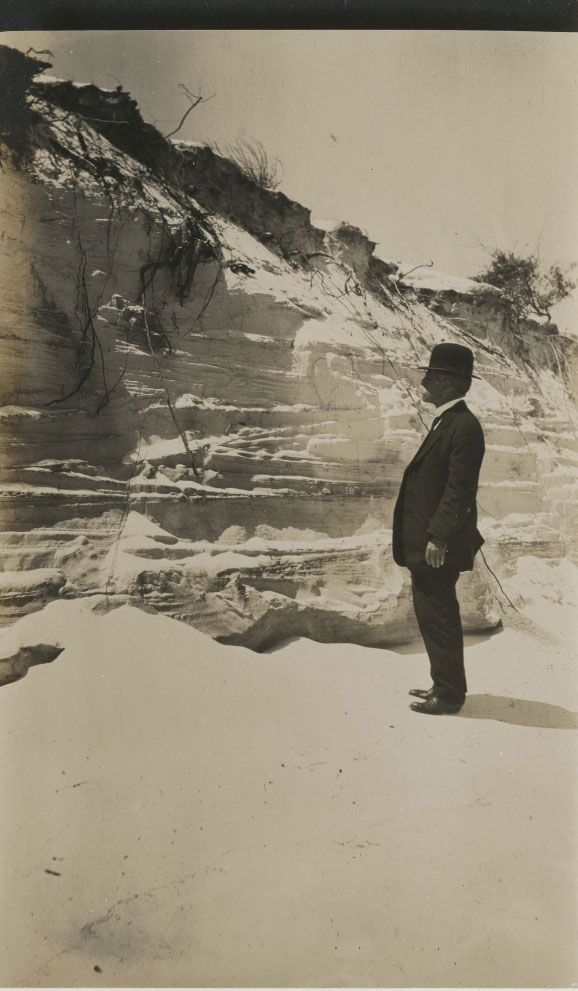
Bluffs at the outlet of Perdido BayCaption: Bluffs about 10 ft. high made by waves cutting into dunes near outlet of Perdido Bay. 1.31 pmFrom Roland Harper Photographs Collection(Collection number 633, Folder number 187.2)

http://acumen.lib.ua.edu/u0001_2008032_0005568


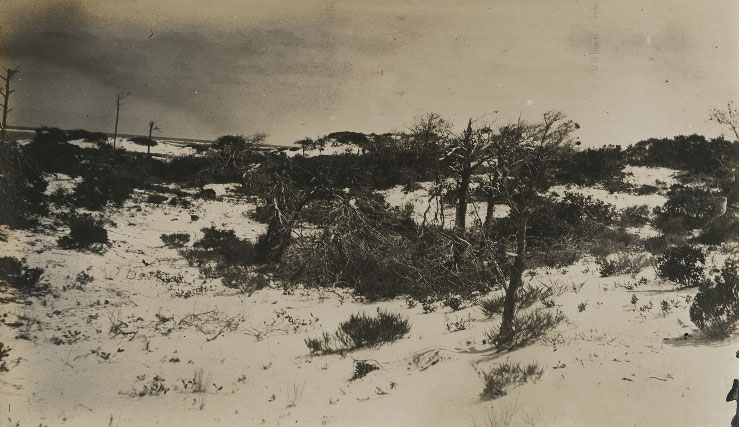
Dunes at Orange BeachCaption: Looking South among older dunes, with Corradina in foreground, Pinus clausa (dead), Quercus myrtifolia, Ceratiola, etc. 2:04 pm.From Roland Harper Photographs Collection

(Collection number 633, Folder number 187.6)

http://acumen.lib.ua.edu/u0001_2008032_0005575


Then state Geologist, Eugene Allen Smith on Orange Beach (in a suit, not a bathing suit!)Caption: Near view of same bluff, showing bedding of sand [E.A. Smith in picture] 1:35 pmFrom Roland Harper Photographs Collection(Collection number 633, Folder number 187.3)

http://acumen.lib.ua.edu/u0001_2008032_0005569

Thanks to graduate student Alisha Linam, a native of South Alabama for her work with these items!

Keeping it Real: Pioneering Social Critique and Counterculture @Hoole

The Realist, a pioneering magazine in social criticism and satire, was edited and published by Paul Krassner, a journalist, comedian, author, and driving force behind the Yippies, the “New Left”, and 1960s counterculture.Although the Realist is often considered part of the underground press of 1960s counterculture, it was first published in 1958 in New York City and was nationally distributed by 1959.

The Realist fell out of regular circulation in 1974, and received financial support from none other than John Lennon to stay afloat.The final issue of The Realist ran in Spring 2001.It is widely considered the first magazine to print conspiracy theories and criticizes political, religious and cultural issues.

Over the period of the Realist’s publication, contributing authors included social activists, comedians, and political radicals like Richard Pryor, Kurt Vonnegut, Jerry Rubin, Abbie Hoffman, Lenny Bruce, Woody Allen, and Margo St. James.These people and many others wrote articles and illustrated cartoons on issues including racial and sexual freedoms, the Vietnam War, Communism, medical developments, and organized religion.


The Hoole Special Collections Library holds fifty issues of The Realist, including the first issue that ran in June-July 1958 as a “social-political-religious criticism and satire” publication and claimed, in its first headline, to be “An Angry YoungMagazine…” Other issues range in date from April 1959 to April 1965.

Our collection of Realist magazines was donated by retired English professor Dr. Mathew Winston. This fascinating publication provides an almost continuous monthly record for over half a decade of what the counterculture was talking about, or often talking against.

Special thanks to Jamie Burke, UA American Studies major for her work with Hoole’s copies of The Realist!

A privately developed online archive of the Realist is accessible here, and an edited volume, Best of The Realist was published by Krasssner in 1984.

Football! Football! Football!: Images from early 20th century Corollas


From the 1903 Corolla

From The 1909 Corolla

From The 1901 Corolla

From The 1906 Corolla

Happy Birthday, Jesse Owens!


On this day in 1913, the great athlete Jesse Owens was born in Oakville, Alabama. We blogged on him a little bit last year — you can read about him here — http://coolathoole.blogspot.com/2008/08/olympic-history-and-great-alabamian.html

Provenance Times Two: An Early Gift and the Origins of Crimson and White (o Rosso e Bianco)


One of the many projects we are working on at the Hoole Special Collections Library centers around our foreign language rare books. Right now we’re spending some time with the Italian rare books in our collection. One thing we find is that no matter the origin or provenance of any particular item, it’s always cool to look at any book and see where it can take you. Sometimes it’s far beyond the actual content of the book where you can find the most interesting stories.

Giovanni Domenico Romagnosi

For example, we have in the Hoole Library’s Rare Books collection a book on criminal law entitled Genesi del Diritto Penale (or the Origins of Penal Law), written by Giovanni Domenico Romagnosi and published in Milan in 1823. There is a faint inscription on inside of the front cover – “University of Alabama. Presented by — Ex Libris J. Walker Fearn, N.O. 26 June 1885.”

Inscription on the inside of the front cover

It is said that Romagnosi conceived the Genesi del Diritto Penale in Piacenza, completed the work by 1787 and first published it in Pavia in 1791. It was enlarged with the 5th and 6th parts in the 1823 edition published in Milan, and this is the edition that the Hoole Library holds (and one of only three in WorldCat!). The concepts, theories and reflections on the natural and metaphysical origins of the right to punish that the author exposed remain to this day important in legal scholarship. His theories and ideas were even more broadly explored in this 3rd edition.

While the book itself is interesting and important, it was fascinating to discover through a little sleuthing how and from whom we acquired this book.

The inscription above shows us that it had belonged to and was given to The University of Alabama by John Williams Walker Fearn, a lawyer and diplomat. Fearn was born on January 13, 1832 in Huntsville, Alabama, and named for his grandfather, John W. Walker. Walker was was an important person in early Alabama history — he was President of the Convention which framed the constitution preceding Alabama’s statehood and was the very first Senator for the State of Alabama.

His grandson and namesake, the owner of this book, did not attend The University of Alabama, but graduated from Yale University in 1851. He studied law in France and in 1853 was admitted to the Mobile bar. Soon after, in 1854 he was entrusted with several diplomatic missions in Europe in behalf of the government of the Confederate states. During the Civil War he attained the rank of Lieutenant Colonel, serving on the staff of General Preston. After the war, he practiced law in New Orleans until 1885, when he was appointed Minister to Greece.

So what does this rare Italian law book have to do with Crimson and White? Those colors are everywhere — crimson representing school spirit, pride, and of course, brings to mind that ubiquitous name for The University of Alabama, The Crimson Tide!

It just happens to be that the very year that John Williams Walker Fearn was appointed to serve as Minister to Greece, his daughter, Mary Fearn served as a sponsor for a drill competition held in New Orleans. 1885 was also the very same year that he inscribed and gave this book to The University of Alabama.

UA was a very different place in 1885 — a military school, in fact. And The University of Alabama Company E cadets were in the competition. The story goes that Mary Fearn asked the UA cadets what their colors were so that she could plan her own outfit for the day. When they responded that they had no official colors but wore black caps, gray coats and white trousers for competition. She was purported to have responded that black is too funereal, and gray was too neutral. So she picked crimson, white and gray for her outfit.

It’s exciting to point out that The University of Alabama won this competition! And it’s very cool to ponder about this very book may have travelled back with the cadets from New Orleans to Tuscaloosa. Perhaps it was a token of his esteem to the winning team, or given in honor of his daughter, the team’s sponsor in New Orleans.

The rest, as they say, is history. Beginning in 1892, the football team always wore white uniforms with crimson stockings and large “U of A” in crimson on their sweaters. Other athletic teams at The University followed suit. Within a year, in spring 1893, the annual dance was decorated in crimson and white, and our student newspaper (the oldest student newspaper in the Southeast!) was named the Crimson-White.

The 1892 University of Alabama Football Team

Mary Fearn joined her family in Europe where she met and later married an Imperial Russian Prince, one Sergei Mikhailovitch Volkonsky. (Серге́й Миха́йлович Волко́нский). He was an interesting man, extremely influential in the Russian theatre and one of the the first Russian proponents of eurhythmics, pupil and friend of Émile Jaques-Dalcroze, and creator of an original system of actor’s training that included both expressive gesture and expressive speech.

So if anyone asks where Crimson and White came from, tell them they were chosen by a Princess. And how did we find that out? Provenance!

The man behind the album covers: Remembering the Artist Tom Wilkes

Elite Hotel (LP 12978, 1975) and
Blue Kentucky Girl (LP 9615, 1979)
Covers by Tom Wilkes
From the Wade Hall Sound Recordings Collections

The award winning artist, designer and photographer Tom Wilkes passed away last week. He leaves behind a massive catalog of album covers — work that he did over a career that spanned more than four decades and includes these two covers by Alabama native, Emmylou Harris.Wilkes made his name as the Art Director for the Monterey International Pop Festival in 1967, creating iconic psychedelic images that forever branded the festival in our memories and our imaginations. He went on to a long and successful career that brought us album covers such as the Flying Burrito Brothers’ Gilded Palace of Sin, and Beggars Banquet by the Rolling Stones. His creative genius will be missed, but will surely live on.

Let’s celebrate once again Alabama’s amazing musical legacy with Emmylou Harris, from the album Elite Hotel — Together Again.

Not Running with the Bulls, but Sailing with the Cow’s Head

The famed San Fermin Festival and the “running of the bulls” in Pamplona, Spain is held at this time every year. Whatever one may think about this long-practiced tradition, there is one thing that all can agree upon — the festival brings people to Pamplona from all over the world and has captured the imagination of writers like Hemingway, as well as people who may only write about the experience on a picture postcard. And speaking of travelers and bovines…..


Alvar Nunez Cabeza de Vaca was born at Jerez de la Frontera (c.1490-c.1557) in Andalusia, Spain. His journey is one of the most amazing and personal accounts of exploration in the Americas. Alvar Nunez joined the expedition of Narvaez to Florida in 1526. As treasurer, and one of the chief officers, of the Narváez expedition, Cabeza de Vaca and three others were the only survivors of the party of 300 men who landed near Tampa Bay, Florida on April 15, 1528.

A map from the same period from the Hoole Library (gift of the Warner family)
Americae sive novi orbis nova descriptio
Ortelius, 1570
G3290 1570 O7x
Visit http://www.lib.ua.edu/content/libraries/hoole/digital/warner/ to see more!

Over the course of eight years, various members of the expedition succumbed to disease, starvation, exposure, and the attacks of various Native American groups as they slowly made their way west, toward Mexico becoming the first Europeans to travel across the North American Continent.

Returning to Spain in 1537, he obtained the post of Governor of the Rio De La Plata region (Argentina, Paraguay and Uruguay), he went in 1541. Cabeza de Vaca was a trustworthy subaltern, but not fit for independent command. His men rebelled against him in 1543, took him prisoner, and sent him back to Spain, where for eight years he was kept in captivity. The date of his death is unknown, but it is stated that he ended his days in Seville, where he occupied an honorable and modestly lucrative position in connection with the American trade.

His chronicle of these travels, often referred to as Naufragios, contains a strong dose of emotive elements destined to elevate the central figure of the narration, , to a superior level, achieving with this technique that the reader, identifying with the protagonist, will accept a large part of the fiction that has been poured into the text. A fundamental factor in this process is not simply the novelistic content of the work, but the ability of Cabeza de Vaca to present events that, even if they were real, in many instances are surrounded by a supernatural halo.

The story of his first trials in America as a member of the expedition of Narvaez, which was published in Valladolid on 1555 by Francisco Fernandez de Cordoba. It has been translated numerous times into other languages, including English and French.

The Hoole Library holds the first French edition, Relation et Naufrages, which was by the Librarie de la Société de de Géographie de Paris in 1837. There is hardly a work on early travel history of North or South America where Cabeza de Vaca is not named or referenced heavily.


Title page of the first French translation of Nunez’s work,
published in 1837.

This book shows his accounting to the King Carlos V about the expedition from the moment they departed Spain until he returned and his numerous and colorful reflections on the voyage. This work represents one of the great examples of early Travel Writing, where the words and descriptions take us beyond history to a world through his eyes.

En Español:

Naufragios, contiene una fuerte dosis de elementos destinados a elevar la figura central de la narracion, alcanzando con esta tecnica que el lector se identifique con el protagonist aceptando sin darse cuenta mucha de la ficcion incluida en el relato. Un factor fundamental en este proceso no solamente es el contenido novelistico de Cabeza de Vaca, pero su abilidad al presentar eventos, que si fueran reales en muchas instancias estarian rodeados de un aire o significado supernatural. Este libro representa las cronicas o relatos de Cabeza de Vaca al Rey Carlos V, incluyendo algunas reflexiones de lo acontecido, hay que notar que estas cronicas no fueron escritas hasta que Cabeza de Vaca llego a Espana en 1537. Para muchos estos relatos y las reflexiones que le siguen representan un buen ejemplo del comienzo, de lo que en la actualidad se conoce como “Travel writing”, donde las palabras y descripciones nos llevan mas alla de la historia, hechos o descripciones a un mundo a traves de los ojos del escritor.

Read more here:
Cabeza de Vaca, Álvar Núñez: The Narrative of Cabeza De Vaca. Translation of La Relacion by Rolena Adorno and Patrick Charles Pautz.
Howard, David A. (1997). Conquistador in Chains: Cabeza de Vaca and the Indians of the Americas. (E125.N9H68)

See this edition in Google books: Relation et Naufrages by Alvar Cabeza de Vaca, French Edition 1837 ( E125.N9)

So, why Cabeza de Vaca? Why not. Well, also because we want to welcome a new staffmember to Hoole — Luis Boggio, who is working with our foreign language rare books. He wanted to share a little bit of what he thinks is cool@hoole. Luis is a native of Uruguay and new to The University of Alabama. He brings an exciting new dynamic to the library with his background in Spanish and Italian and his great love for travel. Bienvenido, Luis!

Bonus points if you tell us where the very interesting and unflattering name of “cow’s head” came from? Cool indeed.

Ahead of the curve: the anniversary of prohibition in Alabama

(front)
(detail)
(back)
Alabama Prohibition Postcard, sent 1909
This bold political statement, in the form of a picture postcard from the Hoole collections, was sent to an Alabama voter in 1909. It urged “Mr. Voter” to vote for statewide prohibition in Alabama. While statewide prohibition did not go into effect until July 1, 1915, it is interesting to note that the ban of alcohol became state law in Alabama nearly five years before the Volstead Act (the national reinforcement of a ban on alcohol, most commonly known as “Prohibition”) was passed in 1919.

An added point of interest with this postcard is that it is addressed to “Mr. Voter” — this was written over a decade before the passing of the 19th amendment, granting women the right to vote, stating that “the right of citizens of the United States to vote shall not be denied or abridged by the United States or by any State on account of sex. Congress shall have power to enforce this article by appropriate legislation”. There were no Mrs. or Miss Voters until 1920. Ms. Voter came along a little later. So did zip codes. And a stamp that costs more than one cent. We’ve come a long way, baby.

"…and walk through a door that leads to opportunity for others.”

“There will come a day in your life when you must act for others–your family, perhaps your community–and you must be ready. What you have done to reach this milestone today is part of that preparation. So take from all the books you have read, all the lessons you have learned, the certain knowledge that one day, any day, you must be bold, have courage, and walk through a door that leads to opportunity for others.”

— Vivian Malone Jones (class of 1965), in her commencement speech to the UA class of 2000

June 11 marks the anniversary of the successful integration of The University of Alabama. It was on that day in 1963 that Vivian Malone and James Hood registered for classes in Foster Auditorium. On that day, all eyes were on our campus, witnessing both a “stand” and more importantly a profound and bold act of courage.

Two short years later, Ms. Malone graduated from The University of Alabama, and featured above is a page from the 1965 University of Alabama yearbook, the Corolla with her senior picture, along with thirty-one of her classmates (she is the face in the third row from the top and in the third column from the left). It’s impossible to measure just what went it took to be just another face on a page in that yearbook. Ms. Malone’s being “just another senior” in the graduating class of 1965, forty-four short years ago, is something worth recognizing, pondering, commemorating.

The entire 1965 Corolla (volume 73) is available online through our digital program and was made possible by Shirley Dowling McCrary as part of the University Libraries’ Corolla Digital Initiative.

In addition, a full run (1893-present) of the Corollas are available to browse in the Hoole Library’s Gandrud Reading Room. An exhibit of Corollas is currently on display in Gorgas Library on the 2nd floor in the Pearce foyer. If you are interested in sponsoring the digitization of a Corolla, please contact us.