Practice, Guidence, Modeling and Encouragement

We have a new set of interns and GTAs this semester. Louise, Alex and Karlie finished their sojourn with us in December, and we have sent them out to rock the world of instruction! This semester, we welcome Steve, Kristen, and Robert to the group, and Brett and I look forward to watching them learn! I know at the beginning of the semester, our group experiences much trepidation- what can be more scary than the thought that in the span of a month, you are going to be expected to stand in front of 25 freshmen and teach them something! As we begin the semester, I’d like to share a post that came across Inside Higher Ed that I think really expresses something lovely. The post is about developing an ethical culture (a further explanation of the resolution stating “We will stop making Faustian bargains in the search for truth, and create a lived and shared culture of ethical conduct and transparency” ) it speaks to what we are striving for each semester in our group.

The thing that I love about this post and it’s analogy to ballet is the environment which the author is describing. A culture of “guidance, modeling, and encouragement toward the ideal.” This is the very culture that we strive for in our instruction internship program- our intention is to invite our interns to join a learning environment where they are going to make mistakes and be nervous, but where they will be encouraged to grow and find their voice. To give them experience in teaching with a safety net, so that when they enter the job market they will both know what to expect and have something to offer their future employer. To guide new instruction librarians in the practice of reflection and intentionality. And to give them a period of time to learn to self-evaluate and assess their performance, and practice without the pressure of impressing anyone. And I hope that with this experience, their future participation in instructional activities will be more fruitful and less cause for anxiety.

So, welcome to a new semester! I look forward to all of the great work that we’re going to do!
Why do the internship with GIS, and what do I expect to learn?

I sneaked in under the door and worked in a medical library for eleven years on the strength of a Master’s in public health. This experience gave me a great foundation for studying librarianship, and my academic work has reinforced the idea that on the job training is necessary to round out any MLIS degree. Since my library work experience has been in a very narrow field, broadening my horizon is the best thing I can do and there is no better way to do that than to work with Gorgas Instructional Services.

What I expect to learn is whether I can still relate to entering freshmen, and to update my teaching and technical skills. As a public health and English as a second language instructor (once upon a time), I found it easy to get students engaged and contributing toward their own education and learning. These days, with so much competition from a 24/7/365 entertainment cycle, I wonder if I still have it in me to be able to capture the interest of students who have the entertainment universe at their fingertips. I view this as a competition for student eyeballs and attention, and any new skills I can learn toward winning this competition will be to my great advantage, now and in the future.

There are positive aspects to this competition. Students are accustomed to being engaged with electronic devices, and getting in touch with the information universe is closely related to entertainment. After all, efficient use of the information tools available can save folks time to spend as they choose, entertaining themselves. The devices used are all the same, and librarians have been tasked with saving patrons time and effort since the beginning of the profession—I am very happy to follow in this tradition.

Looking forward to it. If you see me missing something, please bring it to my attention, and thanks.

gisssteve2013

My Special Project

For my special project I worked on a series of information literacy instruction podcasts. I’ve enjoyed it, even though it’s been frustrating at times (sometimes for fairly trivial reasons). Podcasts are an interesting way of teaching information literacy, because they can be used as just another way of getting the information across to students. I’m not sure they can really replace instruction sessions, but they can be used as a supplement to them (along with tutorials, readings, etc.). At Alabama, we started the Keys to the Capstone podcast series this past summer, with one of our interns recording a series called “from topic to paper,” and I continued on from there.

My work on the podcasts kind of gradually developed as the semester went by. I knew that it would be my special project from the very beginning of the semester, but we were primarily focused on teaching in the first couple of months. During that time I primarily just did some planning – an outline of each episode along with some free writing about each topic. Once our teaching ended the podcasts became my primary focus, and I spent a lot of time in November and the early part of December working on them.

In fact I have a hard time explaining to people the amount of time I’ve spent working on what will end up being just three five minute podcasts. Some of that is my own fault – I’ve become a bit obsessive compulsive about them (I’ll re-record entire segments because I didn’t like how I pronounced the word library, etc.). Some of that is also because of technical issues. I spent some time practicing mixing voices, editing, etc., but it’s still been a bit of a challenge. For example, I had one interview with Andy Johnson, an English instructor here at Alabama, who just has a booming voice (I literally wondered at one point why he wasn’t narrating documentaries for a living). I tried to mix the volume to make his segments sound about the same as my other interviews, but it seemed like he got louder as it went on. So when I recorded my parts of the episode I turned the volume up a bit to make myself louder. Eventually we decided to cut his segments out because I was having a hard time conceptualizing the episode around his quotes (more on that later), but now I’m having to re-record my parts of the episode (that’s pretty much all I have left to do) because they’re almost jarringly loud compared to the other episodes.

The main problem though was in conceptualizing the episodes. The first podcast series was, for the most part, focused on interviewing other librarians, but for this one we decided to interview GTA’s and Instructors from the English department here at Alabama. And it was difficult at times to keep them focused in on information literacy issues. My first interview was with Katie Stafford, and we ended up talking too much about Google, and how it was different than “academic search engines.” The best interview was with Emma Furman (for the Boolean operators episode), and in retrospect it’s not surprising that that one was the best, because she had taken library science classes and knew what Boolean operators were and how they worked. I didn’t want to just script out answers for them (although I kind of did that for the second interview with Katie), but I found it difficult to keep them on topic. For example, during one of Andy’s segments he talked about how important it was for students to keep in contact with their professors during their office hours. I didn’t stop him, or try to prod him in another direction, because the second he started talking about it I knew it wasn’t going in the final cut, so I just let him go.

I think for the most part bringing in some outside perspectives worked well though, and it was worth trying. I enjoyed learning how to use the technology, and I’m pleased to be able to put the podcasts on my resume. In retrospect, I missed an opportunity to put together a blooper reel – it’s amazing how utterly and completely tongue-tied I could get at times.

The Semester in Review

Looking back on my experience with teaching this semester I can definitely see some things I improved on, and some things I still need to work on. Going all the way back to my first practice scout module (which I wasn’t really prepared for) I was a bit surprised by the fact that I was kind of nervous. Partially that was down to the fact that I just hadn’t done much public speaking in a relatively long time, but it did catch me a bit by surprise considering I was just speaking to a small group of people that I already knew.

The practice modules and the observations and the co-teaching definitely helped me prepare for my first solo session, but at the same time nothing really compares to that very first time you teach a class by yourself. I don’t think it’s that surprising that that very first session was by far my worst. I was glued to the podium, a bit tongue tied, went way too fast, forgot some things I was planning on talking about, and ended up finishing about ten minutes too soon. But by the third session or so it didn’t seem like a big deal to teach a solo session. By that time any problems were more about adjusting to new things (teaching a second session for the first time, teaching a hybrid one-shot session for the first time, etc.). I was a bit annoyed that I didn’t feel like my last session was very good. I felt like I was getting better each time, I didn’t have any real nerves beforehand, and it still didn’t go that well. It was mainly just the adjustment to a one-shot session -whenever I’d had an hour and fifteen minute class before that I’d always felt like I didn’t have material, and then during the one-shot session everything felt rushed. The whole thing felt a bit choppy, and I also had a fairly unresponsive class.

Regardless of that, I definitely feel like I improved as the semester went on. The main thing was just feeling more comfortable standing in front of a class. I also felt like I improved on the way I taught some concepts and was pleased that some of the ideas were completely my own. At the end of most classes we’d give the classes time to work on looking for sources on scout, and one thing that I really enjoyed was working with the students individually to help them with their research papers. I definitely got better at that as the semester went on, and it wasn’t so much about becoming more familiar with scout – I already had a pretty good handle on that. It was more about learning how to approach students in different ways. It’s obviously easy when a student specifically asks for help, but I thought I improved at helping the ones that at first didn’t really appear to want help.

There are definitely some things I need to work on. I almost take it too seriously, for one – I kind of forget to enjoy myself at times, if that makes sense, because I’m so focused on getting the material right. I also could definitely improve on ways of getting students involved in discussions. I’ve talked about this in other blog posts, but I sometimes would ask a question, wait a few seconds, and then answer it myself because I assumed the students wouldn’t say anything.

I’m not sure I would say that I really have a firm grasp on what my teaching “style” is at this point – I probably just haven’t given it enough thought. I’m used to lecture, and I’m sure that’s had some impact on my teaching style, but I don’t like just standing up in front of the class for an hour talking non-stop. So I guess I would say I like lecture/discussions (another reason to get better at getting students involved), with some group work/exercises mixed in.

Considering Universal Design

A few weeks ago, Melissa Fortson Green talked with our group about Universal Design for Library Instruction. Melissa is a librarian here at UA, and one of her fields of interest is library accessibility. I feel it is very important for new instruction librarians to consider accessibility from the very beginning, because old habits die hard, and once you develop inaccessible habits it’s harder to reverse than one might think!

Information from Melissa’s talk can be found on her blog, and I encourage you to review it, because she was very thorough.  Melissa will be returning to talk to us a second time at the end of November, this time bringing us information about accessibility and instructional technology. Meanwhile, Karlie, Alex and Louise have been working on UD active learning exercises, which we will review in our weekly meetings.

Teaching the second session

I had my first experience with teaching the second session of our library instruction classes last week. Our first sessions are mainly about how to use the library’s resources to find sources, while the second session is more about evaluating sources – how to distinguish between different types of sources, how to determine if a source is credible enough to include in a paper, etc. I taught a fifty-minute session on Monday morning and I thought it went pretty well. The students weren’t extraordinarily enthusiastic, but for a morning class they were relatively involved. I thought I knew the material well, and just having previously taught a few solo sessions helped – the only time I’ve felt that I was legitimately bad was my very first solo session.

I taught back-to-back hour and fifteen-minute sessions on Thursday, and that was a bit more difficult, just in that I had a bit of trouble expanding on the previous fifty-minute session. I finished a bit early both times, although I was able to go over the Opposing Viewpoints database at the end, which went well (those classes are working on papers using popular sources, and each student needs a source that provides a counter to their argument, and Opposing Viewpoints is a really good database for that type of thing). Having a good second session seems to depend a lot on getting the class involved, and I really struggled with that in my first session on Thursday. The second session went a lot better in that sense, and I really didn’t do anything different. I do need to improve in that regard – overall I’ve felt more and more comfortable with each session, and I think I’ve improved in a lot of ways, but I could definitely be better at encouraging student participation. I also just need to add more content for a longer session. That seems fairly obvious, but at this point I don’t have a great sense of how long a session is going to be when I’m preparing for a class. I do a class outline and try to include time limits for each section, but sometimes a certain part will go much quicker than I expected, and vice versa. I also went back and forth on what content I would include for the longer second section. I spent time working on a mind map similar to what Sara uses (I didn’t want to use her Facebook example – it works well but I just felt like I’d be mimicking exactly what she does), and also spent time working on an evaluation worksheet involving group work, but I didn’t feel great about either by Thursday morning so I ditched both. I ended up using Louise’s evaluation quiz/game and then went into the lecture/discussion, and it definitely would have been better if I had had another exercise.

Marathon Week of Instruction

The last week and half has been in many ways for me a marathon of instruction. Last week on Wednesday I had my first solo teaching experience and while it went okay, I realized that I had some kinks to work out in my approach for teaching. I had expected some issues but being nervous was not one of them. I felt that I had gotten pretty comfortable being in front of the class but as soon as they entered into the room the nerves began. I had to remind myself that this was not a class of piranhas but a class of EN 102 students. They were not going to attack me! This thought helped and I quickly tried to gather my thoughts back in order. Besides the internal nervousness, I was also dealing with another issue that I had never taken into account. For my first solo class, it took place upstairs in the testing lab and that was a whole other set of problems. All of my classes up to that point had been in the instruction room on the first floor which is an open layout. The testing lab on the second floor has partitions around each desk. This made it hard for me to see the students and vice versa. It also made it hard for the class to see the powerpoint that I had prepared. These were considerations that I did not account for in my preparation. The class overall went well however and I gained some valuable experience in the process.

This week has truly been the marthon for me! I have prepped, taught, or helped to teach three different classes this week. My first class on Monday was a Session 2 and I feel like it went really well. I had a lot of anxiety for this class and it stemmed from my first solo teaching which was also a Session 2. As I did my planning though I kept in mind the issues that I had as I created my lesson plan. The first thing that I did is I created a much more detailed lesson plan for my second solo session than the first. With the first I kept the lesson plan kind of open like I had with my Session 1 classes but I realized that while that worked for Session 1 it could be hindering for Session 2 which is much more discussion based. Having a detailed lesson plan made all the difference for me in my second solo session. I did not strictly follow my lesson plan verbatum in the class but when and if I got lost in the discussion my lession plan was there to help guide me back. Having that type of lession plan helped to put my mind at ease!

My next session was on Wednesday with Melissa and in this one I focused primarily on giving one on one help to students. I helped one student in particular to nail down an idea for her topic as well as how to find the sources she would need. The encounter lasted about 20 minutes and once she had left I realized that I had just had a full blown reference encounter which amazed me. It was one of those things that I had learned about in my reference class and conducted in bits in pieces at my jobs within the library system but this was the first time that I had had a complete reference encounter from start to finish. It was one of the most refreshing moments in my academic career and reaffirmed to me that I had chosen the right career for me.

My third session is actually today! I have just completed the first of two 20 minute web evaluation sessions for an EN 101. I have to say that this session so far has gone the best! This was me completely by myself in the classroom and it was exciting. I loved how the class responded and got into the discussion. The experience that I have gained from all my previous sessions I feel like have culminated in this one session and also reaffirmed that I do love teaching! I will report in another blog how part 2 goes! Wish me luck!!

Creating a Departmental Instruction Activity Repository

Over the course of this semester, Brett and I have been challenging our instruction students to create and refine active learning exercise that they can use in class as part of their instruction training. The University of Alabama highly values active learning, and without it students tend to get lost in the new environment (the library’s instruction lab) with a new face (the instruction librarian). Our design goals for active learning exercises have been to provide students with the opportunity to engage with the content using their critical thinking skills.

Because we’ve asked them to design new exercises every week, and the three of them have amassed quite a library of activities. Over the past two weeks, they have had the opportunity to try their exercises out in the classroom to see what works and what doesn’t and have had the opportunity to refine their exercises accordingly.

I wanted to share a few examples of the activities that have been produced this semester. They are simple, and something that I like about both of them is that they ask students to take responsibility for their own learning.

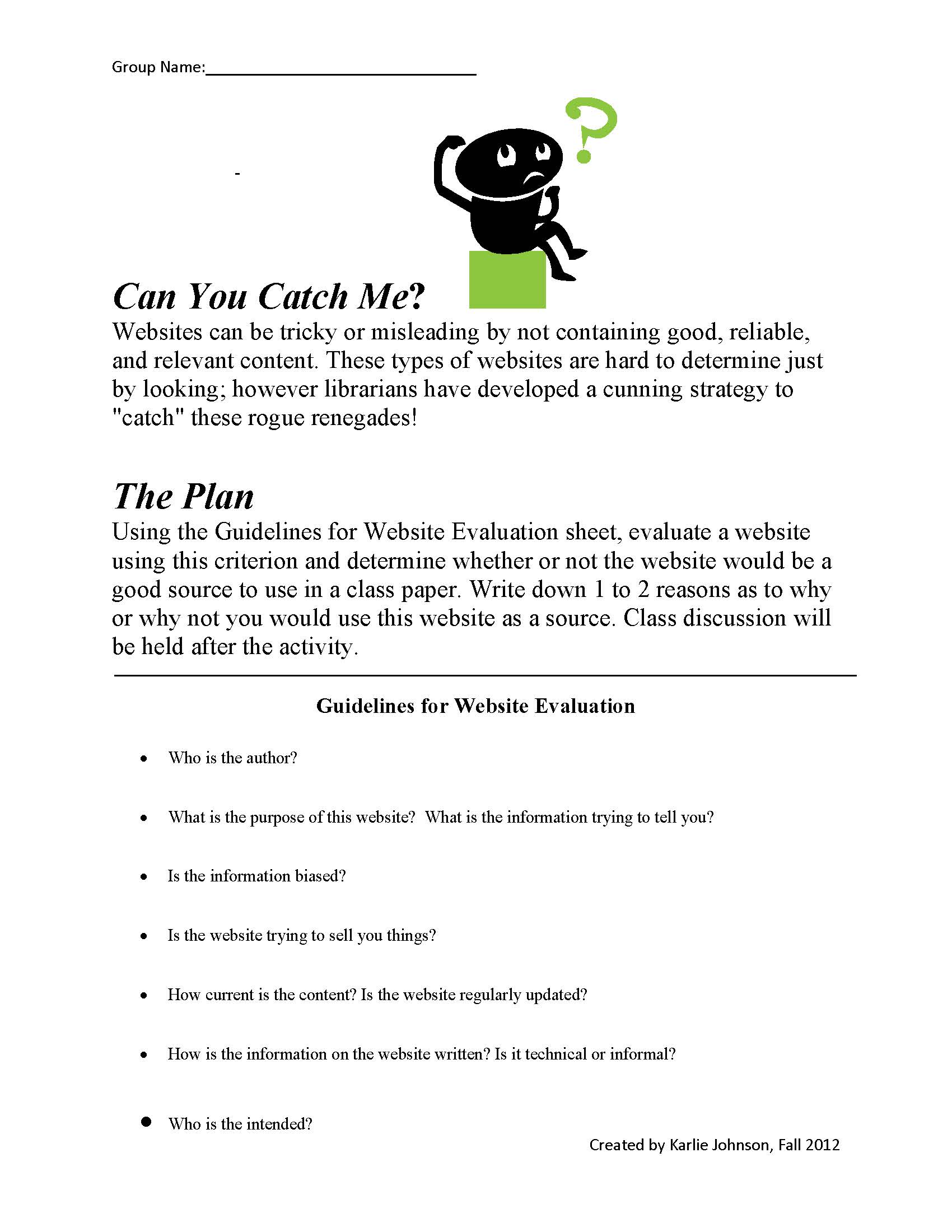
The first is a Web Evaluation exercise that Karlie has created:

This exercise was created for use in an EN101 class. UA’s EN101 doesn’t have a large outside sources requirement, and for the one paper they do use outside sources for they usually let students use websites. The point of the paper is to teach students to synthesis information. Karlie’s exercise gives students clear guidelines for judging a website for authority and intent, which is the critical thinking component of the exercise, rather than giving them a set of rules based on domain. The exercise is completed in conjunction with a short (15 minute) class discussion about domain, authorship, intent and publication process.

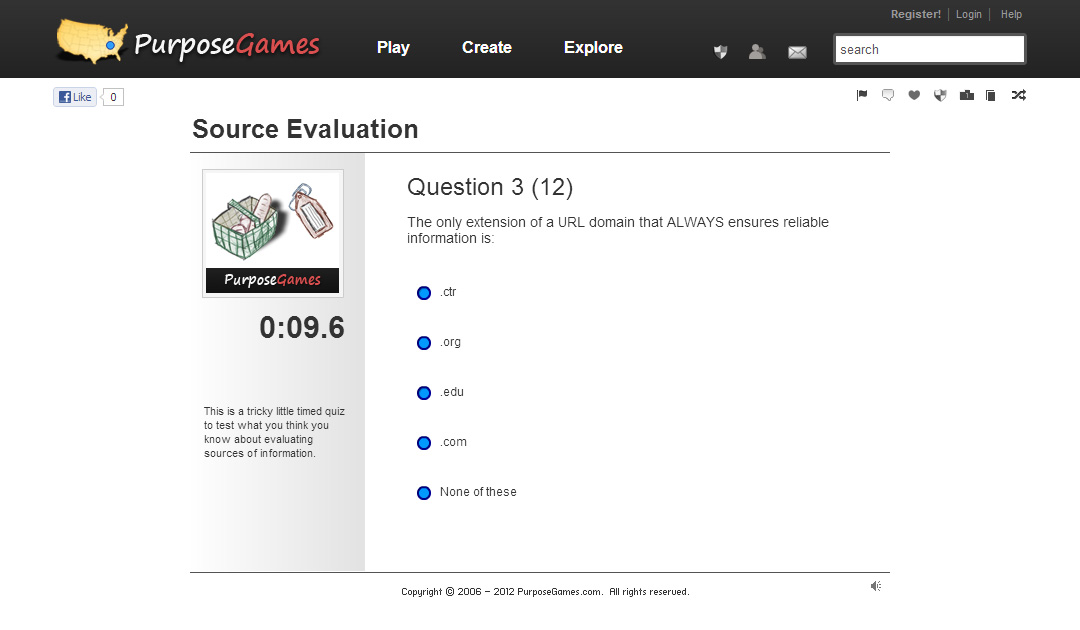
The second exercise I’d like to share with you is Louise’s Source Evaluation game (you will have to follow the link to see the full game).

This game has been a great tool to engage students in a meta-cognitive practice before talking to them about source evaluation during session 2 for EN102 classes. She allows students to play the game as their first activity in class, and then engages them in a 15 minute theoretical talk about scholarly and popular sources. Because they have measured their incoming knowledge, students are aware of what they know and what they need to know before any discussion begins.

The exercises that Karlie, Louise and Alex have designed are being used very successfully in the classroom. When we asked them to begin designing them, it was my intention that we create a pool of activities that can be used by anyone in our department (there are 9 instruction librarians currently in our department). We will maintain this pool and continue to add next semester with our new interns and GTAs. I think it will be great for them, during their job searches, to be able to say that they contributed to a departmental instructional activity repository, and it is going to be quite useful for our department as well, as we seek to serve our 6400 new freshmen by providing them interesting and informative experiences at the library!

First Solo Teaching Session

At first I was a bit worried about the fact that I had to do two long back-to-back sessions, but I figured that however my first session went, that experience would help me in my second session. And that was basically how it went. I wasn’t that pleased with my first session. I went too quickly, forgot some key points, and couldn’t seem to get them involved in any sort of discussion. That’s on me to some extent; I think I kind of expect them to be non-responsive, so I ask a question, wait for a few seconds, and then answer the question myself. Sara’s pretty good at persuading them to be involved – I’m not, at this point. There was also a computer issue at the end of my lecture that didn’t really help things.

Time was an issue for me in the first session (it was a one hour and fifteen minute session and I wanted to go for at least fifty minutes but only went around forty minutes), and I had similar problems with the second session (it went almost fifty minutes, better but not exactly what I was looking for). Beyond that, I think the second session went a lot better. I would still do some things differently if I had the chance, but it definitely was better. I feel like I started the second session off much better than I did the first. I was moving around, wasn’t stuck to the podium, asking more questions (even getting a few responses), and even though the first session didn’t go that well, just the fact that I had done it made the second one easier.

I was a bit bothered by how quick I was moving through each part of the session. Like I said, the start of the second class seemed much better to me; I was more relaxed, there was more of a conversation, and yet when I went back to the podium I noticed that we had only talked for like five minutes, when it had seemed much longer. Just looking at the clock at that point threw me off a bit for a few minutes as I moved into the keyword section of the lecture. Keywords and mind-mapping to me was the most problematic of both of my classes. I don’t feel like I explain that well, except for the part where I show how “asking a question” works on Google but doesn’t work on scout. Also, the keyword game didn’t work either time, and that’s probably on me to some extent as I probably didn’t make it competitive enough; it definitely worked for Louise.

I did think my Boolean part worked, especially the second time. I didn’t use a game, but just showed them how to use it in Google (which they’re more familiar with), and I think it worked reasonably well the first time and really well the second time (there was even a little discussion about it). Scout training was about the same both times. It was ok, I went over it, hit the high points, and asked if they understood, and while they were fairly unresponsive, my impression (especially when I helped them in their individual searches) was that they did. The only thing I think I really forgot the first time was to show them how to limit a search to newspapers and magazine articles, but I didn’t forget that the second time.

Then we went to the part where they search on their own, and even though I wasn’t very good the first session, and they weren’t very responsive, the help time with the first session was actually better than the second session. They seemed more motivated to find their sources and really seemed to want my help. When I co-taught with Nancy and Sara I’d just wander around and ask people if they needed help and ended up not helping many of them. This time instead of asking them if they needed help, I asked them what their questions were (it was helpful that the professor had them come in with a topic) and went on to help them. The first session I had conversations with pretty much everyone about what their topic was and how to search for it. The second session wasn’t bad in that sense; I was able to help almost everyone, but there were a few students who just weren’t interested.

Reflection on “What First-Year Students Know About Information Research”

Kate Manuel, “What do First-Year Students Know About Information Research? And What Can we Teach Them?”

This article challenged some of the assumptions about what freshmen students know about information literacy and how successful information literacy instruction can be. The basic assumptions about freshmen and information literacy is that they generally don’t know a great deal; they use unsophisticated searching techniques, follow the “principle of least effort,” and are likely to do research on the web and accept their findings uncritically. This study of a freshmen information literacy instruction class found that students know a bit more about searching than they are generally given credit for, but also argued that information literacy instruction was not as successful (at least in this case) as one might hope.

This article led me to thinking about what exactly our students seem to “know” going into their first sessions. Obviously this isn’t a complete picture as I’ve only observed and co-taught some sessions, but it seems like whenever students are asked why we use quotation marks someone always seems to know the answer. How many of them actually know why is a different story – some might have known but didn’t speak up, or maybe the only student who understood was the one who answered (only between 2.7 and 3.8% of the students in this study initially stated that using quotation marks was a way of narrowing a search). It seems like Boolean operators are a bit more of a foreign concept to students though, which isn’t really surprising as quotation marks are often used on basic Google searches. It would be interesting if we could find out (through some kind of questionnaire) what a certain class knows about information literacy beforehand, but that may not be really feasible.

The main thing I took from this article is that freshmen may not be the stereotypically lazy, uninformed searchers that they are portrayed as. The only real problem I had with this article is that I didn’t really know what they had taught the students during the instruction sessions. The students only showed a slightly better understanding of advanced searches based on the pre and post-tests, but we don’t really know how much time the instructors spent discussing advanced searches (we don’t really go into that for the most part). I also thought some of the gains shown in the post-test were a bit more significant than the authors apparently did (the use of quotation marks is one example).