Cool@Hoole

Covering Christmas: Publishers’ Bindings at The University of Alabama

By: Amy Chen, CLIR Postdoctoral Fellow
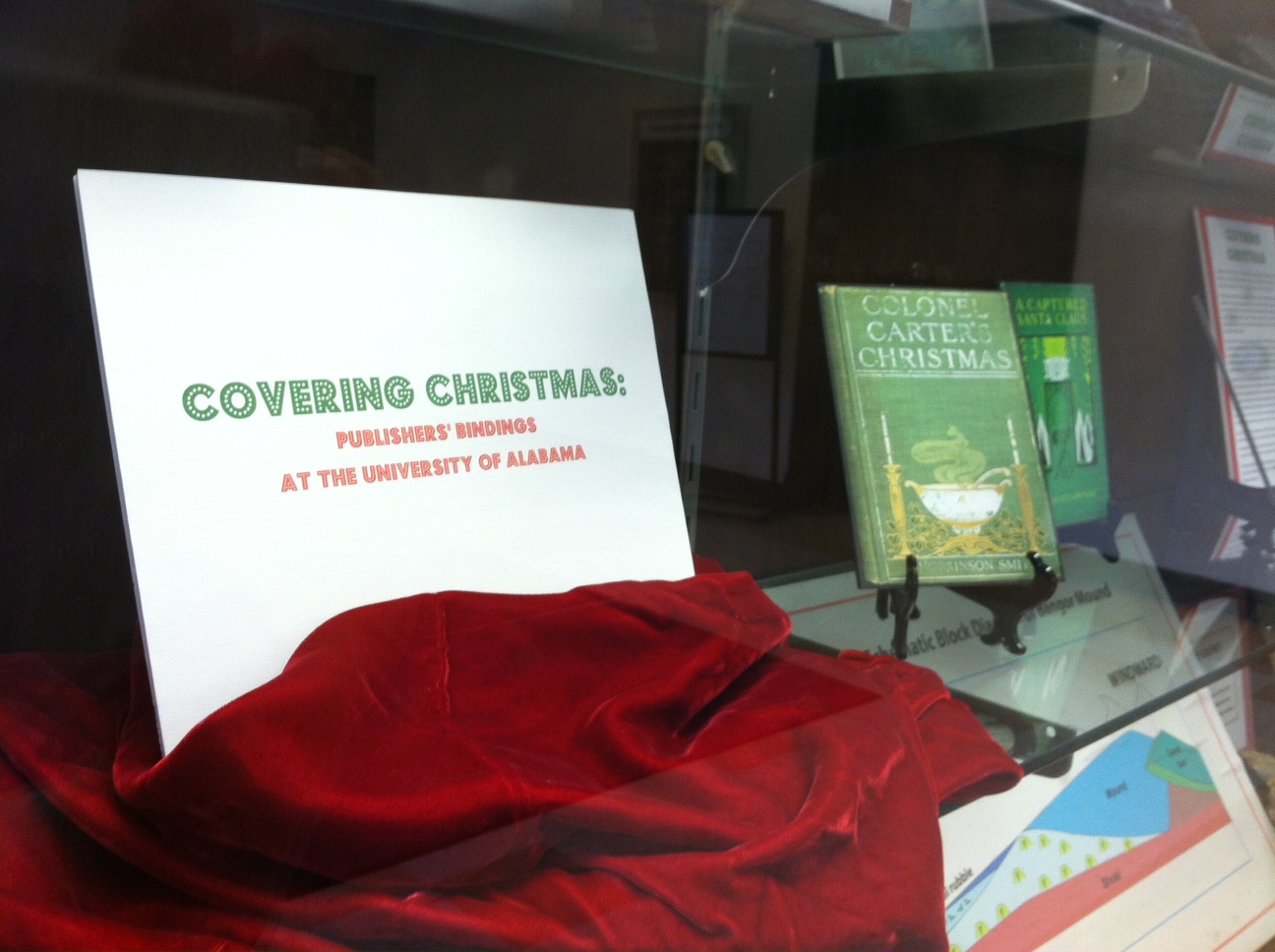
CoveringChristmas

Covering Christmas

During the month of December, “Covering Christmas: Publishers’ Bindings at The University of Alabama” will be on display in the lobby of the Mary Harmon Bryant Building and in a case in front of the Capstone Drive entrance of the Amelia Gayle Gorgas Library.

All items from this exhibition belong to the Division of Special Collections at The University of Alabama. Additionally, each of these items is represented in the database Publishers’ Bindings Online (PBO). PBO foregrounds how decorative bindings provide a look into culture and history of the era of 1815-1930, a time of social, political, and industrial change within the United States, by giving users the ability to view around 5,000 different bindings from the holdings of the W.S. Hoole Library at The University of Alabama and Special Collections at The University of Wisconsin. Each of the books shown here come from either the Wade Hall Collection for Southern History and Culture or the Alabama Collection at Hoole.

Ranging from 1898 to 1921, these publishers’ bindings celebrate Christmas in a variety of ways depending on the years they were produced, the artists that created the designs, the content of the books, and the style of the times.

For example, ragtime music, yellow journalism, mass circulation magazines, and national advertising campaigns defined the prosperous 1890s. Publishers’ bindings from the 1890s usually were multicolored and flat-stamped. Artists became essential to publishing houses at this time. A select few, such as Frank Hazenplug, became well-known. A later example of Hazenplug’s work can be seen on Sonny: A Christmas Guest (1905).

pba00632f01l

Sonny: A Christmas Guest

At the turn of the century, the social problems of modernity increasingly began to be identified and debated, but light-hearted entertainment also had a place in the lives of Americans. As women’s skirts grew shorter, The Ford Model T car and Victrola phonograph became all the rage. In the book world, paper dust jackets began to be produced to match the ever-more elaborate publishers’ bindings.

From 1910-1919, World War I dominated headlines. In 1917, the United States joined the fight. Due to the United States’ ability to mobilize and mass produce supplies for the battleground, this decade shaped America into the international superpower it is today. The diversity of publishers’ bindings of this era reflects the spread of inexpensive dust jackets and more efficient publishing methods. Whether at war or at home, American culture began to reflect an increasing emphasis on satisfying the growing number of mass market consumers.

The firm Decorative Designers took the idea of standardization from Henry Ford. Instead of employing one artist to make an entire cover, the firm chose to hire a number of designers who each made one portion of a binding. Decorative Designers created Christmas-night in the quarters (1917), which can be seen here.
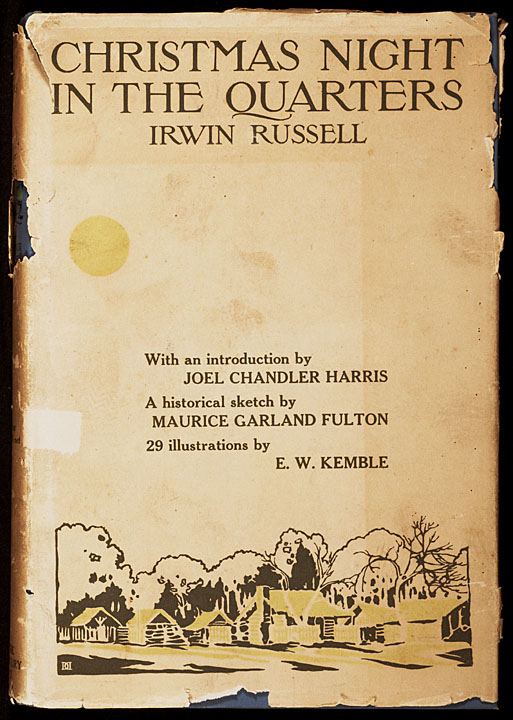
pba00575f01l

Christmas-Night in the Quarters

The freewheeling 1920s, which began with the ratification of women’s right to vote and Prohibition, ended the time of the publishers’ binding as dust jackets became ubiquitous.

Items on display include:

William Aspenwall Bradley. Old Christmas and Other Kentucky Tales in Verse. Boston, MA: Houghton, Mifflin and Company, 1917. Wade Hall Collection PS3503.R226 O4 1917x

John Fox. Christmas Eve on Lonesome. New York, NY: Grosset and Dunlap, 1904. Wade Hall Collection PS3511.O95 C5 1904x

Maud Lindsay. The Joyous Guests. Chicago, IL: E. M. Hale, 1921. Alabama Collection PZ7.L66 Ja

Thomas Nelson Page. A Captured Santa Claus. New York, NY: Charles Scribner’s Sons, 1905. Wade Hall Collection PS2514 .C3 1905x

Irwin Russell. Christmas-night in the quarters, and other poems. New York, NY: The Century Company, 1917. Wade Hall Collection PS2740 .A2 1917 c.2

Francis Hopkinson Smith. Colonel Carter’s Christmas. New York, NY: Charles Scribner’s Sons, 1903. Wade Hall Collection PS2864 .C642 1903bx

Ruth McEnery Stuart. Sonny: A Christmas Guest. New York, NY: The Century Company, 1905. Wade Hall Collection PS2960 .S62 1905x



The Culinary Arts of Clementine Hunter, Louisiana’s Black “Grandma Moses”

By: Allyson Holliday, W.S. Hoole Library Complex Copy-Cataloger

ClementineHunter

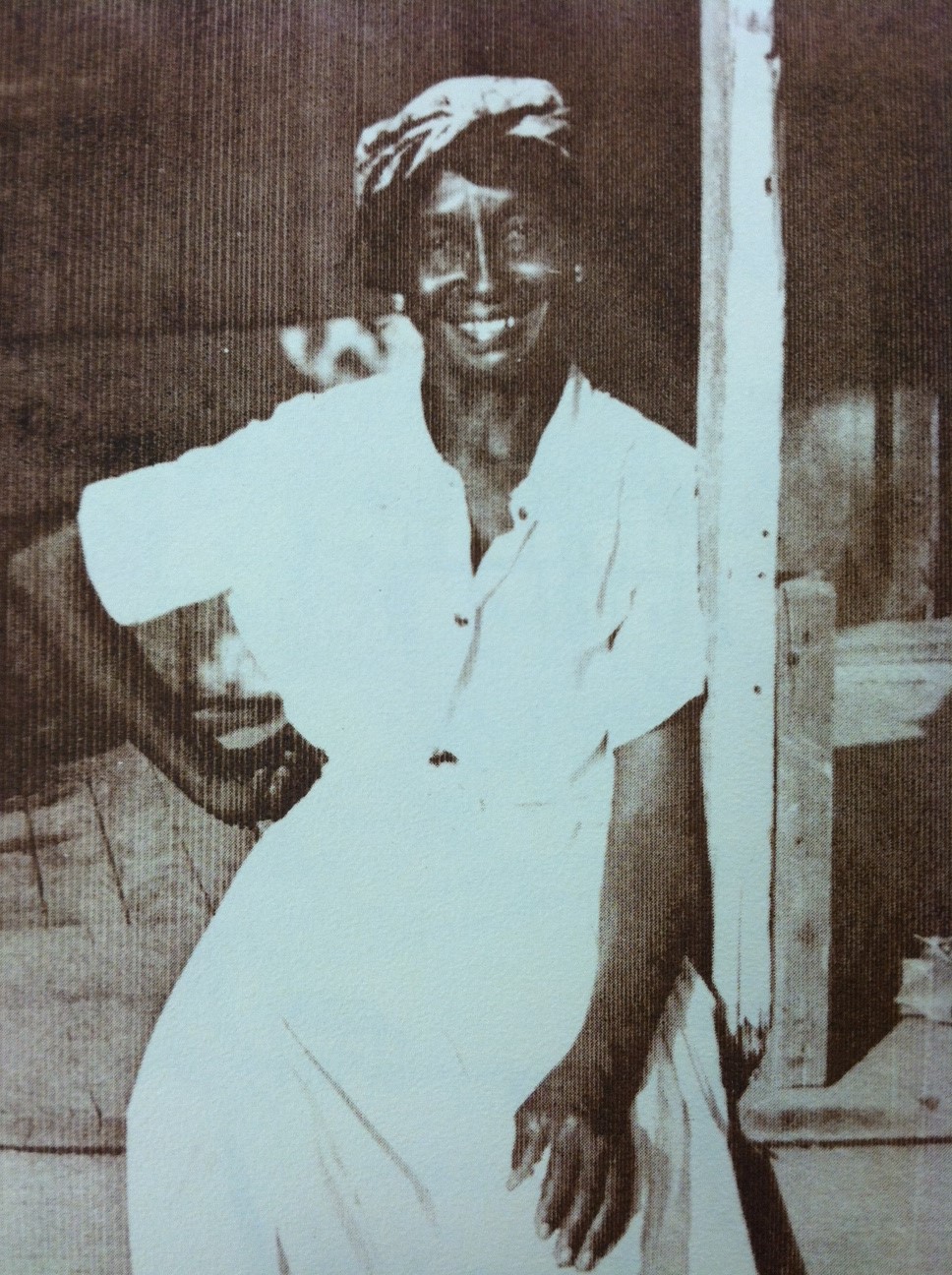
Clementine Hunter, from the Melrose Plantation Cookbook

Clementine Hunter was born in 1880 “in the lower reaches of the lush Cane River country” of Louisiana (Introduction, 4-5). She grew up working in the cotton fields and pecan groves of different plantations before moving to Melrose Plantation as a teenager. Melrose was a very large plantation, created by a former slave called Marie Therese and her family in the late 1700s. The plantation had become known as an agricultural empire, with its thousands of acres of corn, cotton, tobacco and hundreds of head of cattle.

The plantation was eventually sold to John Hampton Henry and “Miss Cammie” (Carmelita Garritt Henry) in 1898. Miss Cammie desired to preserve the arts and crafts of the Cane River area, and over the years Melrose became a haven for many artists and writers. Clementine was eventually promoted from the fields to the house. It became clear that she had hidden talents and this is where her culinary and artistic side was allowed to shine.

Clementine became known for her recipes while working in the Melrose kitchen. Boiled Bass, Potatoes Arroyo Hondo, and Game Soup were just a few of the unique recipes she created. As the plantation’s guest book of artists and writers grew, so did the fame of Melrose and its cuisine.

Clementine compiled the Melrose Plantation Cookbook (Lupton TX715.M53 1956) with her friend and artistic mentor, Francois Mignon, in 1956. It consists of 31 of her recipes including this recipe for “Eggs Grand Ecore.”

EggsGrandEcoreRecipe

Eggs Grand Ecore

AlexHolliday

Alex Holliday, the author’s son, enjoys his special collections-inspired meal

While known for her delectable cooking in her time, Clementine also began to paint with encouragement from Francis Mignon. Over some 40 years, she produced over 5,000 paintings, each one telling a story of life as she saw it in a simple, straightforward way. She did not always have canvas so she used old window shades, bottles, cardboard or even brown paper bags. She was illiterate, but her paintings were her storybook – a storybook about everyday life on and around the plantation. Her prolific folk art soon led to her being known in some circles as the “Black Grandma Moses.”

Clementine Hunter died on January 1, 1988 and was buried near Melrose Plantation, next to her friend Francois Mignon who believed in her gift.

The Melrose Plantation Cookbook is an excellent example of the library’s holdings in African American history and culture.

Editor’s note: Want to learn more about the David Walker Lupton African American Cookbook collection or view a list of all the books found in the collection? Read about it here

Intrigued by Clementine Hunter’s art as well as her cooking? Start by reading “Looking for Clementine Hunter’s Louisiana” and then check out Clementine Hunter: Her Life and Her Art by Art Shiver and Tom Whitehead. An excerpt from Shiver and Whitehead’s book can be seen on South Writ Large. You can even keep up with Clementine Hunter’s work as it is covered in social media by liking her fan Facebook page

John F. Kennedy assassination, 50 years on

A local reflection on the assassination of our 35th President, from our campus newspaper, The Crimson White, December 5, 1963. Click on the image to see the spread up close, or take a look at the transcription below:

kennedy_spread_edited3

It Is Time For This Country To Take A Leading Role

John Fitzgerald Kennedy, 1917-1963

“…the torch has been passed to a new generation of Americans…”

“Only an America which has fully educated its citizens is fully capable of tackling the complex problems…of the world in which we live.”

“We face…a moral crisis as a country and as a people. It is time to act…above all, in our daily lives.”

“All this will not be finished in the first 100 days…Nor even perhaps in our lifetime on this planet. But let us begin.”

“The conquest of space must and will go ahead.”

“We in this country, in this generation, are…the watchmen on the walls of world freedom.”

Part 2: Interview with Haley Aaron, Division of Special Collections graduate assistant

Editor’s Note: This interview continues Monday’s conversation with Haley Aaron. See the first post here.

GirlsJournal2

Cover of Virginia J. Hanson’s Girl Graduate Journal (1912)

Have you used archival materials in your graduate work? 

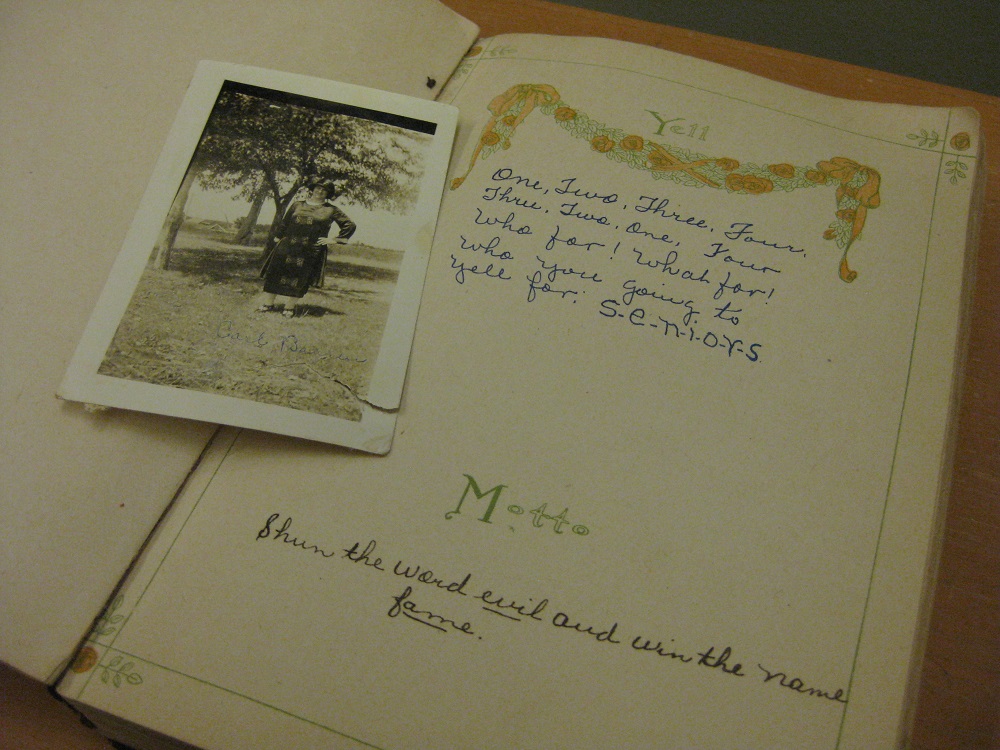
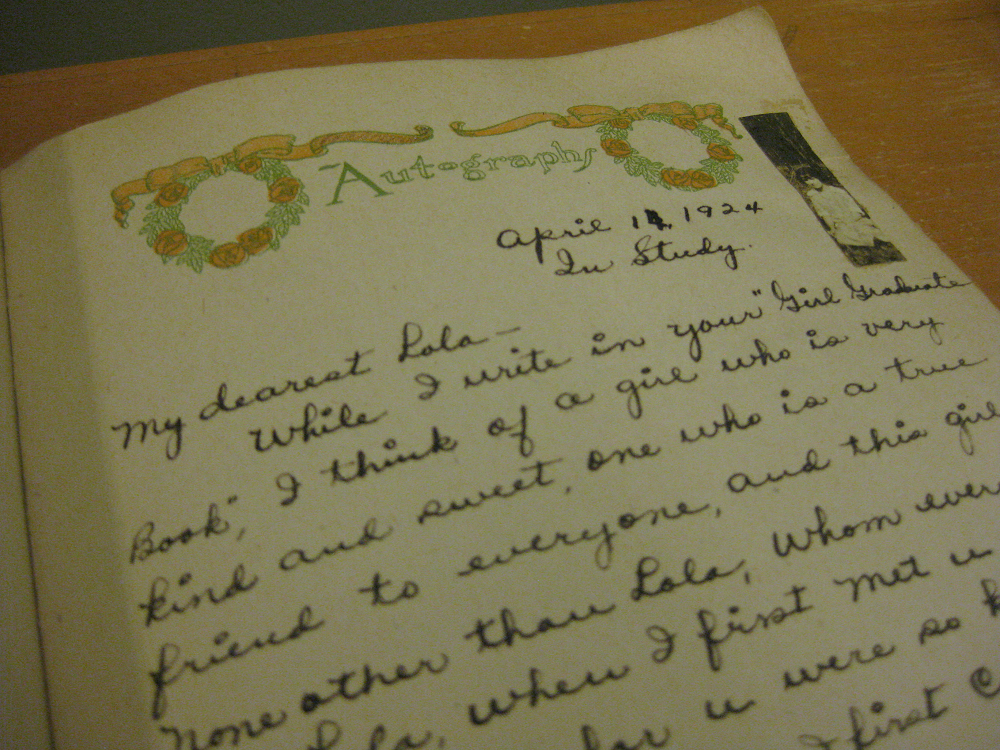
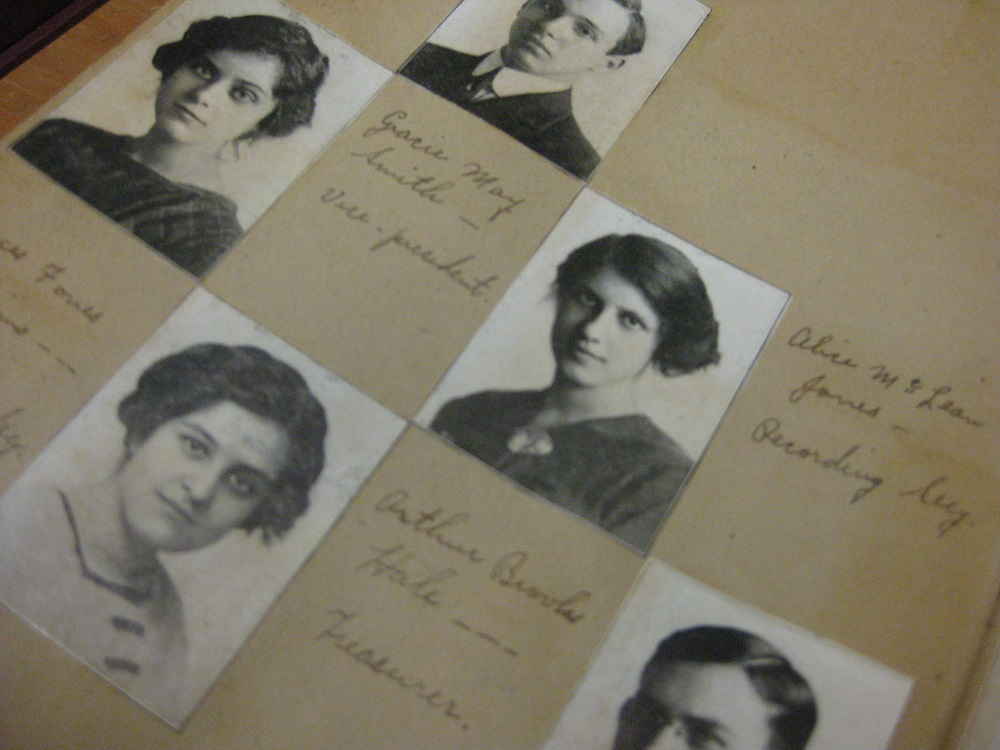
I have used a few of the collections available at the University of Alabama as a student at School of Library and Information Studies. In “Be True to Your School: Documenting High School Using Girl Graduate Journals,” I analyzed the girl graduate journal as a documentary form for an archives class. Girl graduate journals were mass-produced scrapbooks produced by book publishers that gained popularity in the 1920s. The journals contained pages with pre-fabricated headings and illustrations and provided room for high school seniors to collect letters and autographs from friends and teachers; include descriptions, tickets, and other ephemera from school events; and record information such as class mottos.

The Williams Collection contains three journals compiled by graduates of Alabama high schools: the Marie Brink memory book, Sidney Lanier High School 1922 (W.0017); the Virginia J. Hanson memory book, Birmingham High School 1912 (W.0018); and the Lola Higginbotham memory book, McAdory High School 1924 (W.0033). The scrapbook compiled by Virginia Hanson is particularly detailed; the Williams collection also contains other items created by Hanson, including a travel scrapbook describing a later trip Hanson took with three friends. It’s interesting to compare the high school scrapbook with the travel scrapbook.

GirlsJournal1-A

Page from Lola Higginbotham’s Girl Graduate Journal (1924)

How does your history training (Haley has a master’s degree in history from Georgia State University) contribute to your perspective on the material you handle in the archive?

I think my previous historical studies have given me a greater level of appreciation for the archival material I have been processing. At Georgia State, I was trained to think critically about the historical context of archival documents – asking questions about why items were created and how they fit into a larger narrative.

I drew extensively on archival materials while writing my thesis. Using archival collections allowed me to analyze the effectiveness of finding aids created by archivists and think critically about what made those access tools effective to me as a researcher. My historical training has also given me greater insight into how researchers may use the material I’m processing. My colleagues and professors used traditional and non-traditional resources in a variety of innovative ways. By speaking with them, I have a much better understanding of how historians approach and use archival materials.

GirlsJournal1-B

Page from Lola Higginbotham’s Girl Graduate Journal (1924)

As a researcher, I’ve always felt like historical research is like putting together an old jigsaw puzzle – some pieces may be missing and you may not have a very clear image for guidance. However, with some persistence and creativity, you can pull together a fairly complete picture using archival resources and fill in the gaps by reading and understanding the work of other historians. As an archivist, it’s my job to provide guidance to researchers piecing together the historical “puzzle” by clearly explaining what researchers can expect to find in a collection and explaining what gaps may still exist.

Congratulations in advance for receiving your master’s degree from the School of Library and Information Studies this December. Tell us about your next step. 

Thanks! I am very excited to start my first full-time archival job in January. I will be working as a Manuscripts Archivist at the Alabama Department of Archives and History in Montgomery.

My work at the state archive will be similar to the work I have completed at the Williams Collection; I will be responsible for processing manuscripts collections and creating finding aids. I feel that my experiences as a student employee at the University of Alabama have opened doors in Montgomery; when I interviewed for the position, the interviewers spoke highly of my processing and inventory experience, which I gained by working on campus. The theoretical experience I gained in the classroom as a SLIS student was also essential. I am so thankful for the opportunities that my time at The University of Alabama has afforded me; I am especially grateful for the advice and support of the faculty and staff at the School of Library and Information Sciences and the Division of Special Collections.

As a native Alabamian, I feel honored to play a role in preserving and providing access to collections documenting the rich history of the state. I also feel blessed to start my career at the institution where I first found my calling – that high school visit to the archive really made a lasting impact!

GirlsJournal2-A

Page from Virginia J. Hanson’s Girl Graduate Journal (1912)

Part 1: Interview with Haley Aaron, Division of Special Collections graduate assistant

Editor’s Note: This interview will be posted in two parts. Check back on Wednesday for the second portion of my conversation with Haley.

HaleyAaronSmall

Haley Aaron

First off, what got you interested in special collections?

My love of special collections stems from my first two encounters with archivists. As a high school junior, I visited the Alabama Department of Archives and History in Montgomery on a trip sponsored by the Cullman County Youth Leadership initiative. The archivists that led the tour were incredibly gracious, taking the time to show us some of their favorite collections and explain their preservation efforts. That trip was my first introduction to the archival profession, and I was fascinated by my first “behind the scenes” look at archives.

In the summer between my junior and senior year, I attended Alabama Governor’s School, a two-week program held at Samford University each summer. At governor’s school, I took a class in Alabama history and had the chance to research and write a paper using materials housed in Samford’s Department of Special Collection. Even though I was a young researcher, archivist Elizabeth Wells went above and beyond to make sure I found the materials I needed to complete the paper.  Ms. Wells’ enthusiasm for special collections was irresistible; using census records, letters, and maps, she told fascinating stories about Birmingham’s history.

I was blessed with the opportunity to attend Samford and double major in journalism and history. Ms. Wells’ door was always open if I ever had a question about the resources available at Samford; her advice was invaluable. During my senior year at Samford, I had the opportunity to work as a student research assistant at the Department of Special Collection, answering patron’s research requests. Working with Ms. Wells and the rest of the Special Collection staff taught me a number of valuable skills, including perseverance, accuracy, and attention to detail.

What roles have you had at The University of Alabama? 

I have had the opportunity to work on several different archival projects during my time at the University of Alabama.  In February, I started work as a student employee at the A. S. Williams III Americana Collection. I have been responsible for processing manuscripts, the unique and unpublished letters, diaries, book manuscripts, and business records collected by Mr. Williams, who generously donated his collection to the University of Alabama in 2010.  I have arranged and described a diverse set of materials, ranging from Civil War soldiers’ letters to the business records of Birmingham steel companies. As of November 12, 2013, finding aids for 59 collections are now available online, and more finding aids will be available soon. I’m very excited that these collections are now open to researchers, and I am grateful for the opportunity to play a small role in making this rich collection accessible.

In August, I was appointed to a one-semester term working as a graduate assistant for the Department of Special Collections.  I have split my time as an assistant between the Williams Collection and the W. S. Hoole Special Collections library. At Hoole, I worked with another graduate assistant and began compiling a comprehensive inventory of manuscripts held at the library.

Finally, I have worked at a third on-campus archival collection not affiliated with the university library Department of Special Collections. The Center for the Study of Tobacco and Society is a collection compiled by Dr. Alan Blum. The materials collected by Dr. Blum address how advertising and business efforts by the tobacco industry have impacted American culture and public health initiatives. Since March, I have been arranging, describing, and digitizing materials related to alcohol marketing and addiction; this collection is a small subset related to the larger collection on the tobacco industry. I have also briefly worked with the larger collection of tobacco materials, helping create a detailed inventory of items for an exhibit created by Dr. Blum.  [Editor’s Note: Visit the Center for the Study of Tobacco and Society’s exhibition up in the Pearce Lobby of the Gorgas Library now through November 20, 2013.]

Gaining archival experience as a student employee has greatly enriched my experience at the University of Alabama. I have enjoyed working with and learning from the talented staff at the Department of Special Collections, and I appreciate the training opportunities that the department has provided. I have learned a great deal about processing, exhibit planning, and reference by working as a student in these university archives.

SocietyScriptSmall

Initiation script for the Cowbellion de Rakin Society

What is the most surprising item you’ve seen during your time in the stacks?

I was particularly surprised to come across a handwritten initiation script for the Cowbellion de Rakin Society (W.0035), Mobile’s earliest carnival society and one of the earliest Mardi Gras societies in the nation. The Cowbellion de Rakin society set the foundation for the parades and revelry that have become a hallmark of Mardi Gras celebrations; however, the society’s first parade, led by revelers carrying cowbells and rakes, was actually held on New Year’s Eve in 1830. Gradually, floats and the tradition of throwing items to the crowd were introduced. In 1888, the New Year’s Eve parade was discontinued, but the parade tradition lives on in the elaborate Mardi Gras celebrations held in Mobile and New Orleans.

UnionLetterSmall

Morris Boss Letter

Out of all the items you’ve come across, which is your favorite?

That’s a really tough question! The Williams Collection contains such a variety of fascinating materials it’s almost impossible to choose just one item. I would encourage researchers to visit the Williams Collection and discover their own favorites.

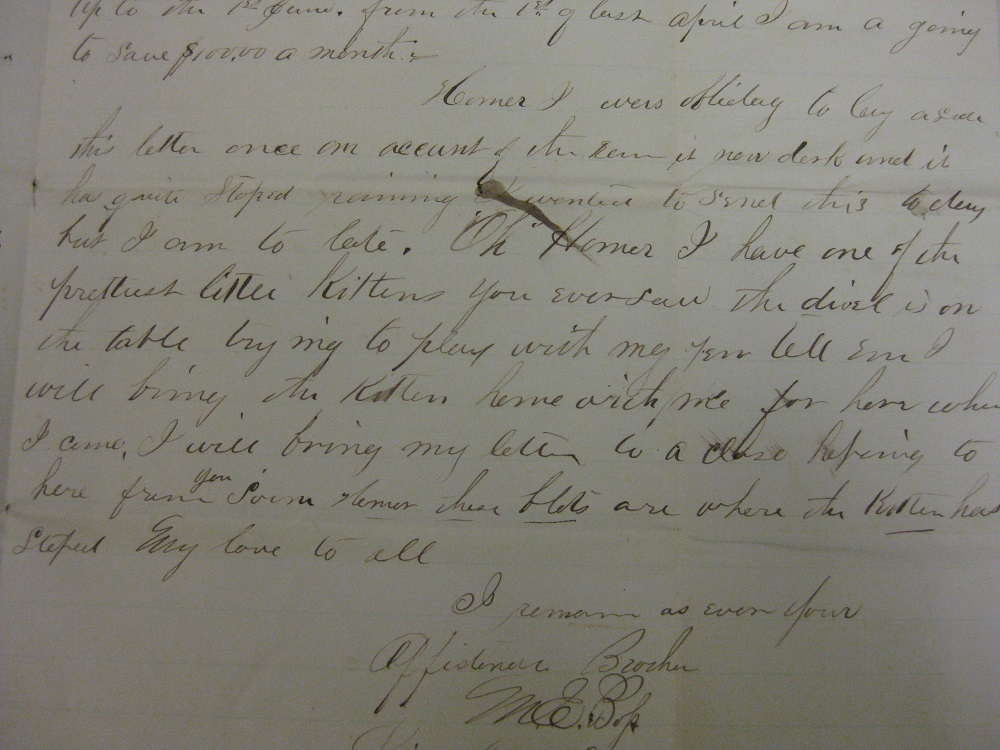
If I had to pick a single item, I would have to pinpoint a letter written by Union soldier Morris Boss (W.0078). Boss enlisted in November 1861, and he saw his share of death and suffering. Many of his letters describe the hardships of military life and he discusses a number of historically significant issues, including the draft and the execution of soldiers who deserted.

However, my favorite letter deals with none of these issues. Boss writes a letter home in 1865 after the war has ended and he is preparing to return home. Sitting at the Union camp, he talks about a kitten he plans to adopt and take home. The end of the letter is smudged and splotched. In a postscript, Boss offered an explanation for the messy writing – the kitten, which had been standing on the table playing with a pen, had walked across the letter!

This letter may not have the same historical significance as Boss’ other letters, but I think it still tells a compelling story. Boss lived through a horrific war, but he was still able to show compassion to a kitten that needed a home. The innocence of Boss’ letter surprised and delighted me.

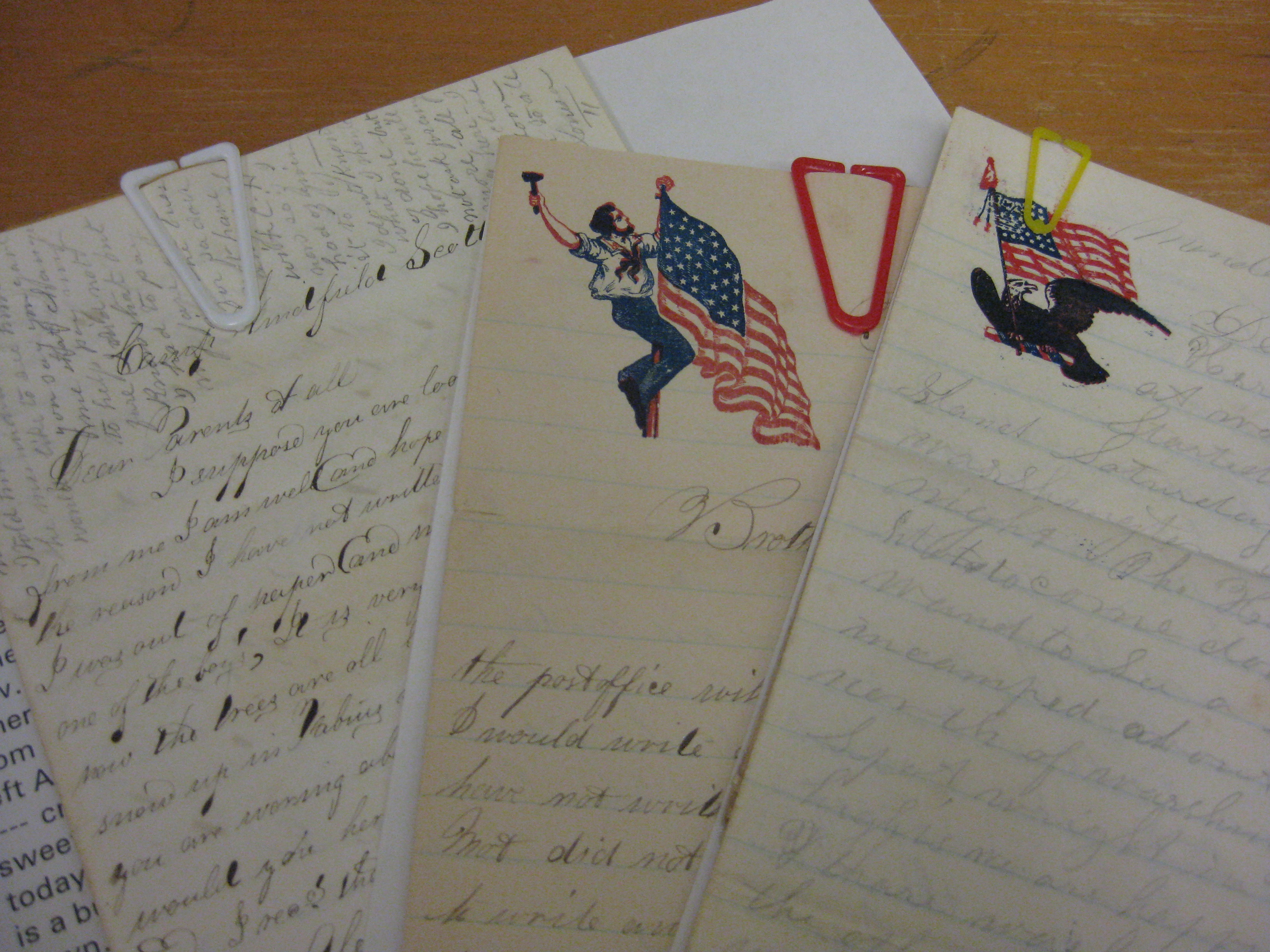
UnionStationary

Union stationary in the Morris Boss letters collection

There are several reasons that this little letter is one of my favorite items in the Williams Collection. I love archival materials that provide a new perspective about events. I also love when items provide insight into humanity. The Williams Collection, like most archives, contains stories of love and loss, triumph and tragedy – all of the experiences that define the human experience, regardless of time or place.

Come back on Wednesday to read more about Haley’s time in the Division of Special Collections at The University of Alabama and her upcoming plans after she graduates this December from the School of Library and Information Studies!

Women and Their Cars

Over a hundred years ago, Alice Ramsey and her friends took the first all-female cross country automobile trip. You can read about Ramsey’s experience at Smithsonian Magazine online — what they ate, where they stayed, how they found their way in an era with limited roads and even more limited road maps.

Among our digital collections’ images of everyday life, a surprising number are of women and their cars, even as far back as Ramsey’s time.

Maybe they looked a bit like this group, circa 1907:

three women by car, 1907

Or these women, a year later. I wonder: were they just posing with the car, or were they its drivers?

two women with car, 1908

This shot is from the 1910s or 1920s. While nowadays a car like this would be sitting in a museum or kept under cover in a collector’s garage, back then it was just an everyday way to get around. Check out the mud on the tires.

woman with car, 1910s-1920s

These women and their car are from the 1920s — you can tell by that awesome flapper hat the woman on the left is wearing, and the fact that we can see their ankles (gasp!).

women with car, 1920s

In the 1930s, taking a driving break to drink some bottled Coca-Colas.

women with car, 1930s

Also 1930s, a couple of more fashionable ladies posing on their car’s running board.

women with car, 1930s

By the 1950s, we’d come a long way in women’s fashion. Can you imagine the ladies above dressed like this? Car design had also changed a lot, with cars growing sleeker and longer…

woman with car, 1950s

…like this 1960s model Chevy Impala, taking an all-female group up University Boulevard to the University of Alabama campus in 1963.

women with car, 1963

Walter B. Jones in World War I

By: Patrick Adcock, JD and W.S. Hoole Library Archival Technician

1st Lieut. Walter B. Jones, from his scrapbook

1st Lieut Walter B. Jones

On the eleventh hour of the eleventh day of the eleventh month in 1918 the armistice between the Allied powers and Germany went into effect ending the combat operations of World War I.  Thereafter, November 11 was designated as a day of remembrance to honor all of those who had served in WWI.  After the end of World War II, Armistice Day in the United States became Veterans Day to celebrate all those who have and continue to serve in our nation’s armed forces.

One of the many University of Alabama graduates that served in our armed forces was Walter B. Jones.  Jones was an officer in the Army Corps of Engineers in both World Wars.  During World War I, he served in France. Jones also served in the Pacific theatre during the Second World War. The Special Collections library recently received a donation from the Jones family that included the military equipment and uniforms that Walter B. Jones used during both wars.

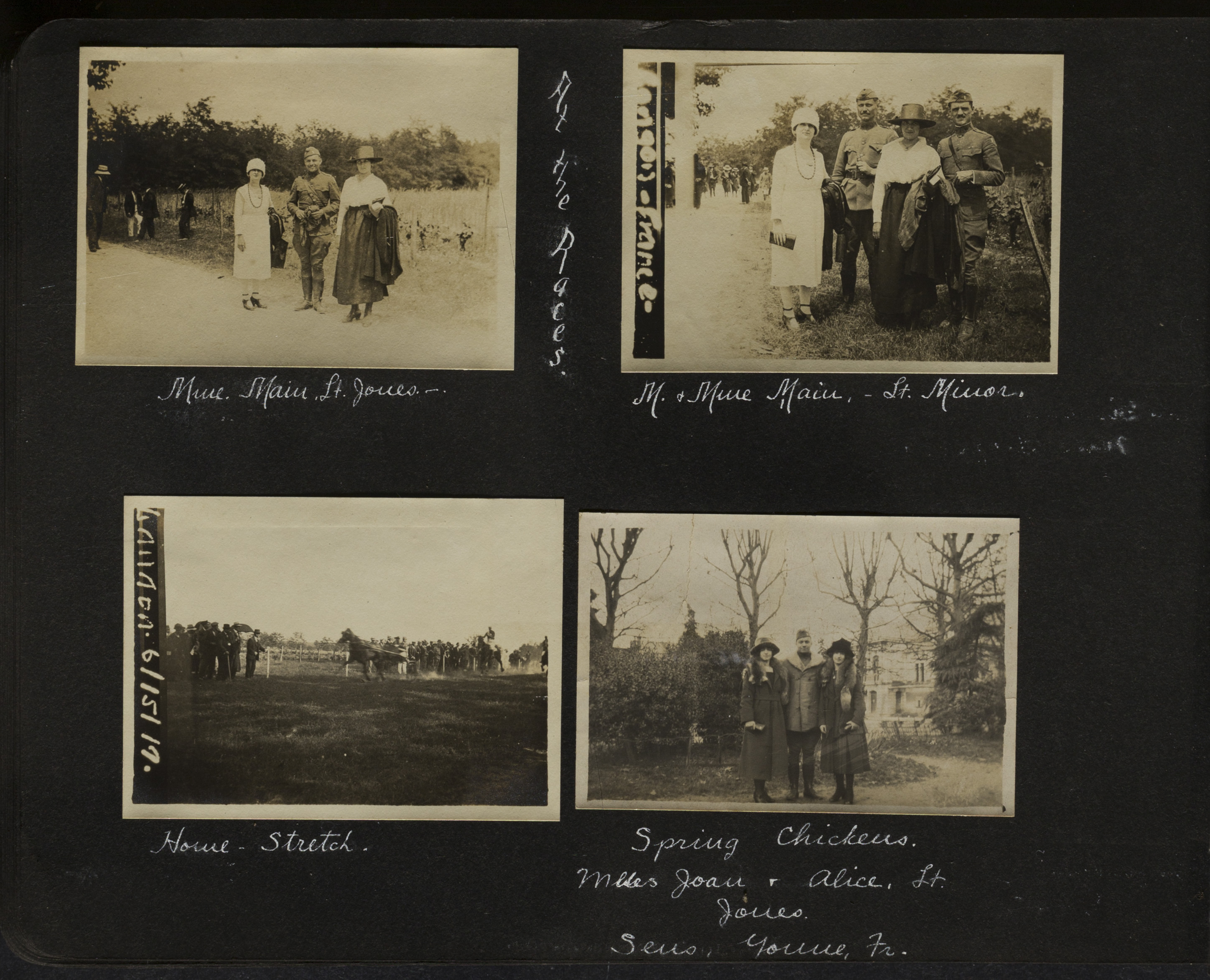
Walter B. Jones scrapbook page

Walter B. Jones scrapbook page

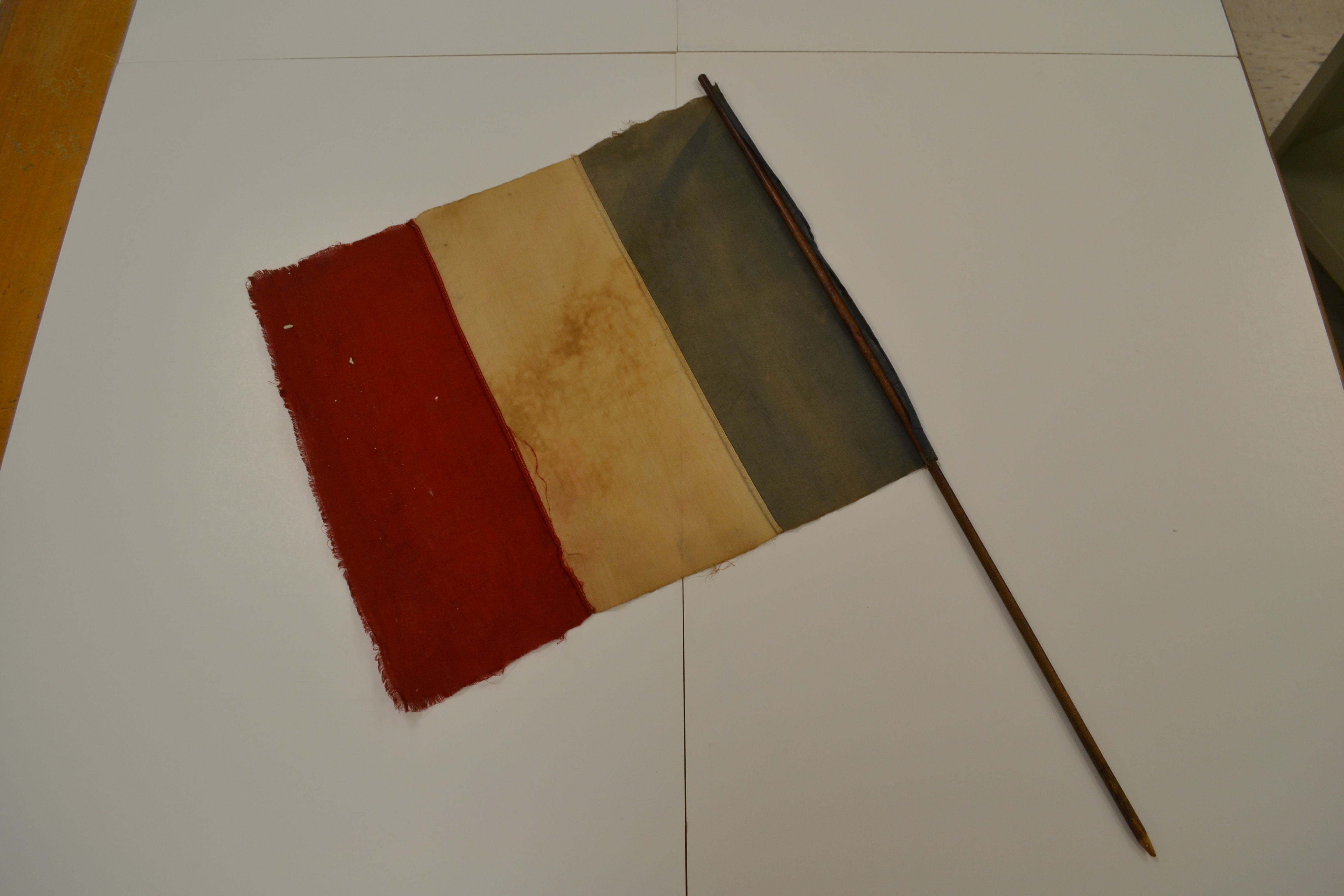
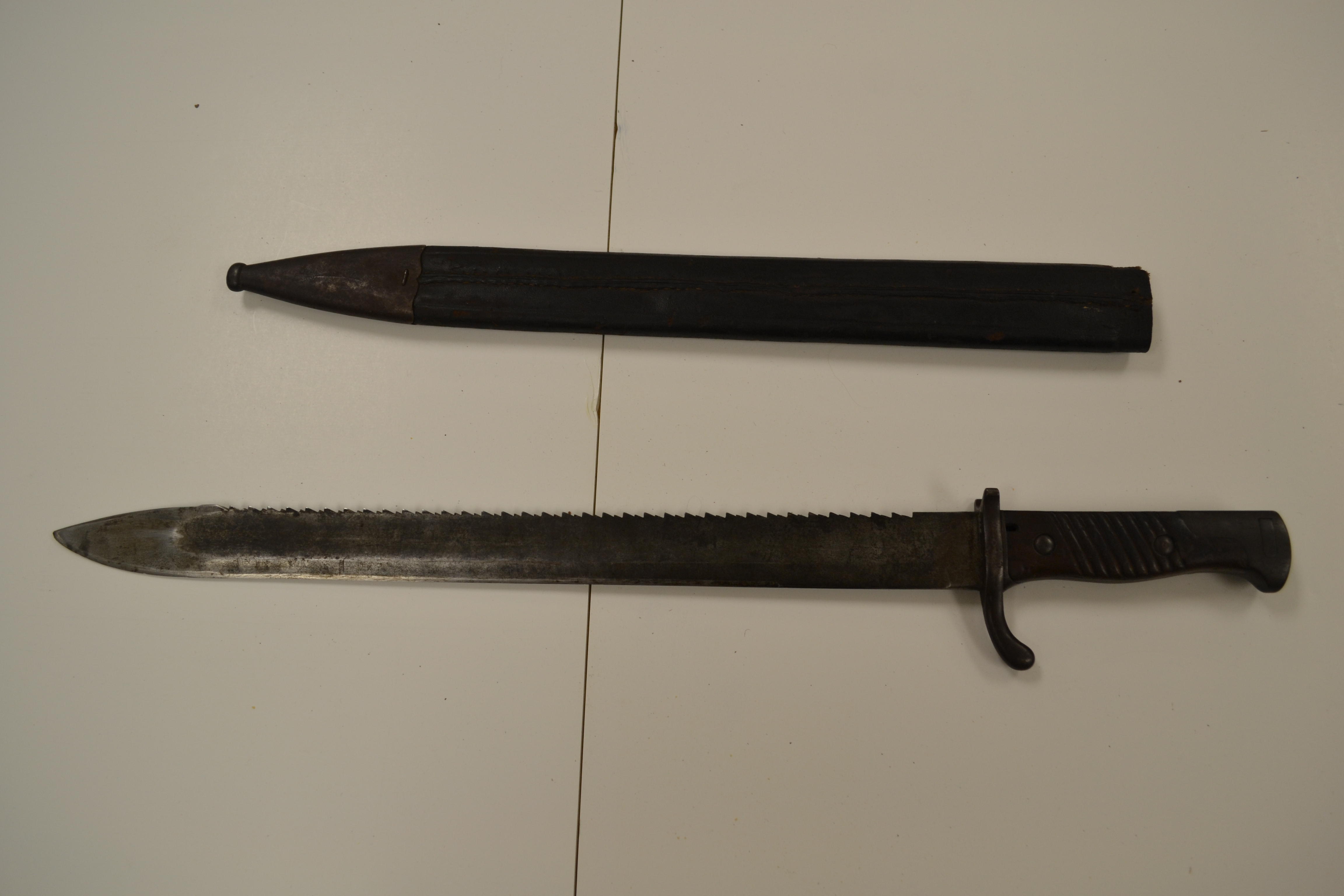
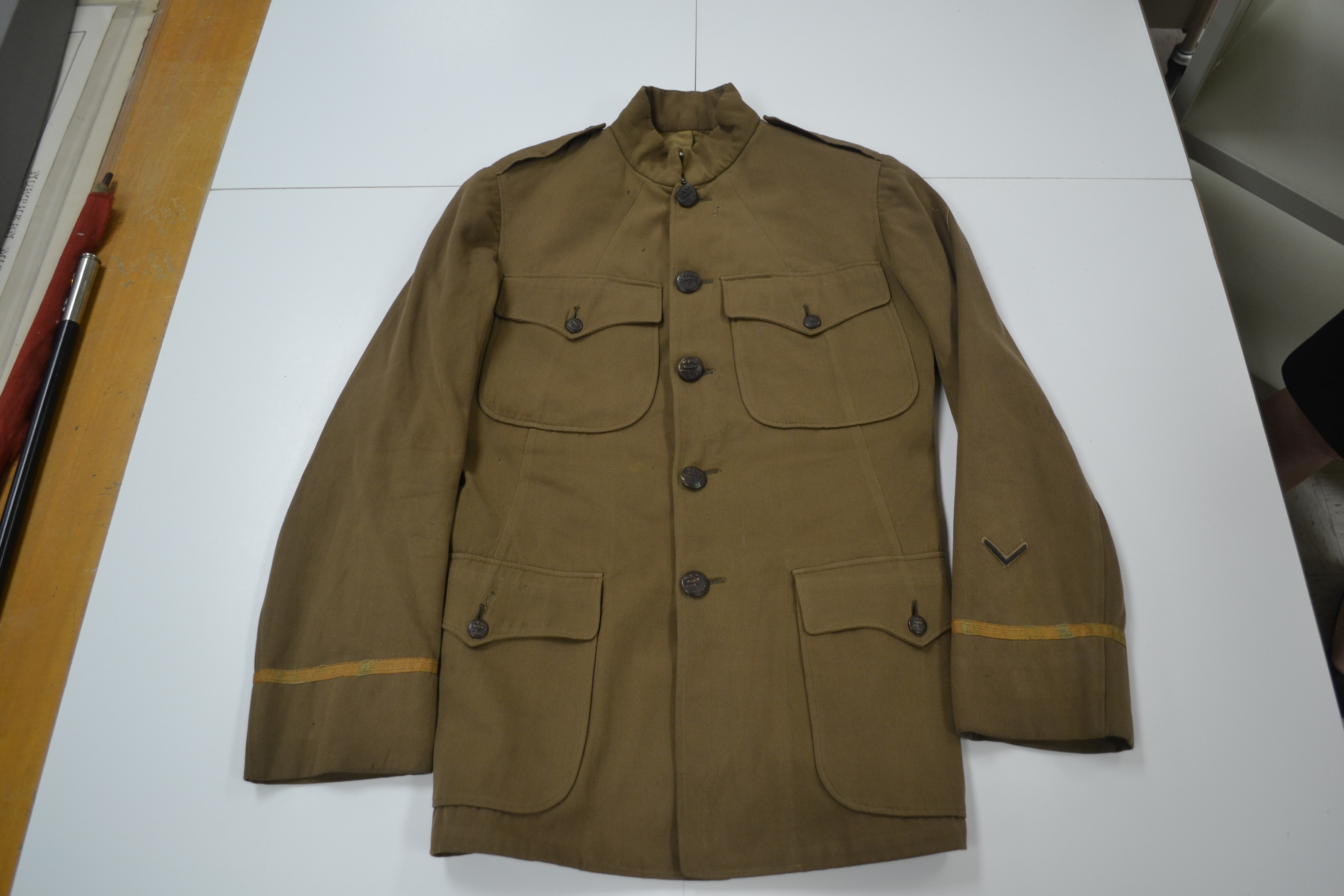
The items from World War I include a small French flag, a rare Imperial German saw back bayonet, and one of his uniforms.  The small French flag is faded and very delicate, but it is a nice example of the type of flags that you see in the newsreels and photographs of the French citizens celebrating after the announcement of the armistice.

French Flag

World War I French flag

The bayonet was made by V.C. Schilling for the Imperial German army. This type of bayonet was generally used by machine gun crews because the saw back helped them clear brush while setting up their positions.

FullView

World War I bayonet

The uniform is a typical example of a World War I American uniform and it is in good condition for being over 90 years old.  These items, along with the others in the collection, help to bring the history alive in ways that just looking at records cannot do.

WWIUniform

World War I uniform

Through this collection and many others in the Special Collections Library we can get an understanding of the sacrifice our veterans made to preserve our freedom and help liberate many nations around the world. On this day we would like to thank all of those who have served in our armed forces.

Walter B. Jones scrapbook page

Walter B. Jones scrapbook page

[Editor’s Note: If you would like to read more about Walter B. Jones, please visit the following sites: UA Museum to host Symposium and Exhibit on the Work and Life of Walter B. JonesWalter B. Jones in the Encyclopedia of Alabama, and Walter B. Jones in Alabama Heritage. You might even want to apply for the the Walter B. Jones Memorial Scholarship!

If you are interested in viewing more World War I-era collections at the W.S. Hoole Library, please consider inquiring about the papers of Janie Mary Eppes, the Walker-Reese family, or Kenneth Allison Roberts. World War I-era photographs can be found in Hoole’s World War I collection or in the Wade Hall photographs collection. The J. Alfred Swatkins collection may also be of interest, as it consists of World War I-era sketchbooks.]

Hugh Davis farm journals, 1848-1880

Hugh Davis (1811-1862) was an Alabama lawyer turned plantation owner. Being a learned man, his record books from the Beaver Bend farm are thorough and articulate, describing both day-to-day activities and overall running of farming operations, including the relationship between master, overseer, and slaves.

A description of the farm’s operational Principles, Rules, and Regulations appears beginning on page 13 of the 1862-1866 journal. Below are some excerpts:

…the plantation shall be governed by a code of law suited to the patriarchal rather than the civil. The employer having the first rank, the overseer the second, and third and last the negroes according to their intelligence and fidelity.

Duty: The overseer is expected to […] study well the Principles, Rules, and Regulations in force on the place, so as to understand and believe in them to which end they are recorded in the farm books.

Punishment: …all discipline and punishment […] shall be inflicted by a broad leathern flail or strap and not by whips, switches, or cow-hides and all punishment should be administered for the purpose of human discipline and free from passion.

Sickness: The manager or overseer is required to report all sick persons at an early time and see that they be attended to during their sickness and is expected to be able to determine sickness from health by the usual signs indicated by the skin, the tongue, the pulse &c., &c.

Lights: …no lights, fire or lamps shall be carried within the gin-house corn-house or other place so liable to take fire…

Equality: No negro shall have authority over the others or to whip them.

Debts: All claims by way of debts among the negroes are strictly forbidden, and the overseer is not to enforce them, and any such claim resulting in a quarrell or fight will be strictly punished.

Sleep: All hands are required to retire to their rooms for rest at nine o-clock P.M.

Babies: Every suckling woman is regarded as half a hand and is to be allowed three quarters of an hour to attend to her baby besides the time for going and coming And shall be kept at work [?] nearer than half a mile

Immorality: All cursing, quarrelling, fighting, and all violations of the right of husband and wife and such other immorality will meet with chastisement From 10 to 50 stripes is the general measure of punishment for stated offenses…

*

Davis clearly had the meticulousness of a lawyer, but who knows where he got his desire to doodle. Throughout the farm journals, even when others take up the writing for a time, the margins are sprinkled with illustrations related to the day’s activities or weather. Most of them are indications of rain, giving the reader an easy way to scan over the previous weeks and see when and how much it had fallen. Some, though, are a little more creative.

This is a typical page, with those rain symbols as well as shovels marking a period of ditch digging:

illustration_01_0205

Here are some other doodles, illustrating a comment in that day’s record:

illustration_05_0050

illustration_05_0051

illustration_04_0092

illustration_01_0140


*

The later farm journals were more and more kept by others, from his overseers to his own sons. This is because Davis’s health began to fail.

In June 1859, he suffered his initial sickness. The overseer reports: Mr. Davis very ill at this time last night. he had 4 physicians with him…

Later that year, Davis, in a shaky hand, comments on what the last few months had been like: Being my 48th Birthday. I am suffering from parallasys & have been since 1st June. Unable to walk or to stand alone. have to lie [?] the arms. Today I set at the table & said Grace. I hoped to walk ere thus, yet I have reason to be thankful I am not worse off for I have been very bad in mind and body. I thank my God for his spareing me yet this one time I have good [?] and kind friends.

birthday1959nov_04_0109

In March 1860, he finally decides he is unable to act as master of the farm: I have found that attending to my business is too laborious for body and mind even while confined to my bed. Mr. John White agreed to come and attend to my business for some time and I hope he will find it agreeable to continue.

On his birthday that year, he writes: This day I am 49 years old but appear to be 65 I am far more disabled than usual at 70. Nearly 18 months of Palsy have weighed heavily on the best of constitutions & pressed hard on the most buoyant of temperaments. I am still patient & hope still lingers & my prayer is that I may not [?] one when I die. I this year have traveled much for a sick man. I went to the Hot Springs Va, White Sulphur, Healing Springs, […] & also to Richmond & saw many relations & among them the only uncle I have. My health is much improved in a year. Still I am strong [an invalid?], 3 times I have been on horse, can walk very little on foot unless with my crutches or cane. May I trust in God & still grow better every way for the [next year?], and all time unto Eternity.

birthday1960nov_04_0236

*

Two years later, Davis was dead, but his family carried on with Beaver Bend plantation, even in the midst of the Civil War. To see more of the farm journals or to further explore the family papers in the collection, follow this link to the online Finding Aid.

Newtown: The Story of Tuscaloosa’s Bygone Rival

By: Mark Robison, University of Alabama Information Services Librarian

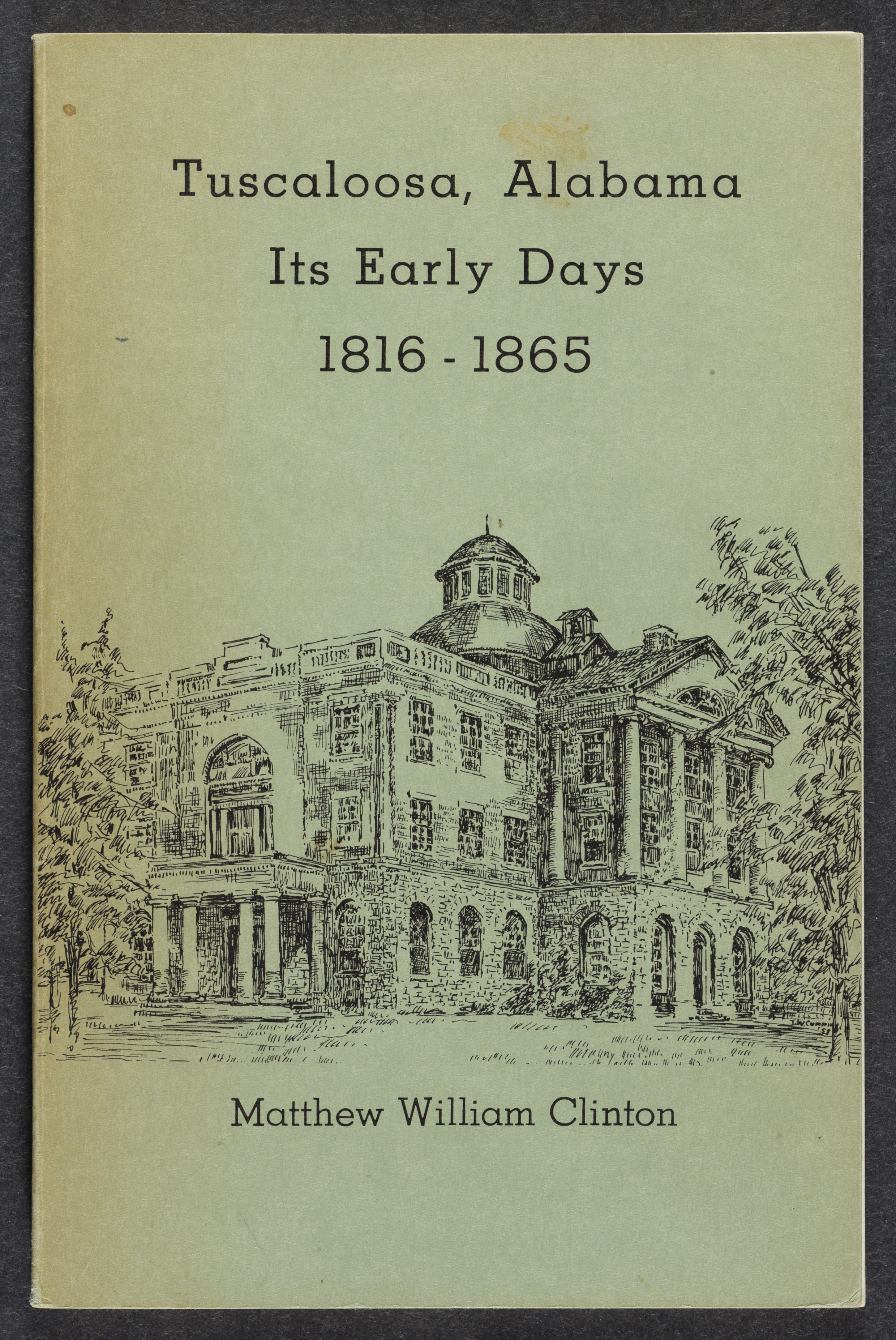
On December 13, 1819, the last day before the U.S. Congress admitted Alabama to the Union, the Alabama territorial legislature passed a bill incorporating the town of Tuscaloosa (Clinton, Tuscaloosa 26). The Falls of Tuscaloosa, as the village was known prior to incorporation, had witnessed settlement by European Americans since at least 1816, when Thomas York moved to the area from Blount County and planted corn. Others followed, and the area grew, resulting in the creation of Tuscaloosa County in 1818. Immediately after the incorporation of Tuscaloosa in 1819, however, its dominance in the county would be challenged by a rival town located just a few blocks to the west.

Tuscaloosa, Alabama: Its Early Days

Tuscaloosa, Alabama: Its Early Days 1816-1865

Newtown was originally known as The Lower Part of the Town of Tuscaloosa. Tuscaloosa sits on a plot of land then known as Section 22, and this new town lay directly to the west on Section 21. Incorporated almost exactly one year after Tuscaloosa, in December 1820, the town’s name was soon changed to The New Town of Tuscaloosa, and eventually simply “Newtown” (Clinton, Scrapbook 33). Newtown’s genesis involves a man, William Ely, who purchased the lands surrounding Tuscaloosa to raise funds for a Connecticut deaf asylum, thereby incidentally inhibiting Tuscaloosa’s growth and incensing the area’s citizens. Ely sold Section 21 to a dozen prudent investors, who founded Newtown and became some of its preeminent citizens.

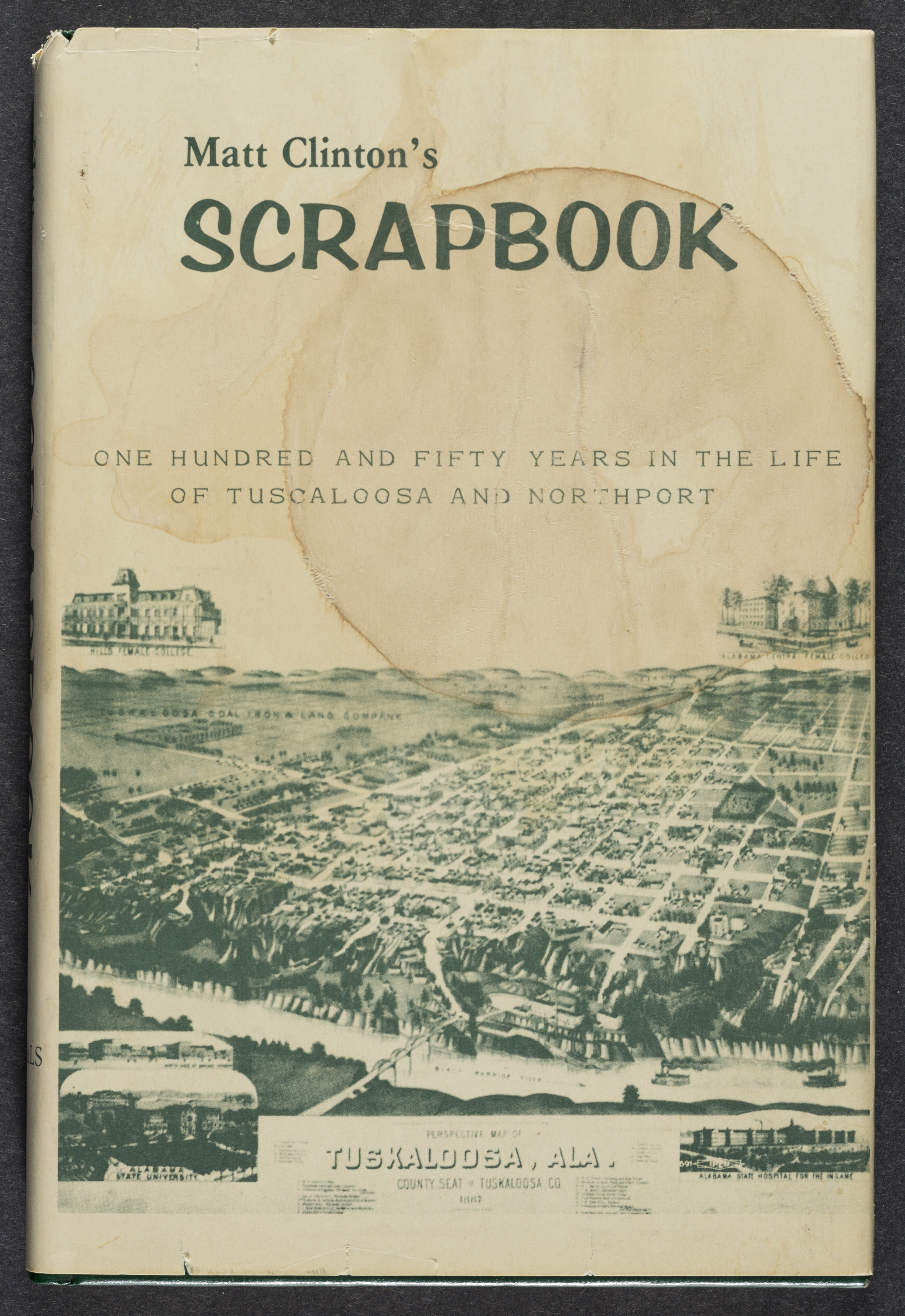
Matt Clinton’s Scrapbook (1980) is a collection of articles authored by the late Matthew William Clinton, detailing the history of Tuscaloosa. Clinton taught history and other social studies courses at Tuscaloosa High School for 43 years and was a prolific Alabama historian. His Scrapbook is a collection of his articles, which originally appeared in the Tuscaloosa News between 1967 and 1969, that was posthumously published by his wife, Bernice Blackshere Clinton. She wrote the book’s introduction.

Matt Clinton's Scrapbook

Matt Clinton’s Scrapbook

The Hoole Special Collections Library houses multiple copies of Matt Clinton’s Scrapbook, two in the Alabama Collection and another in the Reference Collection, which contains an inscription from Mrs. Clinton herself. This history of Newtown is derived primarily from the details in Clinton’s article, “Newtown: Rise and Fall,” located on pages 32 – 34. Other Scrapbook tales include the origins of the name “Tuscaloosa” and details of the 19th-century urban legend of a tunnel that allegedly connected the Robert Jemison mansion to the river (see “The Tunnel Story Persists,” p. 15).

Newtown was a true rival to Tuscaloosa. Clinton writes, “Newtown was surveyed before Tuscaloosa and consequently grew faster than ‘Old Town’” (Scrapbook 33). In 1822 the citizens voted to move the county seat from Tuscaloosa to Newtown, where a courthouse was constructed at the present-day southwestern corner of Martin Luther King, Jr., Blvd. and 6th Street. Newtown was a hub of economic activity in those days, with several businesses lining its Main Street (36th Ave.), including law offices, doctors’ offices, a hotel and a market house located in the center of the street. Nearer the river stood a cigar factory, a sawmill and a warehouse. Newtown even had its own ferry service to Northport. Both Newtown and Tuscaloosa submitted competing bids to build a bridge to Northport, and the state legislature authorized both on the same day in 1821 (Clinton, Tuscaloosa 44).

By the time a bridge was completed in 1835, however, the battle between the towns had been won. Tuscaloosa became the state capital in 1826, and an act of the state legislature greatly extended Tuscaloosa’s boundaries, thereby ending Newtown’s separate existence (Clinton, Tuscaloosa 54). Even today, however, the effects of Newtown’s history are visible. At Martin Luther King, Jr., Blvd., which formed the north-south border between the towns, the east-west streets make a notable jag, becoming more square on the Newtown side. A handful of beautiful historic Newtown homes still stand today, such as the Carson Home on 36th Ave. This abiding influence is in spite of a horrific tornado in 1842, which destroyed many of the original Newtown buildings, including the defunct courthouse (Clinton, Scrapbook 34).

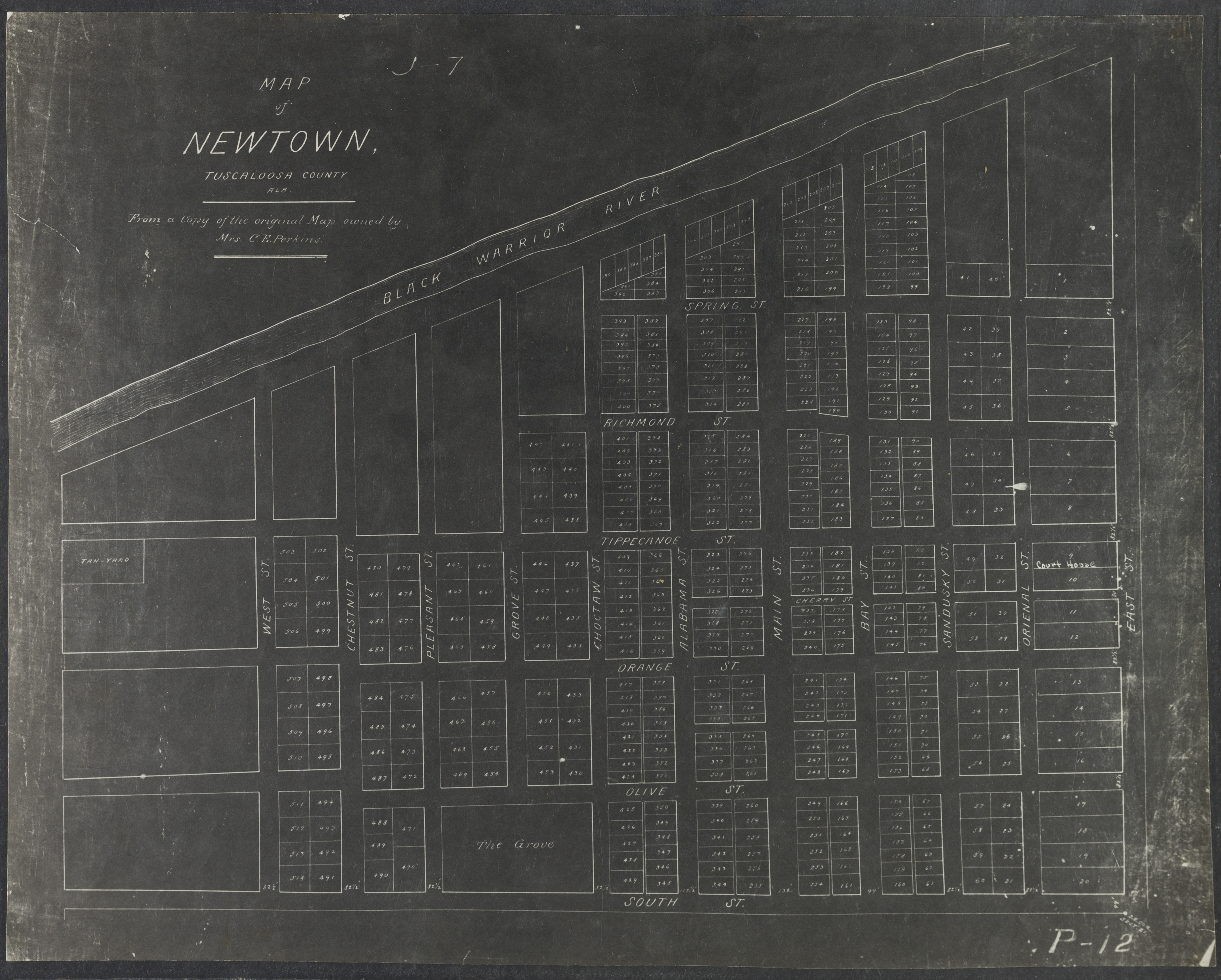
Newtown 1880 Map

Newtown 1880 Map

Regarding the endurance of the town’s name, Clinton writes, “The name of Newtown persisted until after the turn of the century, when that section of Tuscaloosa came to be known as West End” (Tuscaloosa 55). Today a sign along Martin Luther King, Jr. Blvd. demarks the area as the “Newtown Historic District.” However, while several neighborhoods in Tuscaloosa are recorded on the National Register of Historic Places, Newtown is not one of them. Although many locals still recognize the neighborhood as “Newtown,” its history is in danger of being forgotten. Matthew Clinton’s scholarship has played a significant role in preserving the town’s memory.

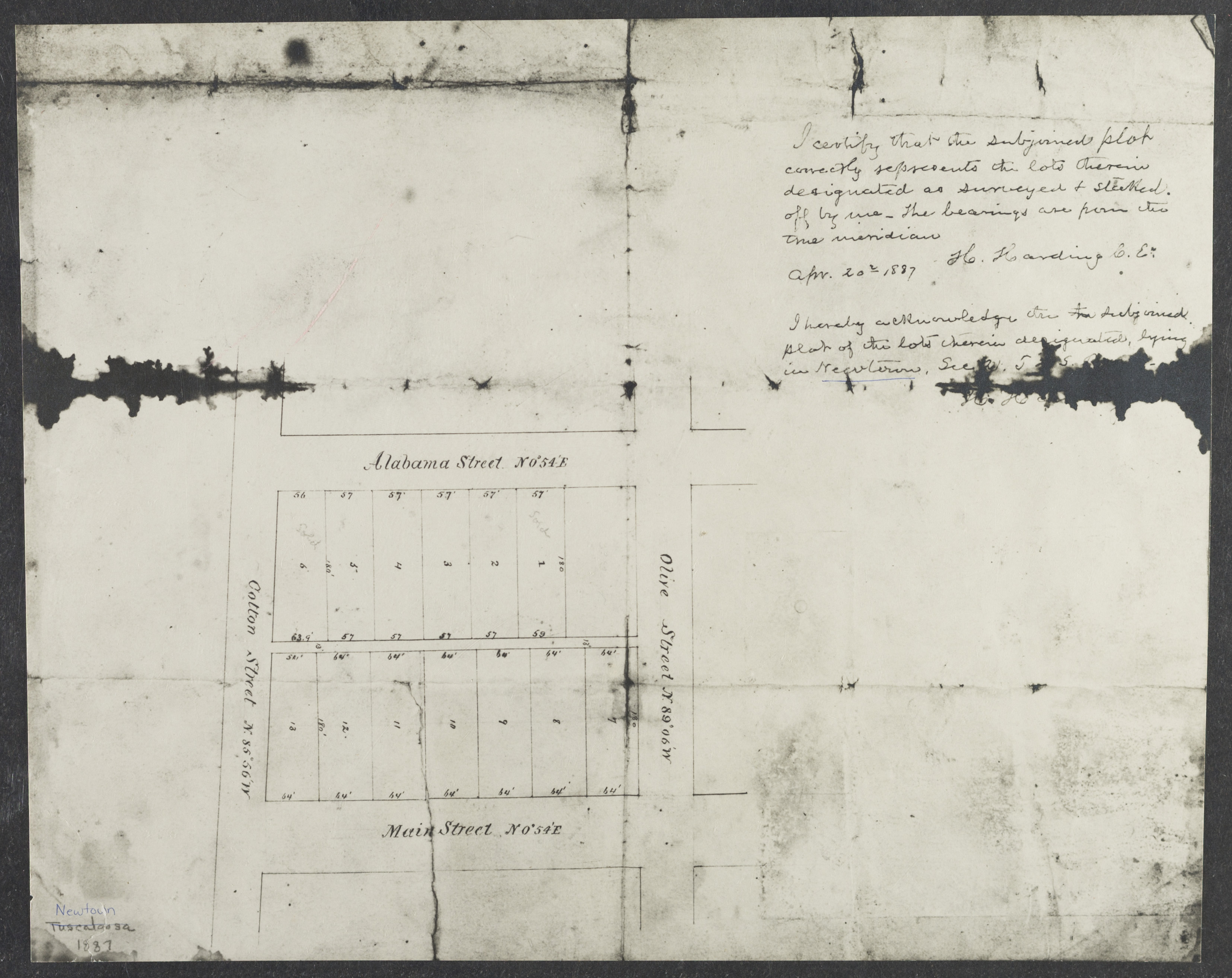
Newtown 1887 Map

Newtown 1887 Map

Hoole offers several other clues to the history of Tuscaloosa’s former rival. Copies of another of Clinton’s histories, Tuscaloosa, Alabama: Its Early Days, 1816-1865, can be found in Hoole’s Alabama, Agee and Reference Collections. Its chapter on Newtown has been cited extensively here. Additionally, two maps of Newtown survive in the Hoole Maps Collection, one from approximately 1880 and another from 1887. The c. 1880 map shows Newtown’s original street names and marks the location of the former courthouse.

Works Cited:

Clinton, Matthew William. Matt Clinton’s Scrapbook. Tuscaloosa: Portals Press, 1979.

———. Tuscaloosa, Alabama: Its Early Days, 1816-1865. Tuscaloosa: Zonta Club, 1958.

Unintentional Spooks

If you’ve ever spent much time looking at photos of “ghosts” on the Internet, you know our eyes are very good at seeing what we expect to see — a face in the window, a shadowy figure in the bushes — rather than what’s really there. There are also a lot of tricks photographers can pull to create the effect of something supernatural lurking in the frame.

Sometimes, though, such an effect is unintended. Early photography was especially susceptible to capture accidents and development instabilities, many of which caused creepy or just plain weird things to crop up in pictures. This week, we look at spooky images to examine just how they might have been created. Of course, since this is Halloween, you could just enjoy being spooked. 🙂

Just why is this girl’s face glowing?

girl with glowing face

(Probably an exposure problem.)

Does this person even have a face?

mine worker with glowing face

(Probably. He also has a lighting issue.)

What is this sinister shadow creeping up on this miner?

coal miner with double

(Probably the miner himself — or at least an echo of him. This image was taken from a negative created with a wet collodion process, a difficult, fussy process of bathing a glass plate in various solutions. It easily lent itself to such shadows.)

The woman on the right seems perfectly nice, but there’s something…off about her.

woman with blurred face

(When blurry objects or people show up in an otherwise in-focus image, it’s usually because they were in motion. We have this problem even with our modern digital cameras, but it would’ve been much worse in early film photography, when exposures were longer, from several seconds to several minutes!)

Are these mine workers ghosts? Or are they just people somehow out of phase with our reality?

blurred mine workers

What about the cadet on the far right?

blurred and glowing cadet

This boy doesn’t look completely corporeal either.

double exposure, boy standing in grass

(He is, though. This is a “double exposure,” where the same negative is exposed at different times to different images, so that they appear to be one complex image — in this case, a boy and some tree branches, probably taken at relatively the same location. In the example below, this kind of effect is even more obvious:

town and trees double exposure

Sometimes, of course, photography problems are more mundane. Whose fingers are those?!

picture of picture with photographer fingers

If I’ve learned anything from our digitized photograph collections, it’s that even if you don’t get your fingers in the shot, it can be very easy to accidentally capture your shadow.

This one is a bit sinister…

woman on porch swing with shadow

…while this one looks kind of…alien.

two women with shadow

(I bet that E.T.-shaped shadow was cast by a female photographer. After all, look at the hairdos of the women in the picture.)

This one isn’t just looming, it’s broken free and is on the loose!

roland harper shadow on railroad tracks

But nothing beats this for weird!

people in uniform receiving awards

(This apparent floating head isn’t actually an accident of photography. It’s what happened when someone placed pictures on facing pages in a scrapbook, and a portion of one image literally transferred to another.)

I hope these images weren’t too unnerving. Believe me, there are plenty of strange photos in Acumen that are less scary than silly, like the one of this woman clinging to…

woman with clark gable cutout

…a cardboard cutout of Clark Gable?

Have a safe and festive Halloween!