Cool@Hoole

Gee’s Bend at Hoole

By: Ellie Campbell, JD and University of Alabama MLIS graduate student

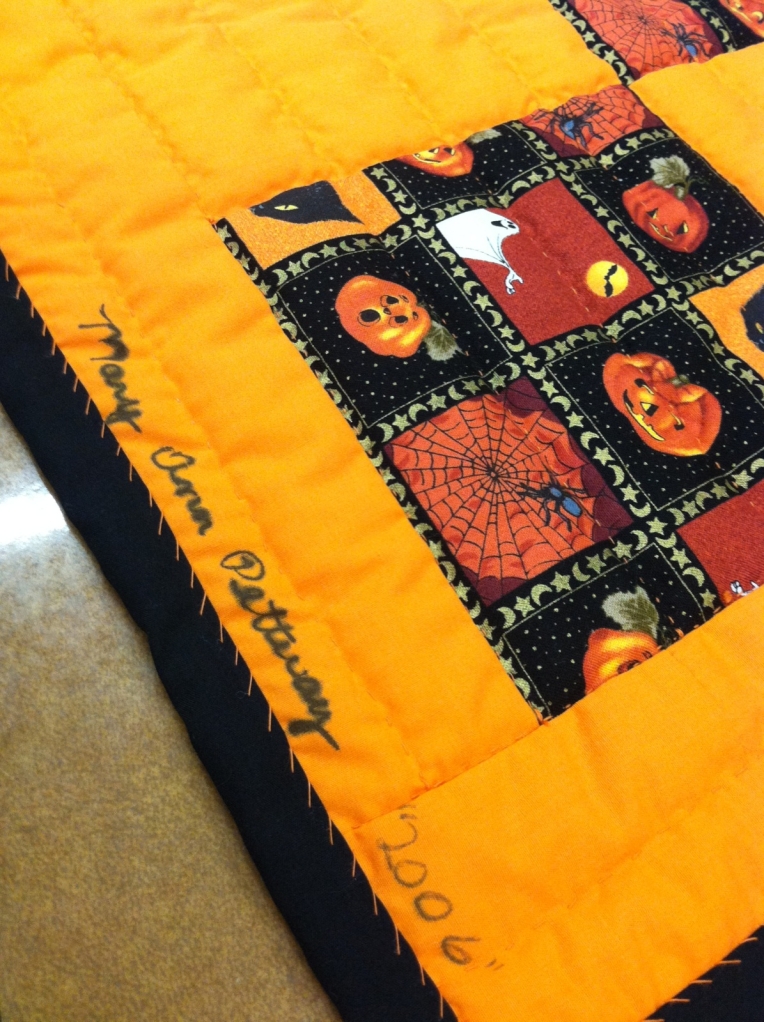
The Wade Hall and Gregg Swem American Quilts Collection contains quilts from the mid-nineteenth century up to the present day that demonstrate the breadth and depth of this American art form. The collection includes the quilt pictured here, a Halloween-themed quilt made by Mary Ann Pettway of Gee’s Bend, Alabama. [Editor’s Note: This quilt’s identifying number is NN-JEES | J5]
Gee's Bend Quilt

A Gee’s Bend Quilt at Hoole by Mary Ann Pettway, 2006

The quilters of Gee’s Bend have a unique place not only in Alabama history, but in modern American art as well. Dated November 2, 2006, our quilt shows how the Gee’s Bend legacy lives on in the 21st Century. Though it is not as abstract as some of the more famous examples, Mary Ann Pettway’s Halloween quilt still displays some of the asymmetric qualities that make Gee’s Bend quilts so unique in American textiles.

Gee’s Bend is located in Wilcox County in the Black Belt of Alabama. Enclosed on three sides by the Alabama River, the area was first settled around 1816, when Joseph Gee founded a plantation on the river. Several thousand acres passed from the Gee family to Mark Pettway of North Carolina in 1845. Pettway forced his slaves to march across four states to join the more than 100 slaves that already belonged to the Gee plantation. Many of the citizens of Gee’s Bend retain the Pettway name to this day, including Mary Ann Pettway, who made this quilt.

After the Civil War, many of the former slaves remained in the area and became tenant farmers. The local population suffered yet again when the value of cotton dropped nearly ninety percent in the 1920s, and then became a social experiment in the New Deal during the 1930s. Several of the Farm Security Administration photographers visited Gee’s Bend, including Arthur Rothstein and Marion Post Wolcott. Their photos helped bring government attention to Gee’s Bend. Several federal and state agencies bought property, built houses, and sold homesteads to the former tenant farmers. Owning property allowed several generations of Gee’s Bend residents to remain in the area, long after the local economy ceased to support small farmers. This continuity contributed to the residents developing their unique quilting styles.

The 1960s brought more changes to Gee’s Bend; Dr. Martin Luther King, Jr. visited in 1965 and inspired many residents to march with him from Selma to Montgomery in support of voting rights. In retribution, many of the residents were jailed, fired by their white employers, had bank loans unexpectedly called in, or had the few remaining tenant farms bulldozed. The river ferry service – the only way to get from Gee’s Bend to the county seat to vote, minus an unpaved dirt road – was abruptly cancelled, and would not be restored for thirty years.

That decade also brought the birth of the Freedom Quilting Bee, which formed to raise money for the families in the area. Sears hired the Bee to make standard bedcovers and pillow shams for department stores, which provided steady work for seamstresses and plenty of scraps. However, by the early 1980s, the Bee was mostly inoperative, and Gee’s Bend might have passed into history as a footnote except for the efforts of Atlanta art dealer William Arnett.

Arnett began his career collecting Asian and Mediterranean art, and shifted into African art in the 1970s. In the 1980s, he became interested in art by African-Americans in the Deep South, in particular that of Thornton Dial and Lonnie Holley.  Arnett was familiar with quilting traditions in other African-American communities in the South, and was stunned by the quilts he discovered in Gee’s Bend in the late 1990s. Arnett began buying quilts in the area. He was already in the process of editing a massive book, Souls Grown Deep: African American Vernacular Art of the South. Arnett helped put together an exhibit of Gee’s Bend quilts, which were shown in museums across the country in 2002-2005. The art world began to take notice after a glowing review in the New York Times called the quilts “eye-poppingly gorgeous” and compared them to Matisse and Klee. Gee’s Bend experienced a quilting renaissance. The cooperative was reformed, and many women in the area work there today.

The renaissance has not been without its controversies; several of the quilters have sued Arnett over profit disputes. Arnett has often been criticized for his interactions with the artists he promotes, most famously by a 1993 episode of “60 Minutes,” which depicted Arnett as exploitative, buying art from poor, uneducated Southern blacks and selling to other rich, white art collectors. The truth, as always, is considerably more complex; Arnett has profited from his tireless promotion of African-American vernacular art, but so have his artists. Without his support, the quilts and quilters of Gee’s Bend would not have experienced the respect and acclaim they do today. Many of the more recent quilts, including our Halloween quilt, might not have been made at all, were it not for this renewed interest in Gee’s Bend and its people. Their quilts hang on the walls of some of America’s most prestigious museums, and are included in collections like ours at Hoole, but many of the families of Gee’s Bend still live in the kind of poverty that characterizes rural, Black Belt Alabama.

Perhaps the best reading of the quilts of Gee’s Bend, and their inclusion in our archive, prompt us to think not only of how far we have come in valuing the history and artistic contribution of these women, but also of how far we have yet to go.

For further reading, see:

Dewan, Shaila. “Handmade Alabama Quilts Find Fame and Controversy.” The New York Times. 29 July 2007.

Kimmelman, Michael. “Jazzy Geometry, Cool Quilters.” The New York Times. 29 November 2002.

Moerringer, J.R. “Crossing Over.” L.A. Times. 22 August 1999.

Wallach, Amei. “Fabric of Their Lives.” Smithsonian Magazine. October 2006.

Jefferson Davis’s Namesake

In 1878, more than a decade after his faction’s defeat in the Civil War, former Confederate President Jefferson Davis wrote a letter to the child of a friend, Confederate General and eventual University of Alabama President Henry De Lamar Clayton. Since the young man, Jefferson Davis Clayton, bore his name, he apparently felt a responsibility to get to know him.

Davis’s letter to Clayton was eloquently written, and it offers wisdom and advice that is clearly borne of his own life’s circumstances. You can click on the images below to read the original — his handwriting is fairly readable — but the letter has also been transcribed for your convenience.

Beauvoir Harrison Co. Missi

15th Aug. 1878

Dear young friend,

The high compliment your gallant father bestowed on me, in giving to you my name, not only imposed an obligation on me to him, but creates in me a deep interest in you. Therefore I write to you, and address you as my friend.

The stormy time in which you were born, if not most favorable to your comfort, was, it has been thought by many, most conducive to noble characteristics in the children of that period. Without [assenting?] to, or [dissenting?] from the physiological problem, I can hope all which is possible for the son of parents as true, and heroic as yours; and so expect my name to receive lustre from your deeds.

Circumstances even more than merit, decide whether one shall be famous or not: but it is in the powers of most men to leave behind them a [pg. 2] good name, on which shall have the unfading lustre of a virtuous and charitable life. The true gentleman never sacrificed his self respect to gain temporary success, on what a poor ambition considers glory; therefore he can never be humiliated by disaster or defeat. The condition of our country enables you to find instructive examples illustrative of the above remark.

But I only intended to express my affectionate regard for you and must apologize for wandering into general reflections.

Please present my respectful regard to your parents and believe me ever

Cordially yours

Jefferson Davis

Mr. Jefferson Davis Clayton
Barbour Co. Ala.

*

Davis also wrote to another Civil War General and future UA President, Josiah Gorgas, whose papers are housed at the W. S. Hoole Special Collections Library. To find those letters, go to the online finding aid and find the series Josiah Gorgas. Click Components in Detail, where you’ll find Incoming Correspondence, and, within that, a folder for letters from Davis.

Gorgas papers screenshot

Interview with Amy Pirkle, Book Artist and author of Smoke (2008)

Interview with: Amy Pirkle, Book Artist & University of Alabama Instructor in the Honors College, New College, and the Department of Art

AmyPirkle

Amy Pirkle, Book Artist and UA Instructor

How would you describe book arts to a layperson?

For me, book arts is a broad field that includes artist’s books, fine press books, fine bindings, and more. In all cases, though, I feel that an artist has made most of the design decisions and had a hand in the production of the book, from creating any artwork in the book, to printing the material using a variety of printmaking techniques, to binding the book by hand, and sometimes even making the paper as well. The book can either be a one-of-a-kind piece or part of a limited edition. The final product is a piece of art that is in book form. Of course, the definition of a book is pretty broad and can include all types of structures, from scrolls to accordions to sculptures and other unique bindings.

How did you first get involved in book arts?

When I was a junior in college (2001), I studied abroad with the University of Georgia program in Cortona, Italy. While I was there, I took an elective class in book arts taught by Eileen Wallace. I had never even heard of the field before; I was in Italy to study painting! But I read the course description and knew that it was a class I had to take. I realized when I was spending more time in the book studio making books than in my painting studio, that this was the thing I wanted to do for the rest of my life. When I got back to America, I finished up my undergraduate degree in art and began researching graduate programs. I found the University of Alabama’s M.F.A. in Book Arts program, and matriculated in 2004.

What’s your favorite book you’ve made – or do you have a favorite?

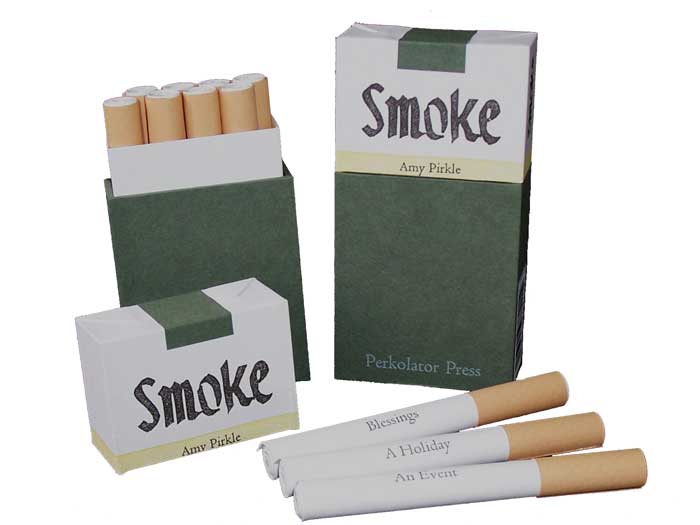
To be honest, each of my books is my favorite as I’m working on it. Right now, I’m really excited to be working on my current book, Eight Bedrooms, about the eight bedrooms my twin sister and I shared while growing up. But when I look back on the work I’ve made, I think I’m most proud of Smoke, Fragments, and A Real Fighting Man. [Editor’s note: view these items online at Perkolator Press.]

smokelarge

Image taken from Perkolator Press: http://www.perkolatorpress.com/

Can you tell us a bit about Smoke?

Sure! The book is about my maternal grandfather, who died from lung cancer in 1992 when I was 12 years old. It was a tough time for me, because he was the first person I had ever loved that passed. I wrote the text for this book in 2006 as a short story. The short story is broken into several shorter passages, each with its own title such as A Place, An Event, or An Early Memory, that represent different memories of my grandfather.

I spent two years playing with various book structures for the text, but nothing seemed to work. I’m a big believer in structure and content working hand in hand. One day, I realized that Smoke was not meant to be bound as a traditional book. Its true form was as a pack of Salem cigarettes, the preferred brand by my grandfather. Each of the shorter passages from the story was printed as a cigarette scroll. All cigarettes, including a colophon cigarette, were then cased together in a hand-crafted cigarette pack made of binder’s board with letterpress printed graphics.

How do you feel about having your books not just at Hoole, but also in libraries and special collections throughout the country?

I’m excited to be able to share my work with people at Hoole and across the country in other collections. One of the most humbling things I have stumbled on was about a year ago, when I found a YouTube video of a college student at Duke talking about Smoke for her book arts class. I think it’s great that other book arts instructors are taking their students into special collections libraries and showing them artist’s books. It generates excitement for a new generation of book artists.

What are some fellow book artists you’d recommend for readers who are new to the field of book arts? 

One of my favorite book artists is Julie Chen. I think she is absolutely amazing, and she continues to push the boundaries of book arts with every new piece she publishes. Hoole has 2 of her books, including one of my favorites, a tunnel book called Octopus, which you can’t find on her website, but is in my opinion, the best tunnel book out there. [Editor’s note: You can see Octopus featured on Julie Chen’s Flying Fish Press page at Vamp & Tramp Booksellers.] Hoole also has You Are Here, a book she produced in 1992 that uses map imagery and map folds to create a truly unique reading experience.

Another book artist I would recommend is Karen Hanmer, who is a master at flag books. Hedi Kyle invented this structure in 1979, and some consider her one of the most influential artists on contemporary book arts (which she is!). But back to Hanmer, she has really explored this structure and created some truly fantastic pieces that show us what potential the flag book really has.

A newer book artist that I’m keeping my eye on is Michelle Ray. She’s incredible, and Hoole definitely has at least one of her books. Other book artists that I would recommend that graduated from The University of Alabama book arts program and would likely have work at Hoole are Inge Bruggeman, Sarah Bryant, and Ellen Knudson. I know all of these ladies personally, and they’re fantastic. [Editor’s note: Hoole has 2 books each by Inge Bruggeman and Ellen Knudson, but does not currently hold any works by Sarah Bryant.]

Smoke, by Amy Pirkle, is currently unavailable as it was loaned to the Hunter Museum of Art in Chattanooga, Tennessee for a spring 2014 exhibition on the book arts.

Pirkle’s work will be accompanied by books by Jenna Adams, Lynn Avadenka, Julie Chen, Nicole Eiland, Susan King, Ellen Knudson, Emily Martin, Coriander Reisbord , and the Combat Paper Project.

We are excited to see our collections travel! Once the exhibition is up at the Hunter, Cool@Hoole will be on the road to visit Smoke at its temporary home. 


Newly Online: Birmingham Barons Baseball Records

Part of the extensive Woodward Family Papers is a collection of documents pertaining to the Birmingham Barons minor league baseball team, owned by A. H. “Rick” Woodward. The team’s park, Rickwood Field, was named after him.

u0001_2007010_0000629

Many of these records, from the 1910s to the 1930s, have been recently digitized and are available online. Below, you’ll find a sample, which include everything from regular attendance figures to financial summaries to league rules and regulations.  Many of them are from the late 1920s through the 1930s, and they reflect the boom and bust nature of the business during the Great Depression.

To find more of these documents, you can browse item titles in the Woodward Family Papers finding aid. Just open up the series for A. H. Woodward and look for Business and Legal Papers. The baseball records are under Birmingham Baseball Association.

The Many Faces of Big Al

By: April Burnett, W.S. Hoole Library Archival Technician

At the University of Alabama, Big Al may very well be the most recognizable face on campus.  However, that famous face of his has changed over the years.  How many of you know that Big Al did not start out as “Big Al” at all, but a large, live elephant named Alamite?

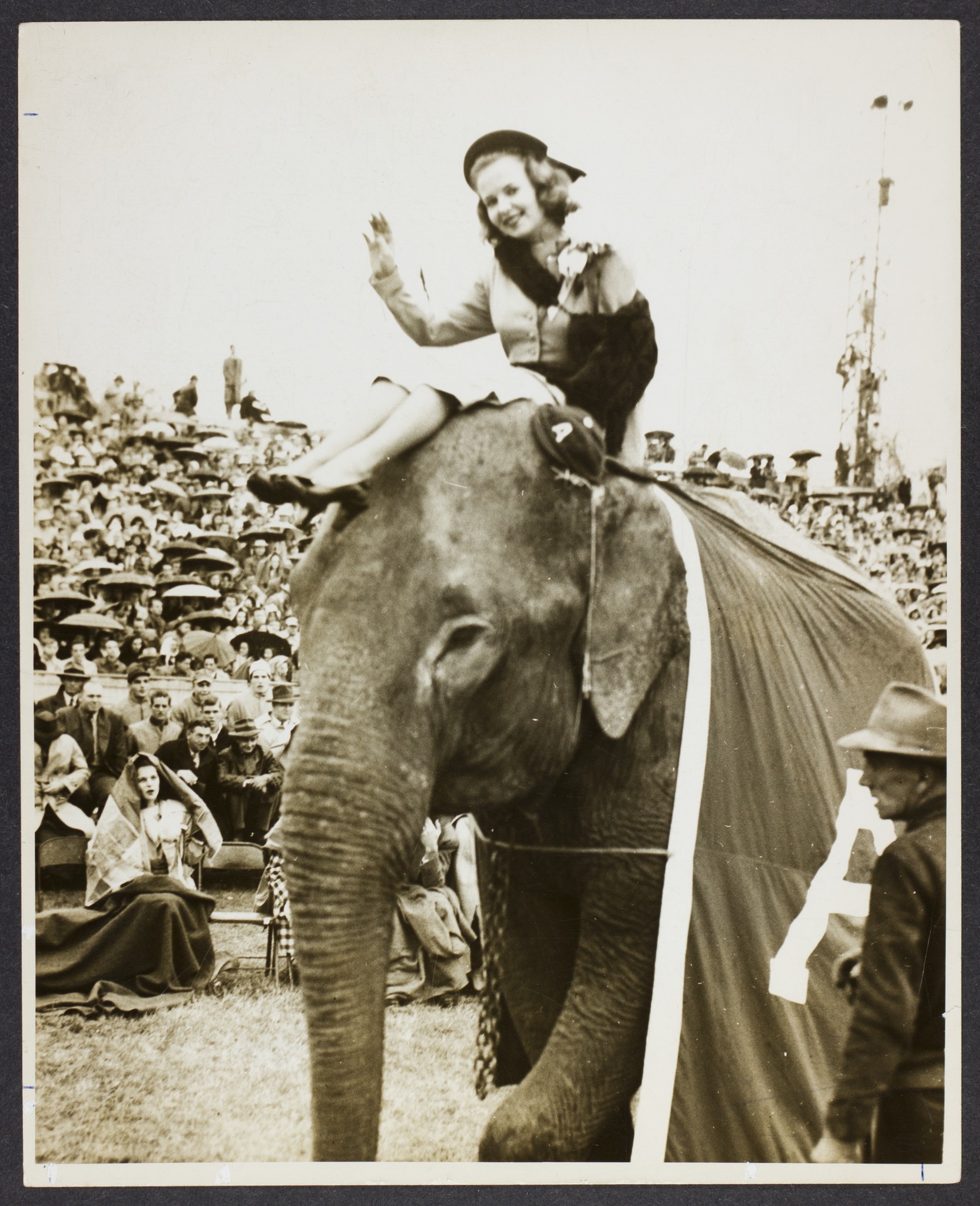
Sue Donegan, 1947 University of Alabama Homecoming Queen, riding Alamite the elephant

Sue Donegan, 1947 University of Alabama Homecoming Queen, riding Alamite the elephant

The above photograph from the University of Alabama photograph collection is of Homecoming Queen Sue Donegan, riding Alamite on the sideline of the homecoming game against Louisiana State University at Denny Stadium in November 1947.  The University of Alabama defeated the eighth ranked LSU Tigers 41 to 12 with 25,000 in attendance.

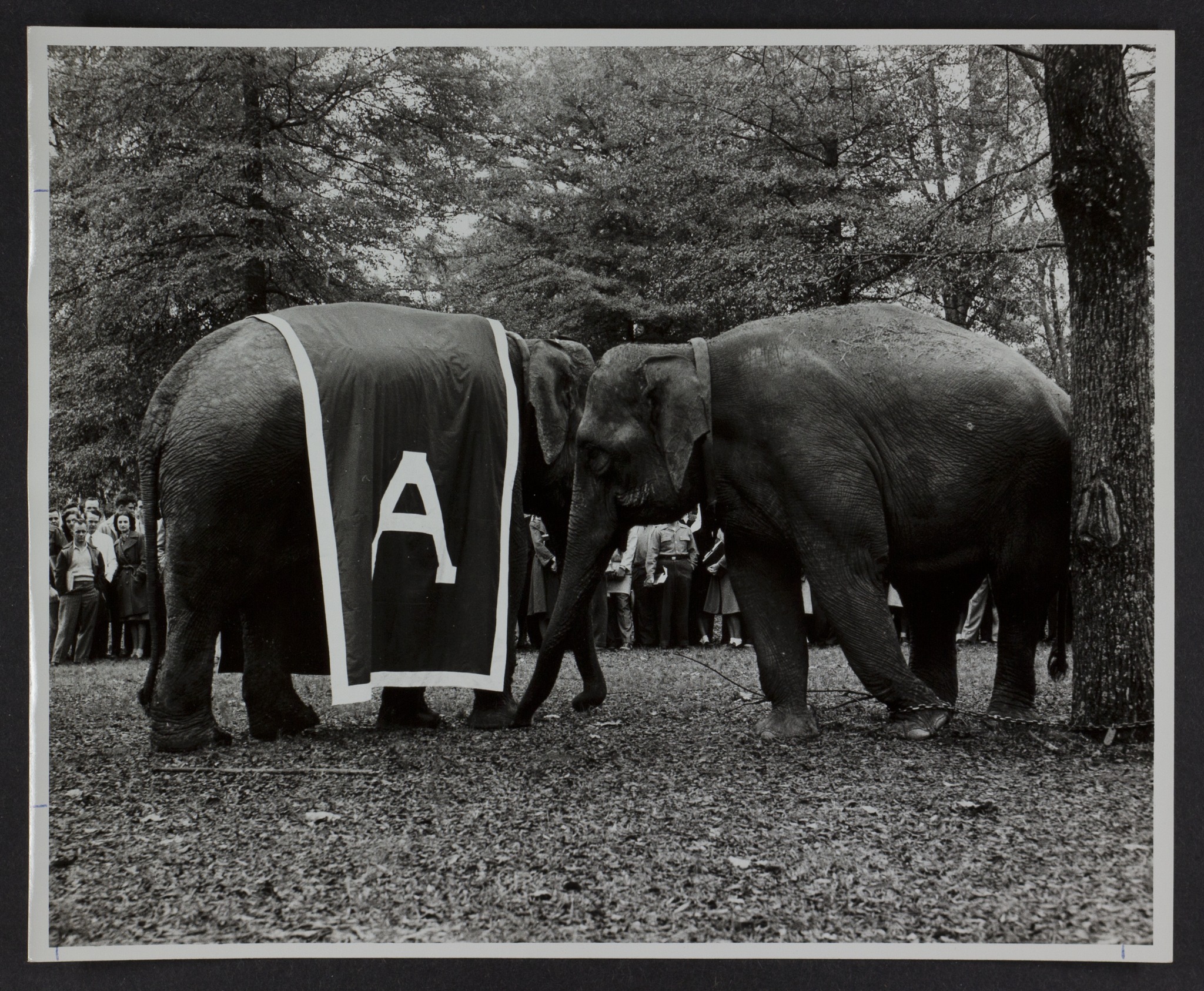
Alamite did not stay around long.  The cost of housing the elephant became too costly for the University.  Occasionally, elephants from zoos or circuses were used during homecoming festivities and other events on campus.

Elephants, one wearing an Alabama drape, on the Quad for Homecoming

Elephants, one wearing an Alabama drape, on the Quad for Homecoming

The elephant was not declared the official mascot of The University of Alabama until 1979, even though the University’s association with an elephant symbol began around 1930 and was seen on tickets, merchandise, and advertisements throughout those years.

A student, Melford Espey Jr., was the first to appear in an elephant costume on the sidelines of a football game in the 1960s.  The Big Al costume made its first official debut at the 1979 Sugar Bowl, where Alabama came out on top of the defensive struggle against Penn State, 14 to 7.

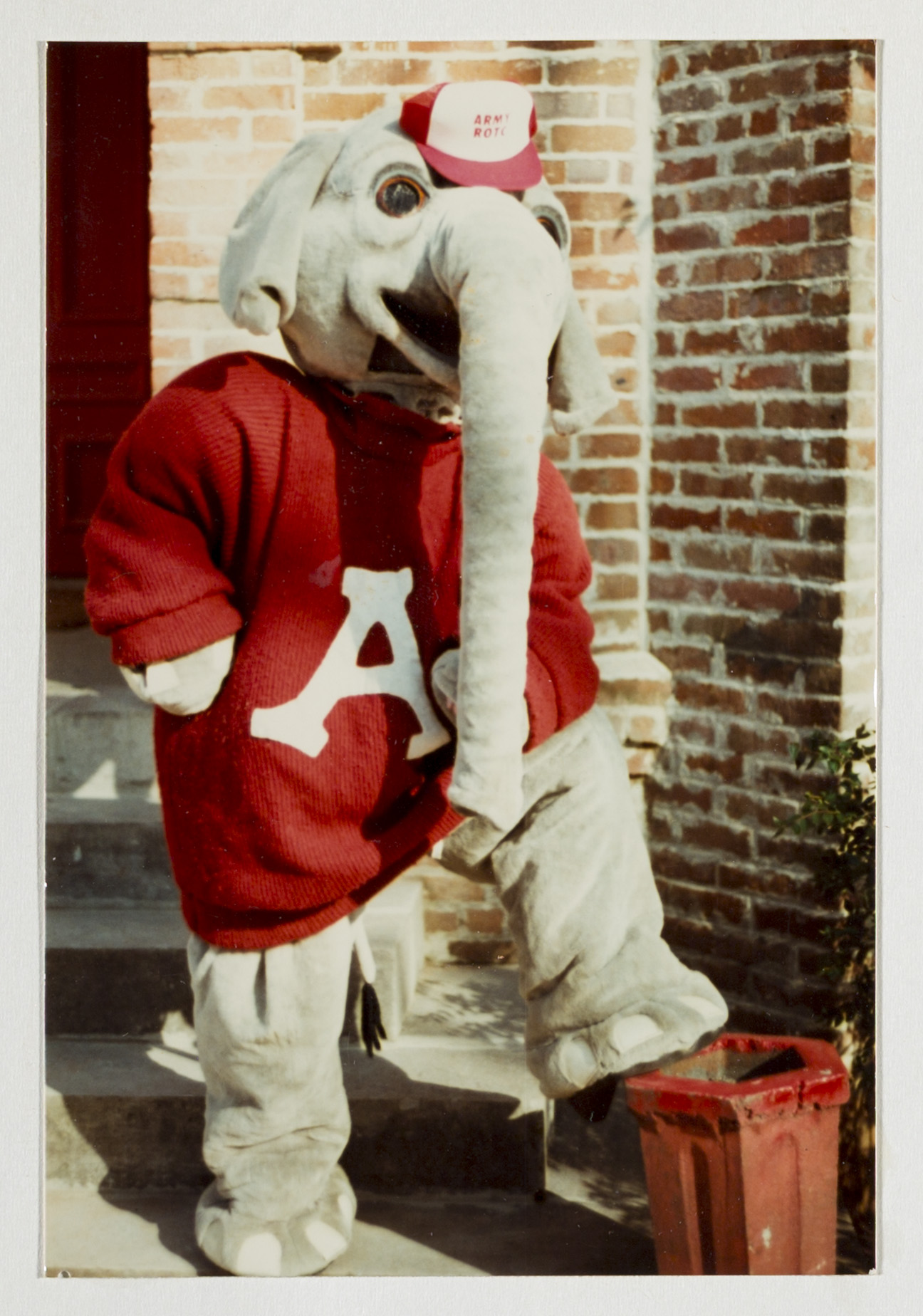
The photograph below, which comes from an Army ROTC scrapbook from 1980-1, shows Big Al in his original mascot costume and wearing an Army ROTC baseball cap:

0027

Big Al in Army ROTC hat. This item recently was digitized as part of an effort to digitize a series of University of Alabama ROTC scrapbooks.

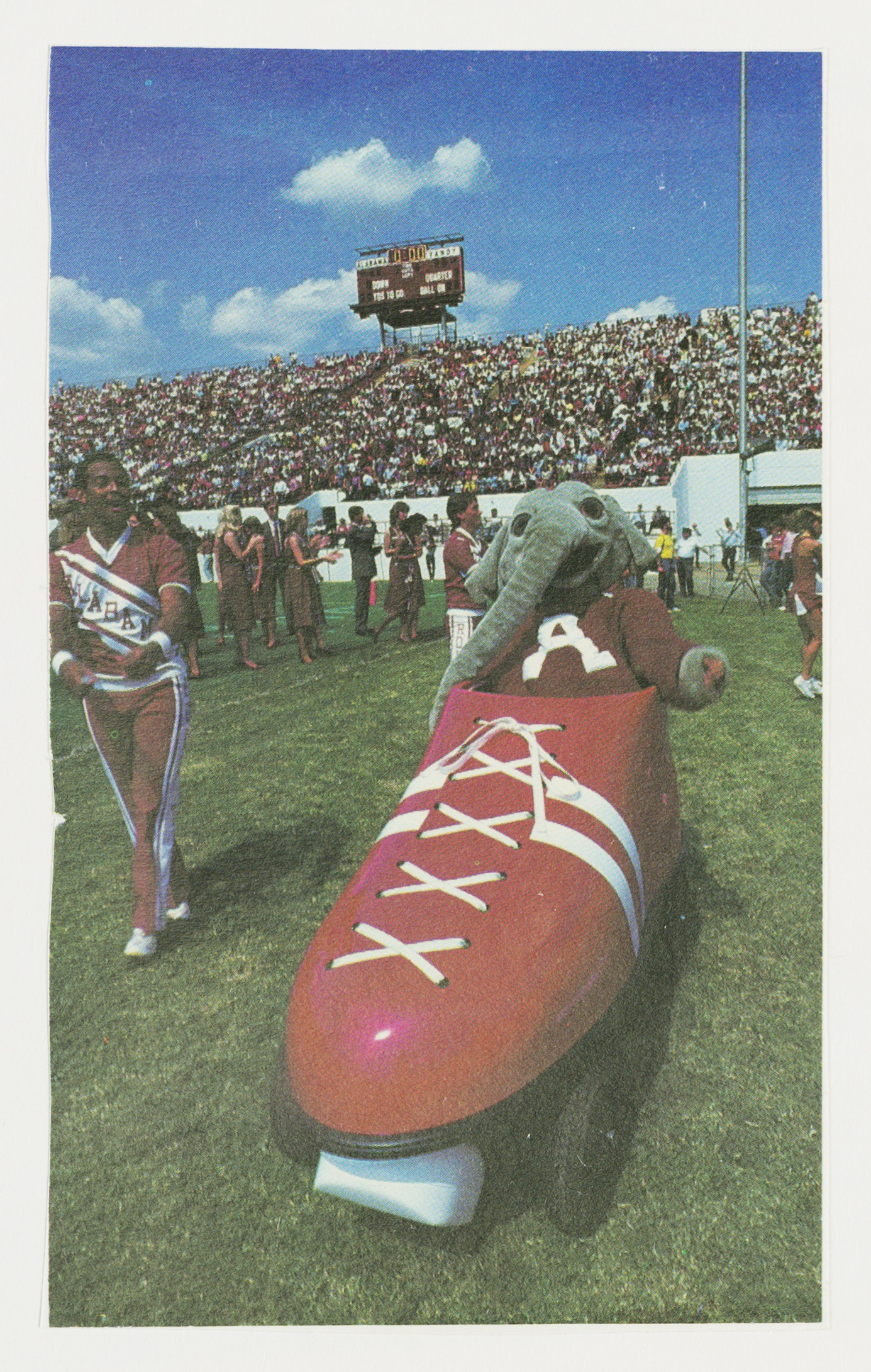
Even today, the big, friendly-faced elephant is most likely seen on the sidelines during the University of Alabama football games.  In the photograph below, Big Al is sitting in a large, football cleat “car” cheering on the Tide with the cheerleaders during a game.

0055

Big Al in Cleat Car during the 1983-1984 football season, from an Army ROTC scrapbook

Big Al is not only a fan of athletics, but also an avid supporter of other groups on campus, as seen below with him standing in formation on the Quad with students in the Army ROTC.

0013

Big Al with ROTC, from a 1980-1 Army ROTC scrapbook

The face of Big Al, as we know today, is still quite similar to the one seen in the 1990s and into the 2000s.  The University of Alabama may not have a snarling tiger, a growling dog, or a ferocious alligator, but we wouldn’t have him any other way.  The vivacious and congenial pachyderm is loved by all old and young alike. Here he is in an image taken from the Encyclopedia of Alabama.

ContemporaryBigAl

Big Al featured in the Encyclopedia of Alabama

The original Big AL costume can be seen on display today at the Bryant Museum.

For more history on how Big Al came to be, RollTide.com also discusses “The Elephant Story.” Big Al also released a video of his life and times from the 2011-2012 academic year.


Confederate Entertainment: “The Southern Soldier Boy”

By: Clay A. McCollum, Master’s student in the School of Music

SouthernSoldierBoy-Large

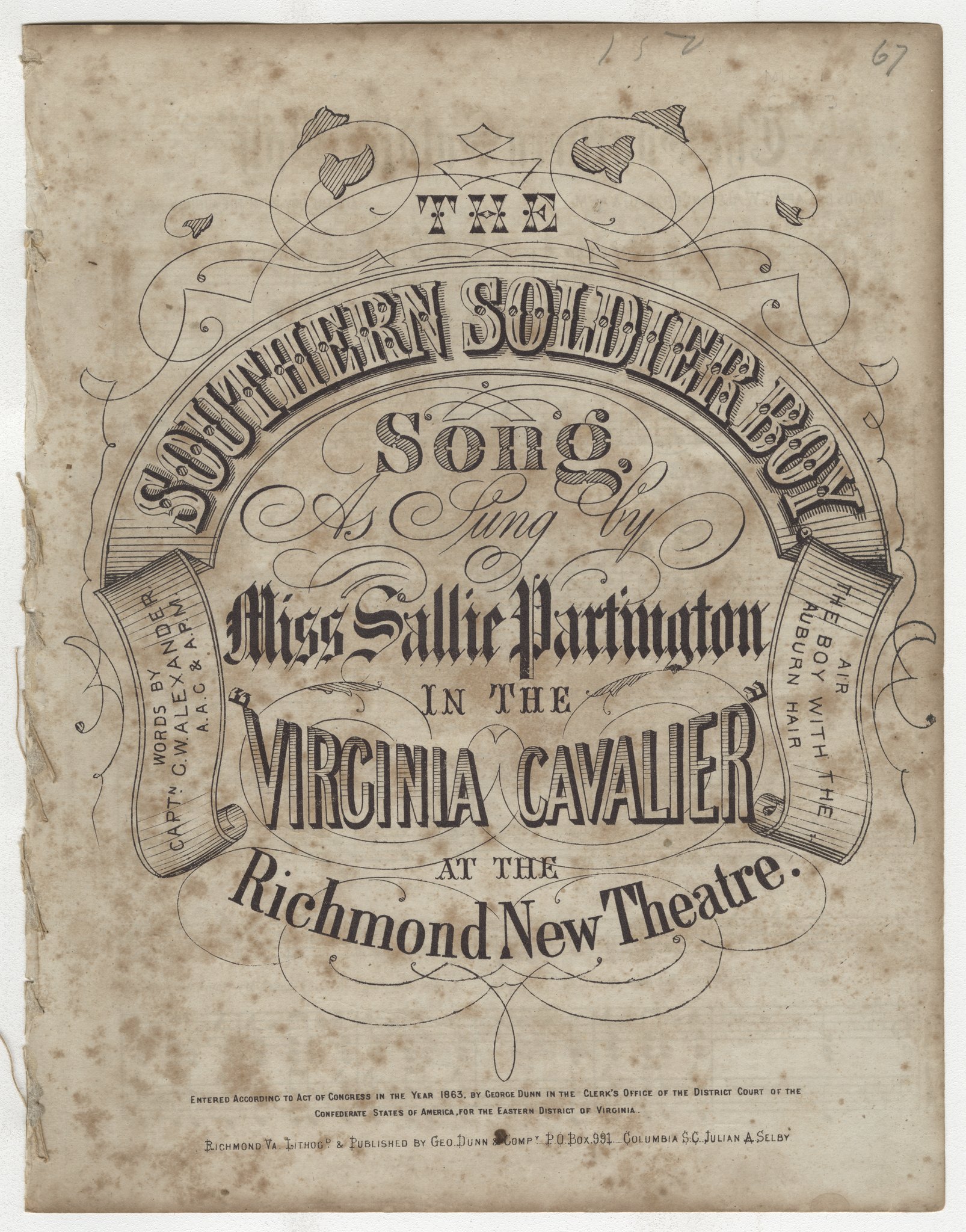
“The Southern Soldier Boy” is available on Acumen, The University of Alabama’s digital repository.

George Washington Alexander’s “The Southern Soldier Boy,” an aria from his 1863 The Virginia Cavalier, stands out among the wealth of Confederate imprint sheet music housed in the W.S. Hoole Special Collections Library at The University of Alabama due to its widespread popularity with Confederate soldiers.

Alexander, who is most known as the commandant of a Confederate POW camp (Castle Thunder) outside of Richmond, Virginia, set “The Southern Soldier Boy” to the preexisting tune or air known as Gilderoy.

Sallie Partington, who created the aria when Cavalier opened at The Richmond New Theatre, is advertised with great pomp on the composition’s cover page. Jeanne Robert Foster, who edited “Songs of the War Days,” the Appendix to the ninth volume of The Photographic History of The Civil War in Ten Volumes, says that “the sentiments of this song [“The Southern Soldier Boy”] pleased the Confederate Soldiers, and for more than a year, the New Richmond Theatre was nightly filled by ‘Blockade Rebels,’ who greeted with wild hurrahs, ‘Miss Sallie’ [(Partington)] the prima donna of the Confederacy.”

Frances H. Casstevens’s George W. Alexander and Castle Thunder: A Confederate Prison and Its Commandant (2004) may be the very best window into understanding Alexander. She says in introducing him, “While some people viewed Alexander as being a harsh and cruel man, he was also ‘sensitive,’ and had a talent for musical composition.” Alan Lawrence Golden corroborates this characterization in his master’s thesis: “There was another side to Alexander’s personality that was far removed from the accusations of his cruel and injudicious treatment of his prisoners. Possessing what some called a sensitive, artistic talent for musical composition, he wrote a ballad entitled ‘Southern Soldier Boy[,]’ which became an important part of the Richmond musical review ‘The Virginia Cavalier’ [sic]” (32).

Disappointingly, given the hype, “The Boy with the Auburn Hair,” or Gilderoy, offers very little interest harmonically. In general and really without much exception, a melody is sung over the root-position i chord in the key of F minor; there are also two brief forays into the relative major key.

The Virginia Cavalier played to Richmond audiences from 16 March 1863 through 22 June 1864. This musical play is a noteworthy contribution to the great outpouring of poetry, songs, and drama about the South, its soldiers, and their loved ones that culminated in and around Richmond during the War.

Newly Online: James A. Goble Civil War diary

Sometimes our records of historical events come to us from ordinary and relatively unknown sources. All we know about James A. Goble is that he was a soldier in the First Alabama Infantry, and that while he was born in New York, he later lived in Auburn, Alabama, and fought for the Confederacy…before moving back to Massachusetts?

Obviously, Goble had an interesting perspective on the war. At the very least, he defies some of our expectations of Confederate soldiers as well as of Northerners. His “diary,” which seems to have been a narrative composed well after the events it describes, contains an especially detailed account of the Siege of Port Hudson.

Like its well-known up-river neighbor, Vicksburg, Mississippi, this Louisiana port town was targeted in a major Union offensive in 1863. The Vicksburg Campaign is considered a turning point of the war. That’s not surprising, judging from the excerpts given below:

The Heat of Battle (May 24):

u0003_0000574_0000001_0073

Rifles cracking like lightning cannon shot wizing in all directions the air is thick with iron hail. how the enemy give back their guns no longer speak but are silent the Rebels rush on like madened woolves charge with point of baynet thousands of musket shot are fired the action is hot for 15 minutes then the Rebels rush on with a yell and wip them back.


Burying the Dead (May 27):

u0003_0000574_0000001_0076

at 6 Oclock in the evening Feds sent in a flag of truce asking permission to burey their dead & both armies meet & they cheared each other with loud cheers in the meantime twas silant at every point as if by mutual consent shells and [miney?] balls fall thick and fast all around and on our House where two ladies are in for reffuge but as a kind Providence takes care of the innoent so it may be in this case now they have gon to work again with their missels of death on the extreem left where the fight was hottest


North and South, Black and White (May 29):

u0003_0000574_0000001_0081

Many negroes lie dead on the field of battle unburied that old Abe sent South to subdue the rebellious children that are fighting for there rights O wat a stain on the North that can never be rubed out black men against white


Life in a Warzone (June 3):

u0003_0000574_0000001_0093

A shell from Fed gun passed under the floor of a house in town & tour up the floor & 8 persons was in the room & while they was replacing it an other shell came & riped it all to peases & scattered trunk & contents all over the room belonging to one of the ladies but without ingering any one in the room.


“The Cruel Hand of War” (June 5):

u0003_0000574_0000001_0097

this morning smiles fourth with its balmy breezes & nature looks on with a sweet smile the birds warble out their songs of praise to that being who alone can give life & peace to mankind. but alas how awful to contemplate the devastation of man. the cruel hand of war sweeps over us like a raging storm & the once happy land that god gave to man is turned into a howling wilderness.

Hidden artistry: fore-edge painting

By: Allyson Holliday, W.S. Hoole Library Complex Copy-Cataloger

“Old” books hold a special place in my heart as the complex copy-cataloger for the Hoole Library. I have a deep appreciation for decorative publishers’ bindings that show the artistry that has been lost with modern day mass trade publication. In January 2008, while strolling the historic streets of St. Augustine, Florida, I came across this treasure at Wolf’s Head Books, Inc.

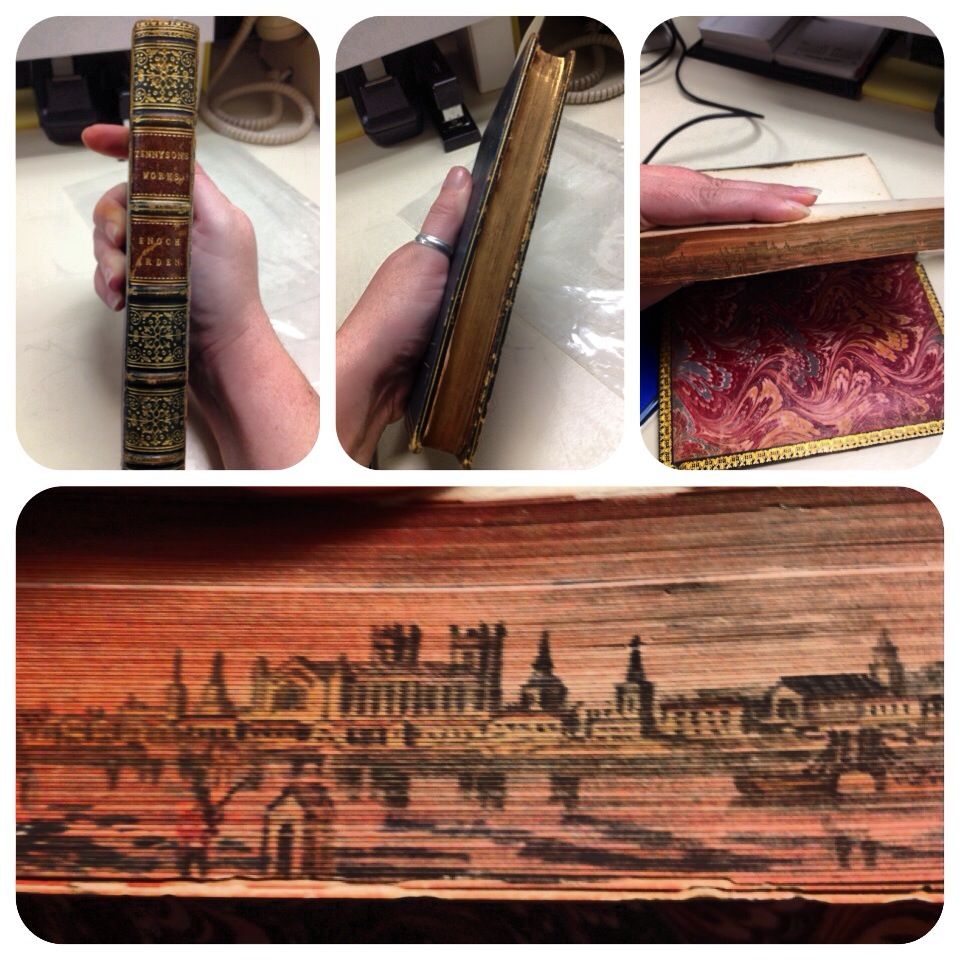
This edition of Enoch Arden (1865) by Alfred Tennyson is an example of a fore-edge painting book.

This edition of Enoch Arden (1865) by Alfred Tennyson is an example of a fore-edge painting book.

At first glance, this copy of Enoch Arden by Alfred Tennyson, published in London by Edward Moxon & Co. in 1865, appears to be a typical 19th century leather binding with gilt accents and marbled endpapers. However, on closer examination, a hidden treasure is revealed. The edges of the book’s pages have been painted in gilt. The margins of each page have also been painted in such a way that when the book is fanned slightly, a picture of a scene emerges. A fore-edge painting! The Enoch Arden fore-edge painting is by an unknown artist. It is a depiction of a Canadian landscape – a view of Montreal from St. Helen’s Island.

The fore-edge of a book is the fourth edge – not the spine, the top, or the bottom edge, but the outside edge that a reader uses to turn the pages.  In the 17th century, one of the Queen’s Binders (a group of highly skilled English bookbinders during the Restoration period) discovered that if one painted on the slight inner edges of the pages, then gilded or marbled the outside page edges, the scene would be undetectable when the book was closed, and only reveal itself when the pages were fanned slightly, creating a disappearing, re-appearing masterpiece.

I had never seen a book with a fore-edge painting! I returned to Tuscaloosa excited about my find and shared the details with our curator at that time, Clark Center. He was able to acquire this text for our Book Arts Collection which includes fine press, small press, and other examples of artists’ books. This collection supports the MFA program in the Book Arts in the School of Library and Information Studies at The University of Alabama.

The fore-edge technique was especially popular in England from the late 18th to the late 19th centuries, making Tennyson’s works good candidates for this type of art. Here is another fore-edge painting on a different edition of Enoch Arden from the Special Collections of the San Diego Public Library.

Many of the books sold today with fore-edge paintings are antiquarian volumes to which the edge paintings have been added much later. One of the most widely seen modern-day fore-edge painting artists is Martin Frost, based in the UK, who has produced countless fore-edge paintings, including many offered for sale on AbeBooks, since 1970.

Social media has recently placed an international spotlight on books with fore-edge paintings.  The University of Iowa’s collection of fore-edge painting books appeared recently in the Daily Mail and received widespread attention on Twitter.

Artists like Martin Frost and the libraries across the world who hold books with fore-edge paintings are keeping the concept of the “book as art” alive. With the proliferation of paperback bindings and e-readers, reading has become more of an easy access, throw-away type of leisure activity. Books intricately decorated and adorned are historic relics of a by-gone era where the object was celebrated as much as the text inside.


Homecoming 2013

Homecoming 2013 is here! The theme for this year is “Leaving a Crimson Legacy,” so let’s look back at some homecoming parades that left a legacy of elaborate decorations, beauty queens, and timely putdowns for our SEC rivals.

The images below (except where noted) are from the Educational Media Collection, highlighting events from the 1960s.

homecoming parade
(1963 Homecoming Queen — can anybody name her?)

homecoming parade
(Probably 1963, when we beat Mississippi State 20-19)

homecoming parade
(1964, Drum Major Bill Fuqua and Miss Alabama Carol Self leading the Million Dollar Band. [from University of Alabama Photographs])

homecoming parade
(Maybe 1964 — if so, David Ray did keep his foot in line, making a crucial field goal in the 4th quarter)

homecoming parade
(1964, the float for the School of Law. I wonder what they’re drinking? [from University of Alabama Photographs])

homecoming parade
(1965 Homecoming Queen, Leigh Stanford)

homecoming parade
(Probably 1965, when we beat Florida State 21-0)

homecoming parade
(Probably 1966, when we beat the Gamecocks 24-0)

Don’t forget to line up along University Boulevard bright and early Saturday morning (7 a.m.!) to see what our campus organizations have to offer this year.

Cool at Hoole Re-Launch

Launching a new era here at Cool at Hoole

We’re launching a new era here at Cool at Hoole

Welcome to the re-launch of Cool at Hoole, the blog of the W.S. Hoole Library at The University of Alabama. Each Monday, we will post a new blog entry to keep you up-to-date on the events, adventures, and happenings here at Hoole.

You can visit us on the 2nd level of Mary Harmon Bryant Hall on 500 Hackberry Lane. We are also on social media. Follow us on Twitter, Facebook, and Tumblr.

The editor of Cool at Hoole is Dr. Amy Hildreth Chen, who is a Council on Library and Information Resources (CLIR) Postdoctoral Fellow. Dr. Chen coordinates outreach and research services on behalf of Hoole.

Although Dr. Chen will write in occasionally, posts primarily will be created by the faculty, staff, and students here at the University. Are you a faculty, staff, or student of the University? Or have you researched a project at Hoole? We welcome contributions from anyone who has used our collections. Email Dr. Chen at ahchen@ua.edu to discuss your idea.

The reason we are launching Cool at Hoole on October 1 is that today kicks off American Archives Month.

October is American Archives Month

American Archives Month is a month dedicated to raising awareness of the role archives play in preserving and providing access to the documents that serve as the memory of our nation.

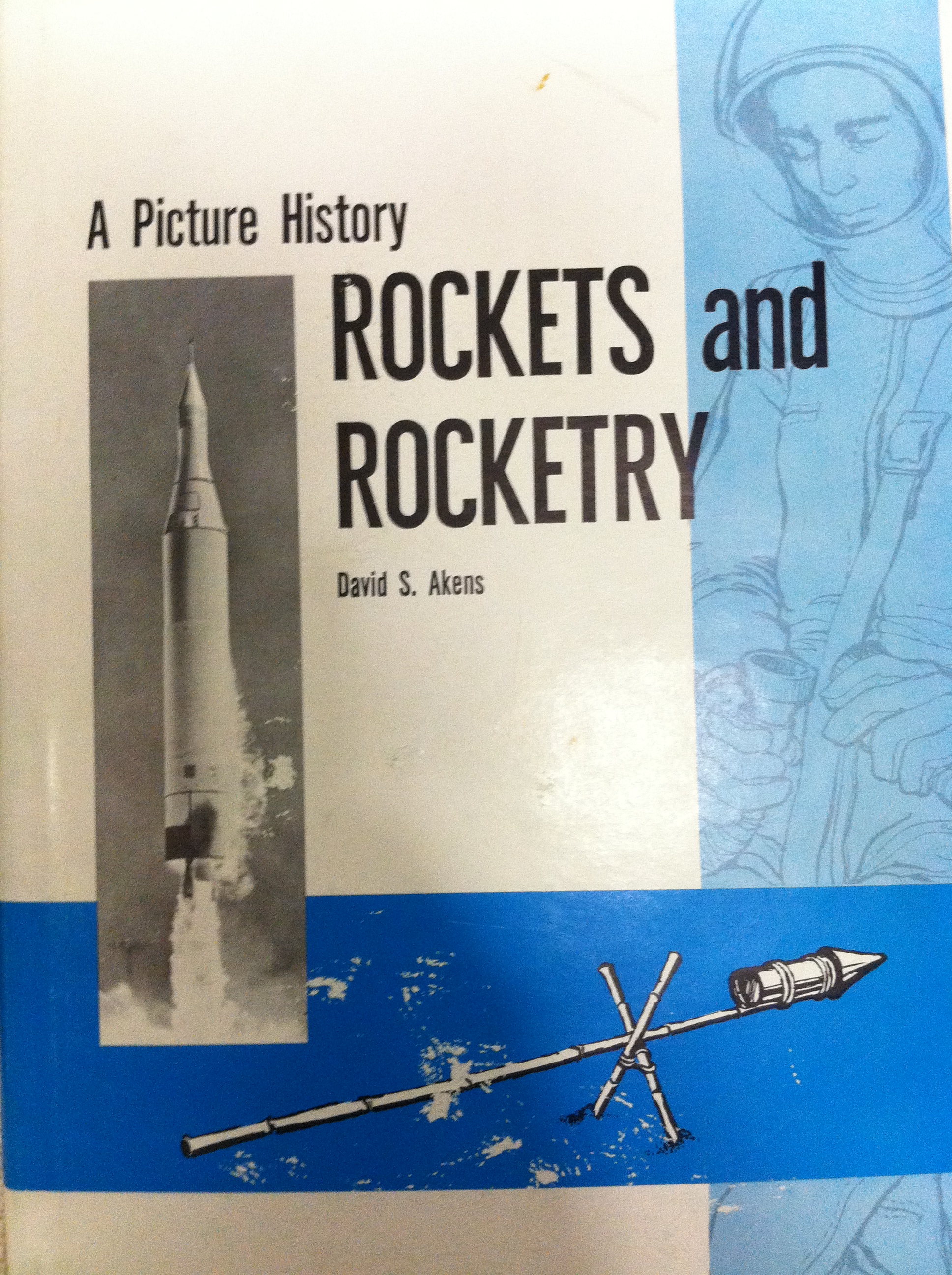
We look forward to participating in Archives Month by sharing with you some of the many treasures from our holdings. In honor of our re-launch of the blog and the 55th anniversary of the founding of NASA, the item featured in today’s post is Rockets and Rocketry: A Picture History (1964) by David Akens. Found in our Alabama Collection, Akens’ book is one of many that document the pivotal role of Huntsville, Alabama in the development of the American space program.