Cool@Hoole

Invisible Digitization?

Sometimes Digital Services captures “Oddities,” which is content that can’t be uploaded into Acumen. This may be content digitized for patrons, donors, and other institutions; or it might be tiff image files that have already been placed online or archived that need enhancing. Any digitization that does not result in tiff files that can be placed online is called “invisible digitization,” and it happens more often than you think. Often, this digitization is a regular step in the process or at least a normal element of the program’s workflow, but it can be hard to track. It might be easy to keep up with initially, but the bigger the repository grows, the more likely it is that this information will be lost.

Our “Oddities” are broken down into four categories: Corrective, Offline, OCR Transcripts, and Weeded Digitization. If the tiffs already exist online but they are not of acceptable quality, then any rescan or further optimization of that particular tiff or group of tiffs would be categorized as Corrective digitization. Offline digitization consists of creating tiffs for a specific patron, institution, or web exhibit. OCR transcripts are formed when we digitize typed transcripts, which are discarded later after OCR. Weeded digitization consists of items that, after digitizing, we learn we do not have the legal right to place online, or else those files are duplicates of content already online.

Digital services records invisible digitization daily in our shift reporter tool, and also in four separate spreadsheets located on a shared drive. Currently our pipeline incorporates a total count at the end of each month to show productivity, including how much content was produced that would not be considered “new content” or “Oddities”, and exactly how many scans that content consists of. Currently the spreadsheets are saved as tab delimited .txt files and our SizeandProgress script picks up the .txt files to include the numbers in our count.

We are in the process of creating a script that will pull the collection identifier, scans, and type of “invisible digitization” from the shift reporter, completely leaving out the need for spreadsheets to capture the count. Our long term goal for tracking oddities would be to create an interface that utilizes a database that is capable of storing oddities in an array, so we could easily retrieve oddity information and create a report based on that information. It’s important that we be able to show all the work that goes into producing our digital content, especially when the evidence isn’t online to speak for itself.

(Thanks to Jessica Anderson, our Repository Manager, for writing this up to share!)

Lasting Impressions

What do pamphlets from the late 18th c. French Revolution and fliers in support of a radical professor in the 1960s and 70s have in common? They were printed and handed out by people supporting radical causes, and they are both classified as archival ephemera.

According to the Society of American Archivists, ephemera documents are “created for a specific, limited purpose, and generally designed to be discarded after use.” Basically, no one meant for such items to last, but they have, and since they give us valuable information about important events, they have been preserved anyway. Labeling things “ephemera” is the archivists’ equivalent of saying, “This stuff might not be pretty, but it’s still pretty cool.”

*

Did you know Hoole Special Collections Library has an extensive collection of French Revolutionary Pamphlets? They include writings by some of the best known political players of the day, including Robespierre, St. Juste, Desmoulins, and Danton.

This is a Speech of Maximilien Robespierre on how to save the state and freedom:

french revolution pamphlet

Another promises Mysteries of iniquity unveiled:

french revolution pamphlet

*

Fast forward almost 200 years. Alabama native Angela Davis was a philosophy professor at UCLA in the late 1960s and 1970s, and her radical views on everything from gender to race to economics made her a hero to some and persona non grata to others. Click on the image below to read more about her:

angela davis flier

The Angela Davis Ephemera Collection includes materials related to the early 1970s movement to have her freed from prison — she was accused and eventually acquitted of conspiring to murder a judge — along with materials related to her campaigns to win the seat of U.S. vice-president as part of the Communist ticket in the 1980s.

angela davis flier

*

Hoole Library houses several other collections of ephemera, including Alabama Election Ephemera. While this collection has yet to be digitized, you can see the finding aid online in Acumen, so that you know if you should make a trip to Hoole to see these items in person.

Advanced Acumen Searching

Acumen is big. Very big. And it’s getting bigger.  I’m pointing this out because when databases like Acumen get big, they become impossible to search through manually. Generally speaking, one can’t just browse casually through thousands and thousands of folder directories and expect to find a very specific file. So custom search engines are created so users can use keywords to locate exact files quickly. Acumen has a search engine (located HERE) that is very helpful at finding files, but like all search engines it has its strengths, its limitations, and its secrets. Knowing more about how Acumen’s search engine works will help you locate the files you want to find.

*Note that Acumen’s search engine is constantly in a state of change as we strive to improve its functionality, so the following information may not be relevant in the future, and may not function as expected from time to time. New features and methods of searching besides those mentioned here may also be added.

If you were to search Acumen for something using only keywords, then the search engine would return thousands of pages of results. This can be a bit intimidating. Sometimes what you’re looking for is near the top of the list, but if you comb through several pages and still can’t find what you need then it can become frustrating. Thankfully, there are ways of narrowing down the search results. By default, Acumen’s Search engine is designed to organize search results so results containing all keywords populate to the top, followed by results containing only some of the keywords. In order to narrow the search further, you have to use search operators.

Boolean…

The Boolean operators AND, OR, and NOT (in all caps form) can be used to force the engine to return only those queries. For example, if you searched for “1813 AND letter”, the search engine would only show results that contained both of those keywords instead of either of them. This drastically reduces the amount of results that are returned making it much easier to find exact files.

Geek Trivia: In 1894, a certain Mr. George Boole recorded a unique approach to problem solving in his book “An Investigation Of The Laws Of Thought” (which was originally titled “An Investigation Of The Laws Of Thought On Which Are Founded The Mathematical Theories Of Logic And Probabilities”, but that’s neither here nor there). In his book, Boole laid out a set of mathematical rules, aka Boolean Logic, which would later become integral to designing electronics, computer programs, and yes even the humble search engine.

Lucene query syntax…

But that’s not Acumen’s only secret. You can also specify specific fields to search using the standard Lucene query syntax, which consists of the following operators:

  • abstract
  • archivist
  • asset_name
    • This is the file name of the associated asset file (if any), and is used to link directly to an asset if the query match is a tag or transcript that has no other metadata at the item level
  • collection
  • creator
  • date
  • description
  • genre
  • repo_loc
    • This is the file name of the parent metadata file without the file extension, which is also its repository location (i.e., u0001_2008003_0000110)
  • subject
  • tag
  • title
  • transcript
  • type

Example Queries:

  • repo_loc: u0001_2008003_0000110
  • title:snow NOT quad
  • title:coal AND type:image AND (date:(1920 OR 1911))
  • title:snow AND type:image OR (date:February AND title:quad)

Parentheses are used to include a group of terms under each field. For instance,  “title:(January AND 14 AND 1832)” functions the same as “title:January AND title:14 AND title:1832”. Using Lucene query and Boolean operators together allows a user to quickly narrow a search down to very specific results. For further information on using Lucene query operators, please read the official Lucene query syntax documentation HERE.

Google…

There is also an alternative method of searching through Acumen that doesn’t use Acumen’s search engine at all. We provide sitemaps containing links to every item in Acumen, which Google in turn indexes; this makes Acumen searchable through Google! If you were to type “site:acumen.lib.ua.edu” into a Google Search engine, followed by whatever keywords you wanted to search for, then Google would search through its index of Acumen and return results matching your keywords. This is especially helpful if you want to do an image search, as you can easily hit Google’s “Images” tab during a search to see a visual list of photo results. Google also allows users to use Boolean Operators just like Acumen. Google’s search algorithms are different then Acumen’s search engine, so a Google search may produce different results.

Of course, all of these search methods are only tools for your toolbox, but if you get stuck trying to track down a particular Acumen file then having a few alternative search methods in your toolbox becomes quite handy. Happy searching!

-Austin Dixon, Digitization Technologist | Hoole Library

Football Champs Again!

To celebrate UA Football’s 15th national championship, we share these scenes of championship football past and the faithful support of Tide fans throughout the years!

January 1926. Running back Johnny Mack Brown takes a break on the sidelines during the Tide’s first trip to the Rose Bowl — and their first win.

Days later, a crowd gathers to welcome the championship team home.

December 1926. The team gathers at the train station to leave for Pasadena, for another Rose Bowl.

Before the Rose Bowl, Dec 1926

The January 1 game versus Stanford was the last Rose Bowl to End in a tie. Coach Wallace Wade’s team was chosen consensus national champions for the second time.

After the Rose Bowl, Jan 1927

Fall 1961. Students gather in Foster auditorium for a pep rally. The Tide went on to take its sixth consensus nation championship — Bear Bryant’s first! — after winning the Sugar Bowl against Arkansas.

pep rally

Later that year, Bryant received the National Football Foundation’s MacArthur trophy. Here he is (second from left) meeting President Kennedy (center), along with UA President Frank Rose (left of Kennedy) and quarterback Pat Trammell (fourth from left).

Bear Bryant meets John F. Kennedy

For more on the Tide’s football championships, check out the list at rolltide.com.

Hidden Gem: comedian Dick Gregory at Emphasis ’70

When he took the stage at UA in October 1969, African-American comedian Dick Gregory joked that he’d meant to be there six months before, for the previous Emphasis program, but he’d been in jail at the time and couldn’t make it. What followed was a speech just as unorthodox as its introduction, a mixture of observational humor and pointed political critique, much of it about the state of race relations in the U.S.

I imagine his words and ideas ruffled some feathers here nearly 45 years ago, but that was just the point of the Emphasis program, to frankly discuss the most important issues of the day. In this case, it wasn’t just frank discussion, it was hilarious! And it still hits home today.

Follow this link to access the digital audio of the speech: Emphasis 1970, The University of Alabama, Dick Gregory

Favorite Things: Rockwell Kent’s Lump of Coal

Portrait of Rockwell Kent by Carl Van Vechten (1933), from the Library of Congress
People often ask archivists and special collections librarians, “what’s your favorite thing in your library?”  This is, of course, impossible to answer. But if forced to compile a list of “a few of my favorite things”, this would be high on the list.
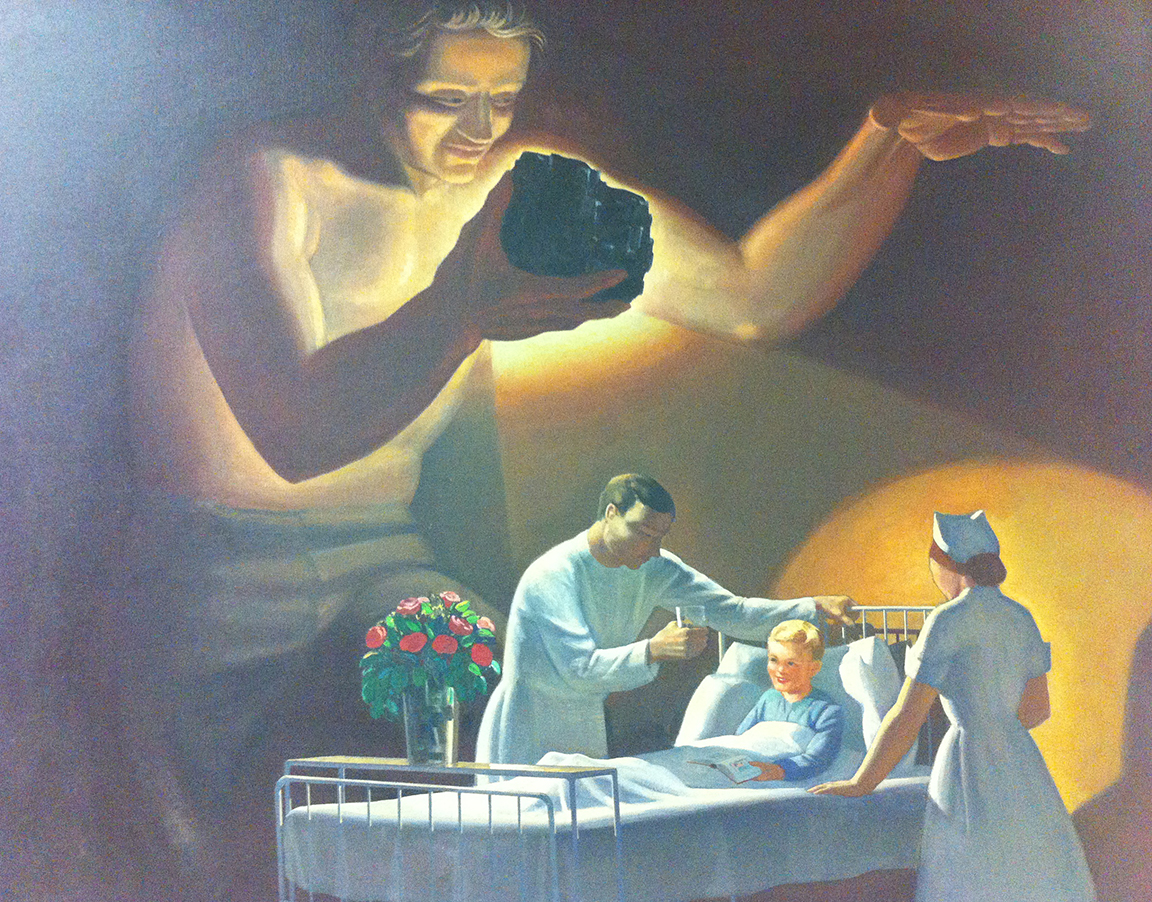
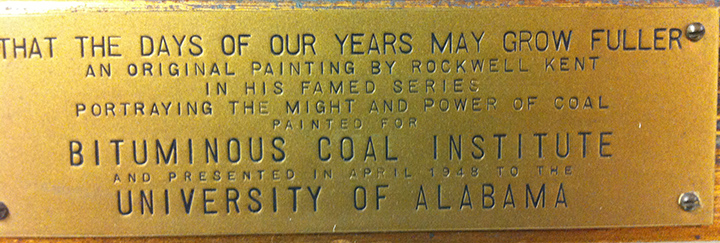
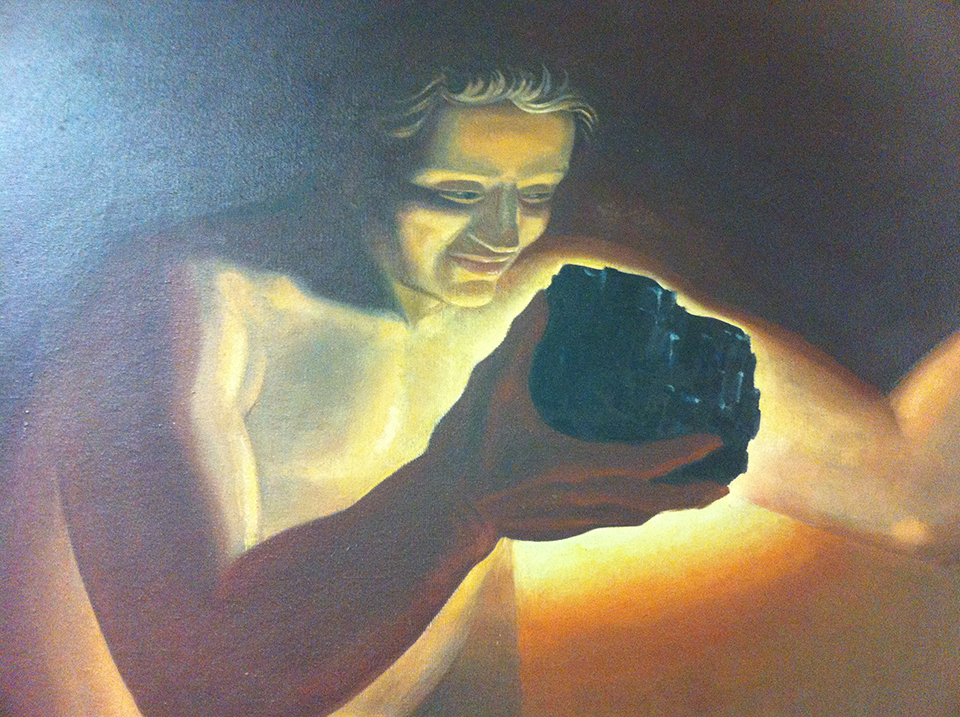
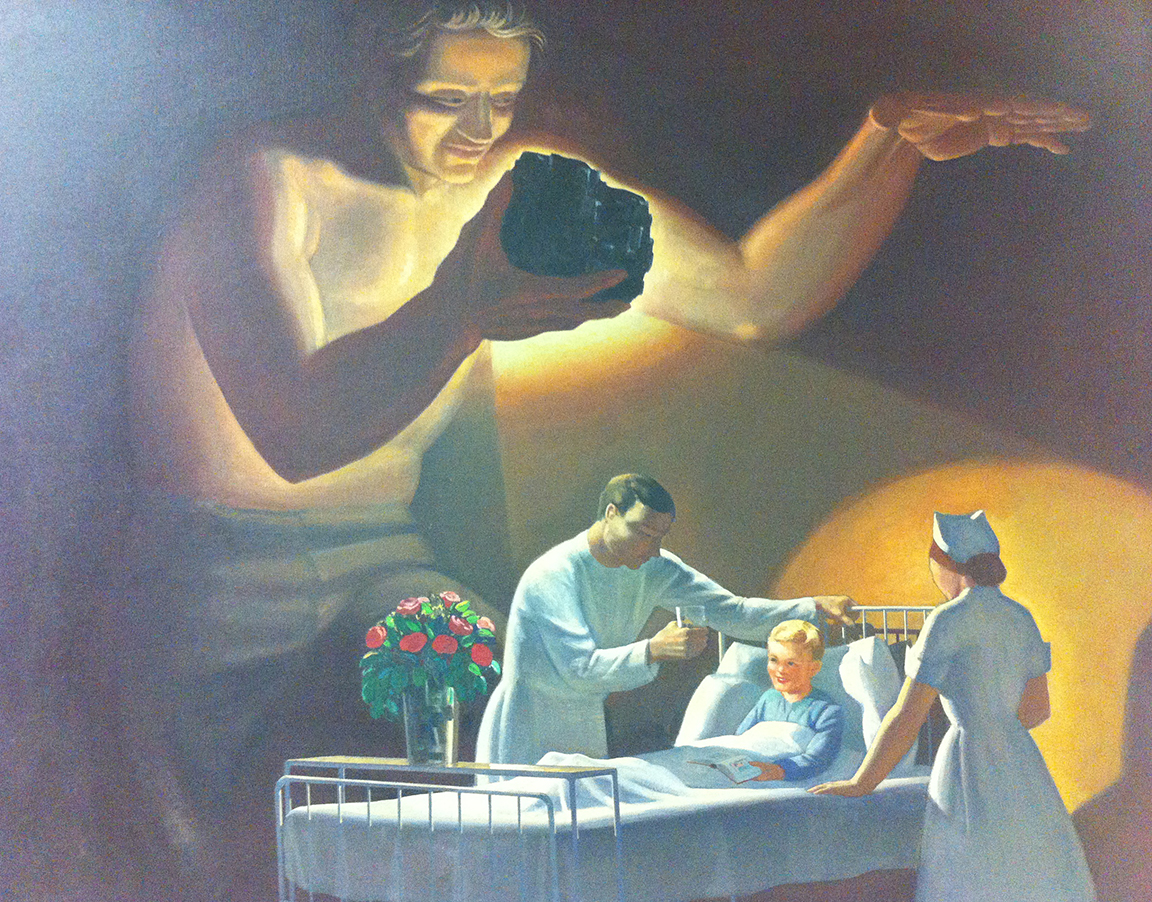
The painting, “That the Days of Our Years May Grow Fuller” was done by the famed artist and illustrator, Rockwell Kent. The University of Alabama received in 1948 one of ten paintings commissioned by the Bituminous Coal Institute from Rockwell Kent. Each painting was given to a university that was strongly linked with the history of coal and the coal industry.
If to the viewer’s eyes, my world appears less beautiful than his, I’m to be pitied and the viewer praised.”  — Rockwell Kent

Not your average christmas carols

There’s so much music written and published just for the Christmas season, but I bet you haven’t seen any of these pieces before.

Here’s some pretty normal fare, from 1887.

Sheet music, 1877, santa claus will come tonight

Notice Santa using his glasses to check his list. (Click on the image above to see it in Acumen and zoom in even more.)

Of course, there are also things a bit out of the ordinary.

From 1866, a polka.

Sheet music, 1866, Christmas Eve Polka

(Where’s Lawrence Welk when you need him?)

This last one is a whole cantata, but it’s nothing like you’d see in church!

Sheet music, 1917, santa and his auto sleigh

It was only 1917 when this was published, but they were already joking about the world changing too fast.

Such singing and ringing, Such accidents bringing,
These new fangled doings are not my kind of ways…
Such hurry and scurry, And no end of worry,
It never was so in our grandfathers’ days.

But no wonder they were worried — they wanted Santa to get an “auto-sleigh”!

santa and his auto sleigh, p. 11

These pieces of sheet music, and many more, are from The Wade Hall Collection of Southern History and Culture.

“Go Local” — and work together!

This semester, I’ve been collaborating with a librarian from Gorgas Information Services and an instructor in the English Department to create a composition course built around some of our most interesting digital collections. We’re pretty excited about it!

The instructor is currently teaching a preliminary version of the course, a freshman composition section interested in local subjects and incorporating some primary source materials. For the future course, she decided to depend entirely on primary sources and to get the instruction department more involved, so that her assignments would work clearly toward the library goal of increasing the students’ information literacy.

She chose to restrict the class’s research to special collections materials, particularly certain digital collections in Acumen. That way, it would be accessible online, and the process of identifying useful primary source materials wouldn’t be so daunting. It would also be a free alternative to having a textbook for the course.

The theme is “Go Local”: all the featured digital collections have a connection to Alabama. From letters written by Civil War soldiers to oral histories about Depression-era Birmingham, from a scrapbook chronicling the activities of WWII soldiers in Tuscaloosa to a set of speeches given at UA during the turbulent late 1960s, there are so many interesting avenues of research in our own back yard.

This library-integrated course would introduce students to the wild world of primary source research as a way of increasing their critical thinking skills and preparing them for future research and writing projects. It’s been proposed to the head of First Year Writing as a potential offering for EN 103 (Advanced English Composition) in coming semesters. We’ll keep you posted.

The Willie Pape Scrapbooks: An Antebellum Alabama Child Prodigy

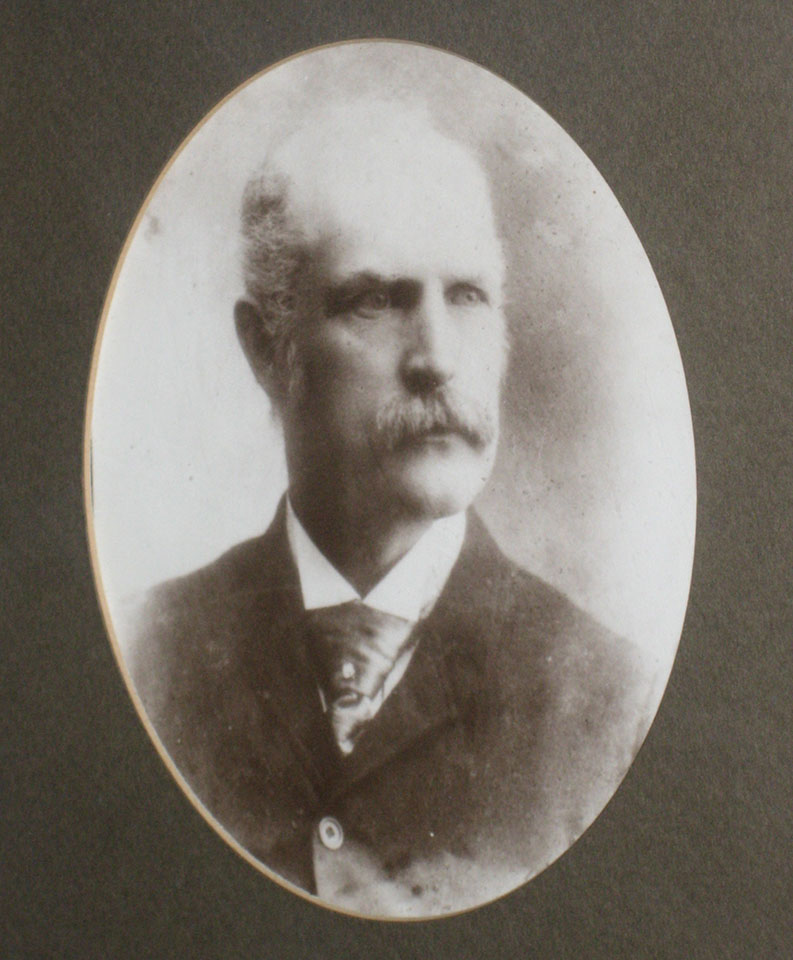
William Barnesmore “Willie” Pape

William Barnesmore “Willie” Pape was born February 27, 1850 in Mobile, Alabama, the son of William O. and Tabitha McBride Pape.  His talent for music was discovered at a very early age and in 1854, Willie’s father began giving him music lessons.  He was so gifted that even at the age of thirteen he was able to play many of the most demanding piano sonatas from memory.

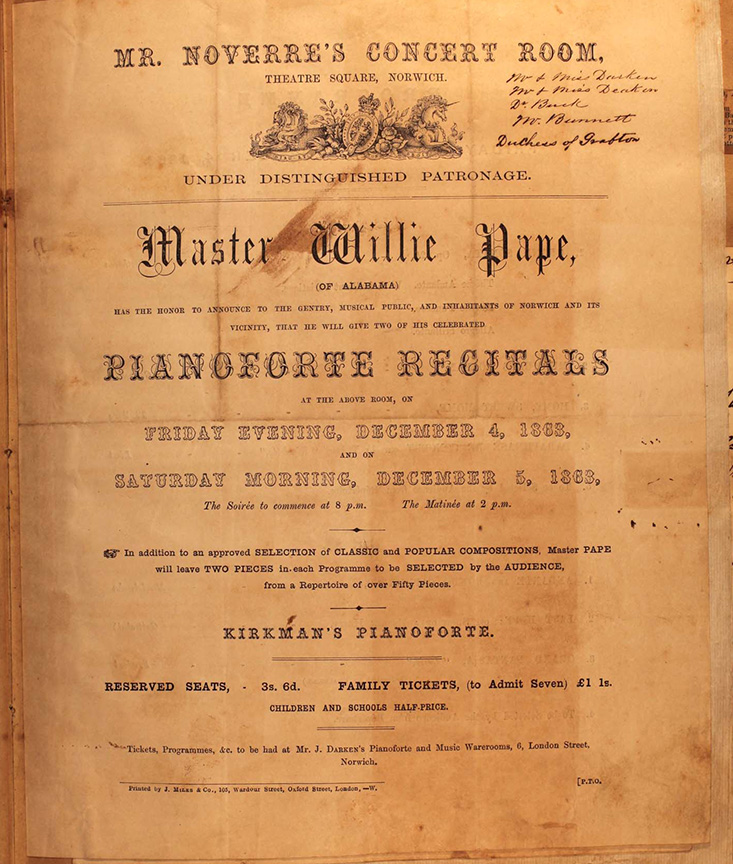
Concert program, 1863.

Willie and his father traveled to New York in preparation to travel to Europe just as the American Civil War erupted.  Alabama, in fact seceded from the Union while they were traveling in January of 1861.  Rather than going abroad as planned, they stayed in New York for two years.  Willie continued his studies under Sebastian Bach Mills.  After brief concert tours to Havana, Cuba, and Canada, Willie and his father finally left for England in 1863.

Sheet music cover featuring Willie Pape

Willie’s first public performance in England on 27 April 1863 was a huge success and eventually led to the patronage of the Prince and Princess of Wales in 1864.  He spent several more years in England, performing and touring, until returning to the United States in 1875 and resettling in Mobile.  He retired from his musical career at the tender age of seventeen years old.  When he left England, Willie gave up the piano completely, though he did play church organ throughout his his life.

He was married twice; first to Ella Anderson (around 1880) who died on 9 August 1889; and then to her sister, Mary Anderson.  Ella and Willie had three daughters, Ethel, Ella, and Hazel; Mary and Willie had one son, William Sherwood.

He began his second career not long after he returned to Mobile, studying medicine. In 1882, Pape graduated from the Medical College of Mobile and began his practice in Mobile. He also served on the faculty of his alma mater where he was a Professor of Physiology and Hygiene.  He died August 30, 1901.

William Barnesmore Pape in later life

The Willie Pape scrapbooks were donated to The University of Alabama Libraries in 2012 by Dr. William Pape Wood.  We would like to thank the descendants of William Barnesmore “Willie” Pape for this generous and historically important piece of Alabama and music history.

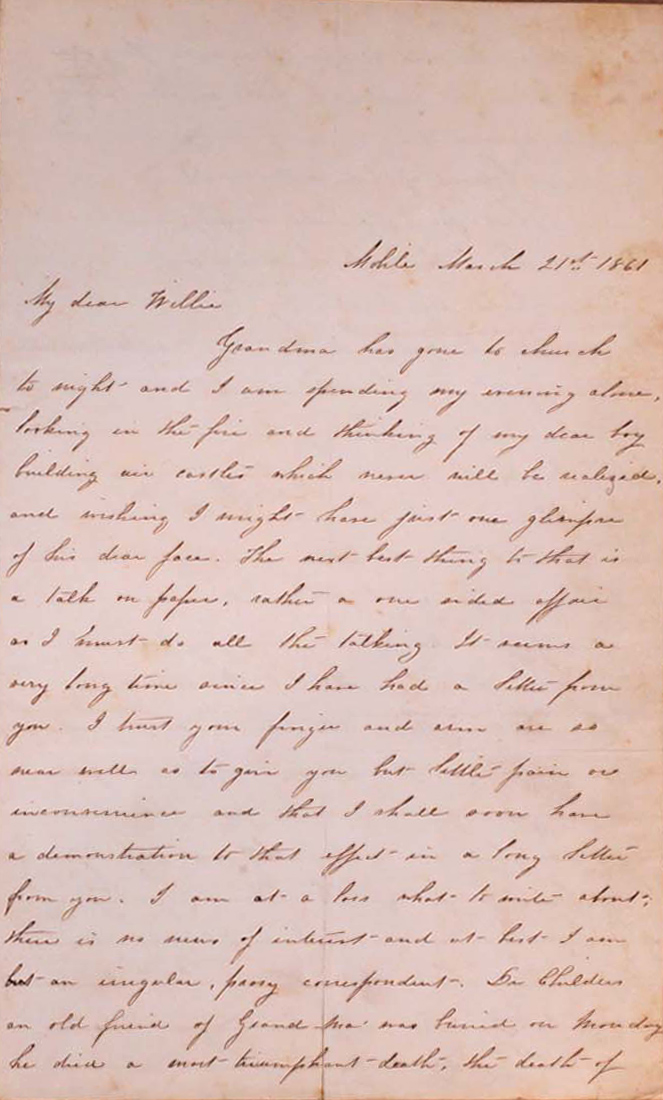
A letter from Mother, March 21, 1861

The two Willie Pape scrapbooks offer interesting insight into his world as a young musician and performer.  The letters he received, as well as concert programs, reviews and other materials are contained in these rare scrapbooks.  They include impassioned letters from his mother and grandmother that discuss family business as well as the War, illness, disease, and death. We also know that young Willie Pape sent a letter to President Abraham Lincoln just two weeks before his assassination.  The letter spoke passionately about a young man’s struggle to connect with his family during the Civil War and the heartache that the war and prolonged separation had caused him.

It reads:

Willie Pape, 9 Soho Square London Pianist to the Royal Family at Marlboro House
By Command of H.R.H. the Prince of Wales, June 6, 1864
March 29, 1865
Your Excellency —

I left my native town, Mobile, Alabama, for the purpose of pursuing my studies under the best musicians in Europe, on the 1st of March, 1861 — now four years since. On my arrival in New York I was informed by my father who accompanied me that our State had seceded from the Union, & that we had better remain a while before we embarked for England. I remained in the North for two years studying and occasionally appearing in public for the benefit of charities. On my arrival in England I was permitted to appear at several Grand Concerts, at which the Royal Family attended, and I have been honored by the highest position attainable by an artist.

I have written my mother many times, and to my Grandmother, by the way all letters to the South go. (I don’t know how that is, only they are deposited in a basket at Bishopgate street, & prepaid), but I have not heard a word from any of my family since the mails were stopped.
I was fifteen years old on the 27th of last month, and have been absent from Mobile since I was 11. I am very anxious to hear from my Mother if there is means of doing so.

I am in daily communication with Her Majesty or the Prince of Wales. They are my patrons & friends, and despite jealousies of native pianists, they awarded me the highest honors. It has been a source of great dissatisfaction to the Royal Academy that an American should have been so honored, but in this country merit alone gives precedence in the fine arts.

The honor of your answer will make very happy one who, although raised to so high a pinnacle of favor, is at all times unhappy and despondent.

I am informed that property left me by Grandfather has been confiscated through our absence from the so-called Confederate States.  Our property was assessed at 25,000 dollars.

To the Hon. Abraham Lincoln.

The Pape scrapbooks will be on exhibit in the lobby of the W.S. Hoole Special Collections Library beginning Friday, December 15, 2012.   The University of Alabama Libraries would like to thank the descendants of William Pape for their generous gift of these treasured and historically significant items

Keeping your digital works alive!

How much of today’s important information is going to be accessible in 10 years or so?

Before the world went digital, we could count on publishers capturing the information of value for research, teaching, and cultural history documentation. But that is no longer the case! “Publishing” has moved upstream, and valuable information appears on blogs, tweets, and web pages every day, only to disappear without a trace before long. Students, researchers and faculty are creating valuable documents daily, often utilizing proprietary software such as Microsoft Word. Just how likely is it that you’ll be able to open a Word document that you created 10 years ago?

Not very likely. Software and hardware change constantly. How many times have you upgraded your operating system in the past 10 years? Windows 95 to Windows 97 to Windows 2000 to Windows XP to Windows 7 to… You get the picture. The software you use on one system hardly ever works on the next one. And software updates constantly APART from operating system changes. Any idea how many versions of Adobe PDF you’ve used? How about Microsoft Word? When’s the last time you tried to open one of these files that you created in a long-ago version of the software?

Content creators, as a rule, have almost no awareness of just how fragile their content is. And how many of us have captured digital images, and saved them in various places on our desktop, laptop, iphone, or elsewhere? Out of all of those images — some very precious to us, that no doubt we’d like to be able to share with our grandchildren! — how many have even had backup copies made? And backups are not enough to ensure continued access. Backups are only the beginning.

One of the critical duties, from my perspective, that librarians (and others!) should be addressing, is the need to educate content creators on how to prepare and manage digital content for long-term access, from the time of creation. The student or researcher capturing and analyzing information that will be of use in the future, needs to be aware of the file formats and software he’s using, the information he should be capturing and storing at the point of creation, the methods of organizing his content for later retrieval and use — backup systems, media storage considerations, and more.

To try to begin this conversation at the University of Alabama, I’ve pulled together a wiki page with Recommendations for Authors and Creators and plan to present a discussion at a Digital Humanities brown bag December 13th (the presentation is here). If *you* are a librarian, please consider doing something similar at your institution. If you are a content creator — aren’t we all? — please take a look at some of these resources and educate yourself on how to ensure access to *your* precious digital content for years to come.

If you have other resources to recommend, please let me know!