Cool@Hoole

ETDs 2012: Math and Science

Check out these dissertations and theses from UA students, published in 2012!

Kinesiology: Can cooling a pitcher’s arm between innings help him stay in the game longer?

baseball catcher and pitcher
This image is from the Woodward Family photo collection

Geography: Can remote sensing help us map water quality in the Black Warrior River?

Black Warrior River view
This image of the Black Warrior River is from the Eugene Allen Smith photo collection

Computer Science: Is it better to teach novice programmers in a visual enviroment or a command line environment?

computer room in 1967
This image, showing a computer room in the late 1960s, is from the University of Alabama Encyclopedia

Biological Sciences: What can studying the pygmy sunfish tell us about aquatic biodiversity in southeastern North America?

young man with fish
This image (which shows a fish much too large to be a pygmy anything) is from a Wade Hall Small photo collection

Music: What do mathematical concepts like pi, the Fibonacci series, and Pascal’s triangle sound like when expressed in a saxophone quartet?

jam session
This image is from the Educational Media photo collection

ETDs 2012: Contemporary Culture and Technology

More great research from UA students: Dissertations and Theses on timely topics…

Finance: Is searching for real estate using the internet really easier?

real estate flyer, 1920
This image is from the Woodward Family Papers

Geography: How accessible is campus for cyclists and pedestrians?

woman on bicycle
This image is from the UA photo collection

Advertising and Public Relations: How do people use Twitter during natural disasters, for example, the April 27, 2011, tornado?

storm damage
This image is from the Roland McMillan Harper photo collection

Educational Leadership, Policy, and Technology: What can school officials do about cyberbullying?

students in a classroom
This image is from the UA photo collection

Communication and Information Sciences: How has the Internet changed the way genealogists conduct research?

genealogy note
This image is from the Martha Young Papers

ETDs 2012: History, Culture, and Art

More scholarship from graduate students at UA. These questions all represent research published in dissertations and theses during 2012.

*

Anthropology: Can we learn anything about the 20th c. Great Migration of African Americans by looking at cemeteries?

cemetery
This image is from the Roland McMillan Harper photo collection

Communication: What was it like to be among the working-class white poor in the late 19th c. South?

small town scene
This image is from Roland McMillan Harper photo collection

Anthropology: Can we figure out how society was structured at Moundville ceremonial center by looking at their use of pottery?

archeological dig
This image is from the UA Photo collection

Music: Is it possible to standardize the size of a viola?

woman playing violin
This image is from a Wade Hall Small Collection (and, no, that’s probably not a viola)

Anthropology: Do Cubans living in Miami understand the cultural background of their staple foods?

sheet music cover
This image is from the Wade Hall Sheet Music collection

Electronic Theses and Dissertations (ETDs) 2012: People

When I was writing my doctoral dissertation, I always wondered, “Will what I do seem interesting to anyone else?” After a survey of theses and dissertations published at the University of Alabama over the past year, I feel a lot more hopeful about an answer to this question.

Scholars from UA have been researching some interesting things this year, and they’re all published online in Acumen! This week, we’ll take a look at examples from across the disciplines.

To start with, there is so much to learn about people: how they think, what they do, and why they do it…

Psychology: Is it a bad thing if your child’s imaginary companion is more of a frenemy than a friend?

children
Image from a Wade Hall Small Collection

Communication: How do athletes repair their images after they make really public mistakes?


Image in the public domain, accessed here

Literature: What can we learn about friendship during the Renaissance period from reading Shakespeare’s Two Gentlemen of Verona?

Image in the public domain, accessed here

Psychology: Do children with Down Syndrome read people’s emotions as well as other children do?


Image in the public domain, accessed here

Communication: Does playing the “good cop” make for more productive law enforcement-suspect interaction?

police and students
image from the UA Photo Collection

A Star is Born: Happy Birthday Mark Twain!

He was born on November 30, 1835, just as Haley’s Comet passed in the night sky. Samuel Langhorne Clemens, better known as Mark Twain, is a true American literary icon, and widely read today just as he was 100 years ago.

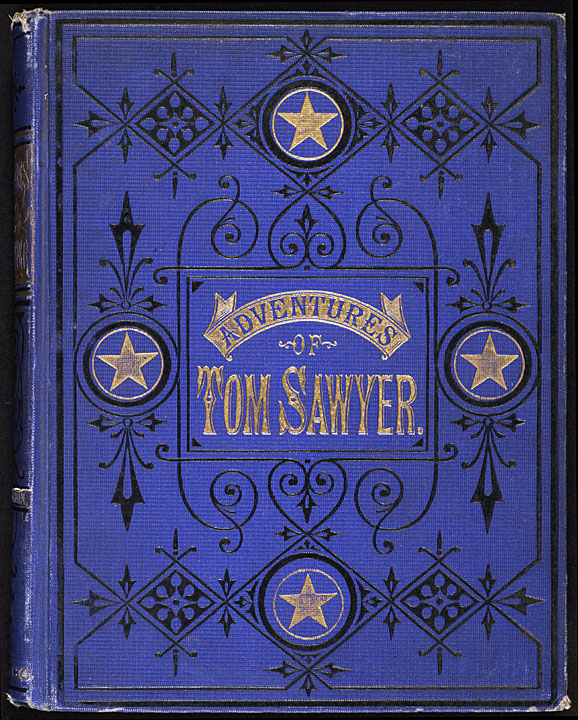
These two beautiful blue books are excellent example’s of 19th century editions of two of Twain’s most beloved and widely read classics, The Adventures of Tom Sawyer (published in 1891 by the American Publishing Company in Hartford, CT) and The Adventures of Huckleberry Finn (First American edition, 1885, published by Charles L. Webster and Company, New York).  Both of these books are housed in the W.S. Hoole Special Collections Library and were featured in Publishers’ Bindings Online, 1815-1930: The Art of Books, along with many, many other Twain titles. A gallery and essay on Twain is available on the site as well, that we so cleverly called Son of a Comet, Star of the West: The Life and Literature of “Mark Twain”.


A Day in the Life: November 28

On this date, through the years…

*

1860. Alabama. Hugh Davis laments the political tumult of his day, which in hindsight we recognize as the prelude to Civil War.

Hugh Davis letter

Davis writes: “Revolution. Fire. Precipitation. Slaughter. How rapidly, how fearfully the words suggest the time before us. Oh! History lend us your pages. Oh! Eternity lend us your wisdom. Oh! Grace lend us your Washington.”

*

1863. Louisiana. War has come. Daniel, a Union soldier with the Army of the Gulf, writes to his sister.

Union soldier letter

Daniel writes: “The last time I wrote you was from Camp Bisland. Since then we have seen some pretty hard times. We marched so far as Opelousas and had a few skrimishes with the rebels but they are too fast for us and so we cannot catch them…”

*

1899. Paris. Alabama native Bertha Woodward writes to her mother while on holiday.

Bertha Woodward letter

Woodward writes: “‘While as yet tis early dawn’ 10 a.m., I will begin my letter. For fear, after the day is well started, there will not be time to write satisfactorily. Besides, this is the real time of day to accomplish things quietly, here in Paris. After you get your breakfast (coffee and rolls) just sit up in bed with your dressing sack on, and write your letters…”

*

1917. Camp Sheridan, Alabama. Herb Taylor, Jr., writes to his wife in Ohio to chastise her, often in sarcastic fashion, for not sending a telegram which would apparently help him in his quest to get home.

Herb Taylor letter

Taylor writes (on the next page): “You don’t seem to understand that I can’t get home Xmas and this is my only chance. 12 men are gone from Battery H. and there working it all around. I should think you’d hurry up so I could get a [?] and have some chance before they all get home and they shut down on it. … I wrote and told you to send it Friday first and then wrote and told you, by special, to send it right away and it’s here — not.”

*

1929. Columbia, County Georgia. A view of Harlem cemetery.

Roland Harper photo

Other photos of this rural cemetery can be found from Nov. 28 here, and from Nov. 30 here and here.

*

1934. Moundville Archaelogical Park and Museum. Works Progress Administration (WPA) workers pose while digging at a mound excavation.

UA Photo, WPA workers

*

1944. Northington General Hospital, Tuscaloosa. An article about World War II veterans, clipped from The Birmingham Age-Herald, found in the Tuscaloosa Service Men’s Center Scrapbook.

Scrapbook page

The article states: “In a nearby ward is Sgt. Harry Beckman, of Long Island, Hew York. … He heard of the desperate condition of Pvt. Brasher [burned in a truck fire] and immediately offered the skin of his entire abdomen to help his fellow patient. The operation was painful and immediately confined Beckman to bed for at least two weeks. The scars left by the removal of the skin he will carry for a lifetime.”

*

1981. Legion Field. Paul “Bear” Bryant breaks the record for most wins by a college football coach.

UA Photo, Bear Bryant

This was versus Auburn, by the way. 🙂 Roll Tide!
Native American Heritage Month

Did you know November is Native American Heritage Month? The W. S. Hoole Special Collections Library houses some really interesting collections pertaining to the Choctaw Indians living in Mississippi and Louisiana at the turn of the twentieth century.

The Choctaw bands whose distinct languages and cultures are chronicled in these books are among those which chose to remain in the south after the 1930 Treaty of Dancing Rabbit Creek, rather than go west to Oklahoma.

*

Here’s a page from Vocabulaire Choctaw (lac Pontchartrain) Louisiane, a hand written French/Choctaw dictionary from 1885.

The book’s author, Adrien Roquette, was a New Orleans native, poet, and Catholic priest who ministered to the native peoples living around Lake Pontchartrain.

(Apparently, he never did discover the Choctaw word for urine. I guess that would’ve been a pretty awkward thing to ask about!)

A bit later, in 1902, R. D. Spratt compiled his Notes on Choctaw Indians, a book about their history, legends, and language.

These pages, for instance, explain his understanding of their music and dancing:

On this page, we gain some insight into the Choctaw names for things.

On the next page, Spratt reports that they named a certain small lizard hvshtvp yuloli, which literally meant “it goes under dead leaves.”

*

Want to learn more? Check out the National Museum of the American Indian, which has its own digital collections on native peoples from the Arctic all the way down to the tip of South America!

What do researchers need?

Since we’re in the business of providing online access to primary source (unpublished!) materials, it only makes sense to wonder how effectively researchers can use our content. However, since most digital library interfaces share many commonalities — search, browse, results lists, display of content, etc. — we might as well generalize the study, so our results can be useful more broadly in the field.

With this in mind, we designed a qualitative user study for which we are now seeking faculty researchers as volunteers. We will ask each participant to identify 1-3 online databases (of primary source materials) that he or she uses for research on a regular basis. For each one, we will ask the participant to show us how he or she uses it, and tell us at each step what he or she likes, and what just doesn’t work. We’ll be watching to see what other software he or she uses and how. For example, does she have to key in information to another document, because she can’t export what he needs in the right format? Is he copy/pasting content into some other software, so he can search across materials he’s collected from multiple sources?

We hope our discoveries will suggest useful, helpful modifications that can be made to online databases of primary source materials, and perhaps tools that need to be developed to make the researcher’s work easier and less time consuming.

We don’t know what we’ll find, but stay tuned! This should be interesting! This study takes place in the spring, and we hope to have results analyzed by the end of May 2013.

Chicago World’s Fair, 1933

The 1933 World’s Fair in Chicago, A Century of Progress, put the city in the spotlight for its centennial, while displaying the best of scientific progress as well as bringing the cultures of the world to Chicago.

Click on any of the images below to get a closer look.

Navy Pier, Chicago

Art Institute, Chicago
(Built for the previous World’s Fair in 1893, this museum is still going strong)

Adler Planetarium, Chicago
(Also still in use, this is the country’s oldest planetarium)

The Hall of Science, Chicago World's Fair 1933

Travel and Transport Building, Chicago World's Fair 1933

Museum of Science and Industry, Chicago World's Fair 1933
(Still in business, too!)

Admiral Byrd's South Pole Ship, Chicago World's Fair 1933

The Belgian Village, Chicago World's Fair 1933

The Wigwam, Chicago World's Fair 1933

The Gold Pavilion of Jehol, Chicago World's Fair 1933

Chicago Skyline at Night

These images (and others!) are from Wade Hall Photograph Collection 29, images 41-66.

Veterans Day and the World War I armistice

The United States has recognized November 11 as Veterans Day since 1954. But we’ve been observing this date even longer — since 1919, in fact, when it was known as Armistice Day. November 11 marks the anniversary of the WWI armistice and is observed as a day of remembrance for WWI veterans. In honor of them, this posts looks at items from some of our WWI-related collections.

This is the back page of a piece of sheet music from 1922, a march written to commemorate the soldiers’ service:

page of sheet music

A letter from Clark Weir, deployed in France, to his parents in October 1918, discusses rumors of an armistice in the works.

Alston Fitts writes to his wife Mary about the Allies’ “wonderful and complete” victory in a letter from November 13, 1918. The soldiers’ future movements, however, were still uncertain.

In a letter from December 5, 1918, written to a fallen comrade’s parents, R. B. Cater also discusses rumors of the future, and he describes the soldiers’ reactions to the armistice as subdued, as the news was “too great to realize”:

Cater letter

Porter Rudolf writes to his father from France on November 21, 1918, that “the great day which we have all been fighting and waiting for has finally arrived when on the misty and foggy morning of Nov. 11 – 1918 at 11 o’clock hostilities ceased.”

He goes on to describe in detail the events of the 10th and 11th, and how proud he was that he was still “in the live” when the armistice went into effect:

P. B. Rudolf letter

Our Digital Collections contain hundreds of letters like this, from soldiers abroad to their families at home, from the Civil War to WWII. Those personal reactions and stories are invaluable tools for getting beyond the historical big picture of the politics and into the war “in the live.”

As President Obama wrote in his proclamation Veterans Day, 2012, “Our men and women in uniform have taught us about strength, duty, devotion, resolve — cornerstones of a commitment to protect and defend that has kept our country safe for over 200 years. In war and in peace, their service has been selfless and their accomplishments have been extraordinary.”