My favorite class moment

Well, it is all pretty fun to me, even when I am dying (no comments, no laughter, no answers, no questions), as I know that most anything in the classroom can be turn around and headed in the right direction in a heartbeat.

My latest, favorite image is “How is a library like a drinking fountain?”  My thought process related to this image is that water must (in these lucky United States) go through an exhaustive process of collection, filtration, purification, sanitization, and finally, safe delivery before it ever reaches your favorite water fountain.  That is, in this country, we can approach a water fountain and be pretty doggone confident that we are going to get a cool, clear, pure drink.
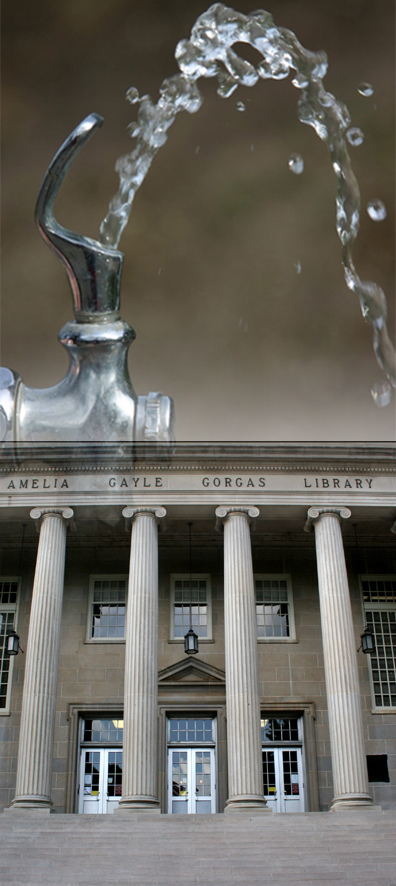
GORGAS WATER FOUNTAIN 130430


Relating this process to the selection  and “purification” process that goes on concerning information in a modern library is an easy leap.  Students immediately say “it’s free” (if they only knew!!!), “you can drink all you want”, or “it’s pure”.  You can extend this image and process as far as you like, given cooperative students (the final, best gift).  I was and am thinking about no specific pedagogical method, tho analogy and imagery have long and dependable histories in teaching critical thinking skills.  Asking anyone how x is similar to y always requires a thinking process on the part of the student, and that is active learning and participation.  Simple.  No props, no whiz bang, just get the brains in gear.

I admire and envy folks who have great (and hip) teaching ideas and tools.  My brain sticks to the facts, and that is great when the facts are needed.  I need to branch out, and rubbing shoulders with this crowd, it is bound to happen.

All good things, gisssteve

Favorite Teaching Moment

Early in my session 2’s, I had a moment where I came up with a new analogy for the publication process to help students understand why a resource should be trusted, and why we rely on peer review. My analogy begins with a discussion of what WebMD diagnoses you with when you give it your symptoms, even if it’s a rash and the sniffles, which most of the time is cancer. In contrast, if you go to the doctor and tell him the same symptoms, he’s probably going to tell you that you have allergies. The next portion of this analogy was to discuss why you trust a doctor more than WebMD, including the doctor’s lengthy education and the accountability of licensing, which then segued into how that resembles peer review. The first time I used this analogy, I saw how the classes came to understand why they trusted sources, and I ended up with lots of laughter and a really great discussion.

The comments from my supervisor and peer were both encouraging. They liked the simplicity of the analogy and they found it easy to understand. I enjoyed getting the positive feedback, and hope to do this with other activities.

Favorite Moment

My favorite classroom moment came in session two. I gave out three different sources to the class, all regarding the Deepwater Horizon oil spill of 2010. One source was scholarly, one was popular, and one was a webpage from BP itself. I also gave out a form worksheet, and this worksheet’s purpose was to get the students to figure out who wrote the article, whether or not it was scholarly or popular, and whether or not this article was reliable and relevant to the sample thesis provided at the top of the worksheet. After 5-10 minutes, we first discussed the BP official statement webpage. This is where my favorite classroom moment occurred. When I asked whether or not the students would use this source for this thesis, two students simultaneously said ‘yes’ and ‘no.’ I asked these students to explain their positions. The ‘no’ student listed bias as their reason. As I was about to say maybe we would use this source to explain BP’s official position but not as a reliable source for factual information, a student who did not even have this source for the activity took the words out of my mouth.

I really appreciated this moment because I think student involvement is most important in the classroom, and I was so excited to hear these students participate the way they did.

Naturally, this was a hard moment to recreate in our meeting because the moment was all about how the students responded and what arguments they responded with. However, it was really great because I didn’t tell Brett or Kristen what to say, and they also said ‘no’ when I asked if they would use this source. I think it is important for us to remember the context in which sources are appropriate, and I feel that this activity addressed the context problem effectively on top of the sort of standard source evaluation it was geared toward.

Metacognition and Reflective Practice

Well, I so seldom do things right, that this is really a treat for me. Apparently, I have been doing things ok and not necessarily knowing it. The unknown author begins by letting us know that metacognition is “thinking about one’s own thinking” and frankly, I have been thinking about my own thinking processes all my life. Mostly, my thoughts are doubts about my process, in general. That is, so much of what I feel is absolute bare logic seems to meet the world somewhere between “you gotta be kidding me” and “that’s not how things work.”

All this relates to information literacy being characterized as metacognition, in that the info seekers are required to think about their search and evaluation skills—and how to use them. Cool. So all this reflecting I have been doing upon my inadequacies has served a purpose, and maybe my questioning not only of students but of myself has been functional and fits this model of getting feedback from learners and teacher-learners (including yourself) at the same time. That is, the evaluative voice in my head never shuts up. Before I run around in any more circles, let me move on.

The horror always is that the learners are not getting what they need, and the two-part reflection about what worked and what did not work make perfect sense. The third part of this reflection, I think, should be modified to “did the learners achieve their goals?” Not to quibble. And yes, never throw anything away, are you crazy? Just re-name and date your files so you can trace not only evolution but get back to something that you will not be able to re-do in time, when next appropriate.

And, I always start with questions. I want to get folks involved and the fastest way to do that is ask questions, right off the bat. Nobody gets to sit back and hover under the radar.  [My tip for the week: folks who do speak up in class quite often do so hesitantly.  If the instructor says, out loud, “I don’t hear well, so please speak up,” students will be encouraged to actually sing out, and then the instructor is not caught editing or paraphrasing student input.  This is a real plus, in my opinion.]

We gots lots to do. Get involved. Contribute. Give me feedback. Allow me to assist. Ask me your questions; when you trip me up, make me think, make me explain, I am learning something, and I thank you.

This Week’s Reading

While I thought that “Standards for Libraries in Higher Education” was a bit of a dry read, I think it is really important that we have standards to apply to our performance. We need to be critical of ourselves, and of our performances. It is important that we uphold standards of performances; otherwise we get sloppy.

Another reason I thought this article to be important is that these sorts of standards will be applied when we (hopefully) find employment after graduation. We need to understand and be used to having these sorts of standards applied to our performance as instructors.

However, I am still wary of rigorous standards such as these. If not implemented the right way, these standards seem like they could become stifling of creativity. I would hope that a good institution would hold its staff to standards and push them to be better teachers, but still allow them the space to create and experiment within the classroom.

Reflections on Last Week

Last week I co-taught a class with Mark and solo-taught three classes. It was my second big week of teaching, and it certainly brought out all of my anxiety. It was actually kind of interesting because last Tuesday I was expecting to co-teach a class and solo-teach a class with Mark Robison, but our classes did not show up and instead another instructor showed up with a class to the same classroom without a librarian to instruct them. Mark and I waited to be sure that our class was not going to make it, and then we started teaching this class that had shown up without an instruction librarian. Our topic wasn’t exactly built for their class, but the principles were the same. It was a valuable lesson in how you sometimes have to improvise when you are an instructor.

On Thursday I solo-taught for the first time. It was an extremely stressful situation, one I was entirely unfamiliar with. It took a lot of coaching and reassuring words from Sarah Whitver and Brett Spencer to calm me down, and I then taught the class with surprising success. I thought the session went fairly well, and I was composed throughout. It helped that the teacher for this class, Erica Meyers, has a great report with her students and knows how to keep them in line.

On Friday, I experienced mixed results with the two sessions I taught. While I again felt composed in front of the classes, I also felt I needed to get through my material a little more quickly, as we only had 50 minutes to work with. Unfortunately I ended up rushing things a bit too much, leaving far too much time at the end of the classes for individual searching. This usually isn’t so bad, as I get a chance to help students one-on-one with their search processes (and I was still able to do that during these sessions). The problem was that it was Friday, so the students were naturally distracted, and they had already been assigned to find sources for their class, so some students felt they no longer needed to be there. Furthermore, their regular instructor was not there either, and they were instead brought in by a TA. These factors all led to some students feeling like it was ok for them to leave early, and being very new to instruction, I wasn’t sure what to say to these students. After all, it was my fault for finishing the instruction portion so early.

All-in-all, I am happy that last week happened and that it is over. It was a stressful time, but it also taught me a lot about myself and about instruction. Hopefully when i instruct my final two classes in April, I will feel even more comfortable in front of a classroom.

Recreate your favorite class moment


Next week, we are going to do a different kind of activity. Since our instruction is winding down and spring break is approaching, I want you to try to recreate your favorite moment of the semester to share with us as a group. Sharing your experiences with your colleagues is an important element of reflection, and it learning what worked in your classroom helps to inspire and motivate your colleagues!


Here are your instructions:

  1. Choose a moment during the semester when you feel things worked really well.
  2. Write a short description of why you feel that was a successful teaching moment. Include how you prepped for this moment, and what your thought process was– did you attempt to use a specific pedagogy or teaching method?
  3. Try to recreate the teaching moment for us during our 3/21 meeting. Pay attention to the details, and verbally annotate each step for us as you guide us through the process.
  4. Directly after our meeting, post your information here on the blog, complete with the reactions that you received in our meeting.

Have fun!

Teaching about thinking and thinking about teaching, and ACRL competencies

Well, I did it again. Wrote a blog post, hit save draft, and then there was not even a puff of smoke left. Gone. Just vanished. No tracks, no nuttin.
What I said was some nice things about the folks I work with, including the Boss, who visited a class I was teaching. She said she had fun, which is a good thing, I hope. I also said something about the dedicated librarians I have observed (and learned from) as well as the engaged and involved English instructors. And I remember something about English being a relatively new language back when I was first a student, and Chaucer being all the rage at the time.
And then I moved on to the ACRL standards for library instruction (and management), saying that I was falling far short of that daunting list. Main thing is to keep trying to hit those marks, teach to your objectives (and to the best of your ability), and then there was something about a roomful of freshmen looking to you to assist them with their big gnarly mean scary paper as being a great grip on reality.
Oh, there was something about seeing new opportunities for collaboration and course integration being sought on a daily basis, as well as good communication up and down the library chain of command, both of which were emphasized in the ACRL framework. I wish I had listened to Sara Whitver, and always put up a draft in Word, as this piecemeal reassembly just does not cut it. Doggone.
Just trying to get it back, but it is not necessarily coming back.
Bottom line is, again, it is great to be working in a well-resourced environment with dedicated people who give a durn about their jobs. No slackers here. Something about dragging students into the deep rich waters of UA resources, and making sure they can swim before the class ends. Also something about customer service not being dead (alive and well, no doubt, with lesson plans being modified at the last minute when instructors modify their assignments at that same last minute). Just saying that it feels good to be learning in this environment, and that overall at GIS, the ACRL standards are in good hands. I will hope to feel better about my performance the next time I go over the standards (did I mention daunting list?), and I know some folks I can trust to guide me as I go. Thanks, all.

Reflections upon “Applying active learning methods to the design of library instruction for a freshman seminar,” by Katherine Strober Dabbour

First, this article made me thankful to be working in a resource-rich environment, whereby every student has a computer.  Some folks say that working as a team with the work being broken up aids better learning for all, but I would prefer to learn the whole process in one piece, mainly by doing the whole process by myself.  Not that I do not like to share, but pizza is different from learning.  Just sayin.

California State at San Bernardino had some retention and graduation problems, and did something about it.  Good job.  Library skills were taught as a for-credit freshman seminar (in conjunction with other school and life skills), and outcomes were good.  Involving the students in talking, listening, reading, writing, reflecting activities is called active learning, and sounds like a good collaborative classroom to me.

Again and again, I come upon the ideas that one must begin from the beginning, and the effort at CSUSB did just that, ranging from library skills to computer us, time management, and attitude adjustments.  Right on!!  There is no reason to expect that students would come from a (relatively) highly-monitored high school environment to the freedom of a college campus and have all of the requisite skills in place.  Also, learning life skills (and library use) is not anything that one forgets upon graduation.  Win-win, i say.

Even though this article is 15 years old, i rather doubt that students would rate anything more valuable than computer skills today—so that is where my emphasis will remain.  Yes, get them involved via active learning, but the real work will continue to be building a student’s relationship with the information universe via their computer.  From this article, i can see the value of the worksheets that are being used with EN 102 students, and i will continue to work via this format.

It all boils down to the day and the student(s).  Some days will be better than others.  Some students will be better than others.  Every day, there is every reason to get the best from every student that they can give, that day, date, time.  Give me the perception, the energy, and the skill, please.

Teaching Back to Back to Back

On Monday, I had the opportunity to gain an interesting new experience–teaching back to back to back.  The instruction session were all for evaluating sources, but they were aimed at assignments for two separate teachers. I spent the morning alternating back and forth between SEC football and Mardi Gras, and wondering why in the world I’d forgotten to bring a bottle of water. The first session most the most talkative of the three, and it made me agree with Sara that students who choose to take their class Monday mornings at 8 AM must be overachievers. The students seemed to understand to what I was trying to teach them, but I forgot to introduce myself in the little bit of nervousness I came into the session with. The second two session were still interacting well, but it was a few students speaking, instead of the larger group as a whole. I feel like the “grocery store magazine” meta cognitive activity went over well, and the students seemed to enjoy the  topics and resources. Overall, I feel like I accomplished my teaching goals for the session.

List of Things to Remember for Next Sessions:

  • Water
  • Introducing myself
  • Wear a matching pair of comfortable shoes (…don’t ask)
  • Write down the Section Number