Cool@Hoole

Pedagogy Series: The Empty Heart of Mary Dees

By: Sarah Smylie, first-year undergraduate at The University of Alabama

Editor’s Note: This post is the third in a six-part series highlighting innovative special collections pedagogy. Read an interview with Sarah Smylie’s instructor, Brooke Champagne, or view this paper’s assignment prompt to catch up on the first two posts of the series.

***

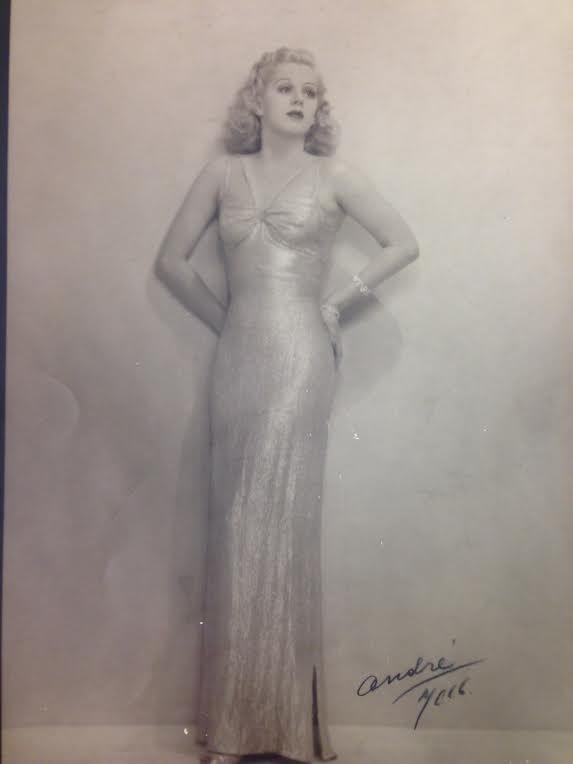
Mary Dees glamour shot

Mary Dees

The news of the tragic and sudden death of film star and Hollywood’s blonde bombshell, Jean Harlow, came on June 7, 1937. The beauty who had stolen the hearts of the American public during her short-lived career died unexpectedly of uremic poisoning, a toxic condition related to kidney failure. Hollywood and the entire country were devastated. It was hard for the public to bear the shocking news of the young death of their beloved star. Luckily for Jean Harlow and her adoring fans, she would be remembered forever as the young, beautiful starlet thanks to the immortality that film allows and her “unabashed sexuality” that everyone was entranced by (Addison, 37). One girl who would mourn Harlow’s death, yet hope to benefit from it, was the lesser known actress, Mary Dees. Dees, Jean Harlow’s loyal double because of their similar appearance, was fond of Jean, but she wanted more than to be in Harlow’s shadow: she wanted stardom.

Continue reading

Pedagogy Series: Featured Assignment

By: Brooke Champagne, English instructor at The University of Alabama, and Amy Chen, CLIR Postdoctoral Fellow at the W.S. Hoole Library

Editor’s Note: This post is the second of a six-part series highlighting innovative special collections pedagogy. Read an interview with Brooke Champagne, the Division of Special Collection’s featured instructor, in our previous post.

***

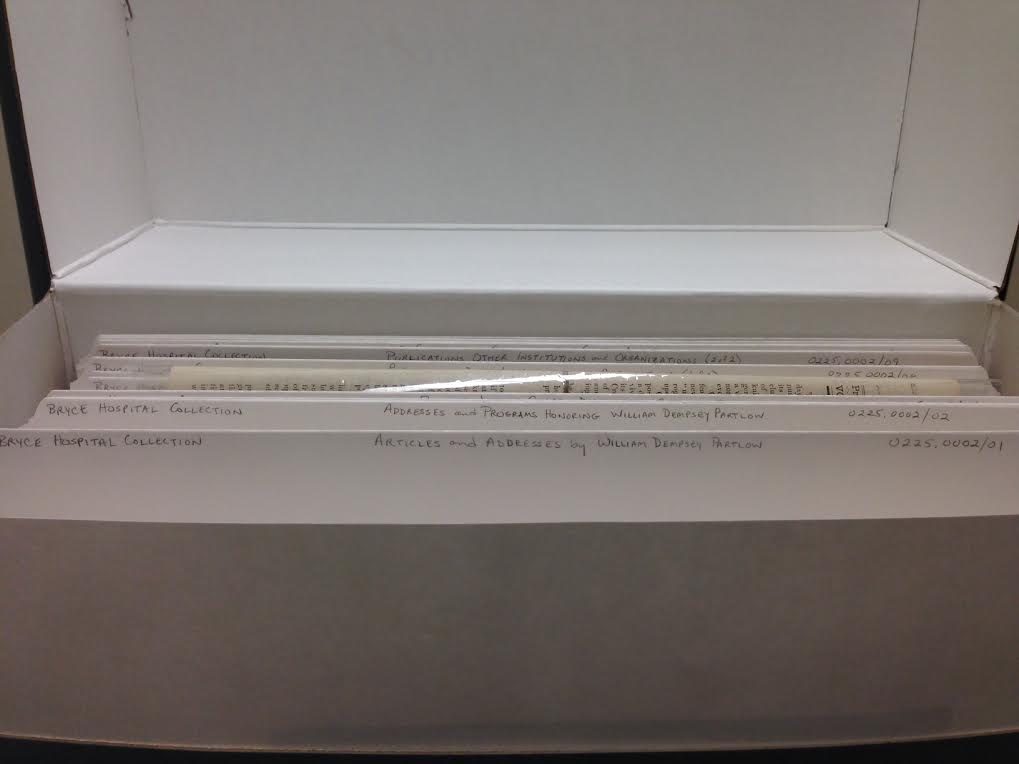
Bryce box inside

Inside a Bryce Hospital manuscript box

Brooke Champagne, an instructor of English at The University of Alabama, taught two sections of ENG 103 honors composition this fall. She previously discussed her experience of using special collections in her classes in the first portion of this pedagogy series.

Champagne’s assignment is provided below as a PDF in order to show both instructors and special collections librarians an example of the content and structure of a successful assignment that uses primary source material.

Assignment: Champagne-Assignment

Amy Chen, the coordinator of instruction at W.S. Hoole Library, also developed a flyer of best resources to direct Champagne’s students to the collections that could be fruitful for further inquiry. This flyer was not intended to be exhaustive and students were not restricted to working with only the listed collections. Rather, the flyer was designed to be an introduction to the types of topics students could potentially chose as subjects as well as the diversity of collections contained in the Division of Special Collections. If students found topics that better suited their interests, both Champagne and Chen encouraged them to pursue those subjects. One featured student, Sarah Smiley, chose to work on Mary Dees, a person featured on this flyer. Shelby Gatewood, the other featured student, elected to write on the history of Bryce Hospital, a topic which was not included on the flyer.

While the following flyer is specific to the holdings at The University of Alabama, this type of document could be created on the holdings of another repository in order to guide students in a similar fashion.

Best Resources: Champagne-BestResources

Pedagogy Series Kick-Off: Interview with Brooke Champagne

By: Brooke Champagne, English instructor at The University of Alabama

Editor’s Note: This post is the first of a six-part series highlighting innovative special collections pedagogy. Brooke Champagne, an instructor of English at The University of Alabama, taught two sections of ENG 103 honors composition this fall. This post is an interview with Champagne discussing the project she assigned her class using W.S. Hoole Library and Williams Collection materials. Following posts will include the assignment, two examples of projects which resulted from the assignment, and interviews with both featured students. 

***

brooke bio pic

Brooke Champagne

Thank you for participating in our Special Collections Pedagogy Series. To begin, why did you decide to use archival materials in your honors composition course this fall?

I was inspired by Erik Larson’s luminous nonfiction text about the 1893 Chicago World’s Fair, Devil in the White City.  I actually read the book several years ago, but I let a writer friend of mine borrow it this summer and we talked about the book afterward.  She was amazed, as I was upon first reading, at Larson’s quality and enormous breadth of research, almost all of which came from primary sources.  She also reminded me about the “Notes and Sources” section in the book which admits to the reader that two scenes in the book were essentially made up (the author had to enter the mind of one of H. H. Holmes’ victims who was imminently murdered, and of course, there is no documentation of those thoughts).  This admission, which doesn’t detract from the incredible research and authenticity of the text, got me thinking:  what do archives tell us and what do they fail to tell us?  What stories are in the archives of our own university’s special collections?  Larson is telling an epic story here, but what about the forgotten figures of our local history?  What stories are waiting to be told, and how, once the research is found, should those stories be told?  I knew it would be a massive, semester-long project for students, but I was confident that my advanced composition courses could take on the challenges.

Continue reading

Tuskegee Institute display up in Gorgas during January

By: Amy Chen, CLIR Postdoctoral Fellow

Tuskegee

Tuskegee Display in Pearce Lobby

“From a Love of History: Exploring the A.S. Williams III Americana Collection” will be back on display in January 2014 in the Pearce Lobby of the Amelia Gayle Gorgas Library. The items selected for this area focus on African American history.

The left side of the Pearce Lobby focuses on the Tuskegee Institute. While the materials on display are drawn from the A.S. Williams III collection, the Tuskegee University archives were arranged and described due to the support of the National Historical Publications and Records Commission (NHPRC). This grant was given to both Tuskegee University and The University of Alabama. The continued support of the NHPRC later allowed these materials to be digitized and placed online. View the Tuskegee University Archives through Acumen, The University of Alabama portal for digitized special collections. Check out Horizons, a magazine published by UA Libraries, to read more about the grant that funded this project.

An additional portion of the exhibition featuring the Williams collection’s strengths in Southern photography, literature, and financial memorabilia from the founding of the United States will continue to be on show in the Williams collection reading room, which can be found on the third level of the Gorgas Library.


‘Tis the Season to be Jolly

Here are a few photo selections from our digital archives of people gathered during this Holiday Season.

u0003_0001604_0000001_0849_2048

u0001_2007001_0002260_2048

Corolla_1968

u0001_2007010_0001485

u0003_0001604_0000001_0086

Happy Holidays to you and yours!

Recent Acquisition: James McClung Sieg journal

By: Nancy Dupree, Ph.D, Curator of the A.S. Williams III Americana Collection

SiegAcquisition

James McClung Sieg journal on display

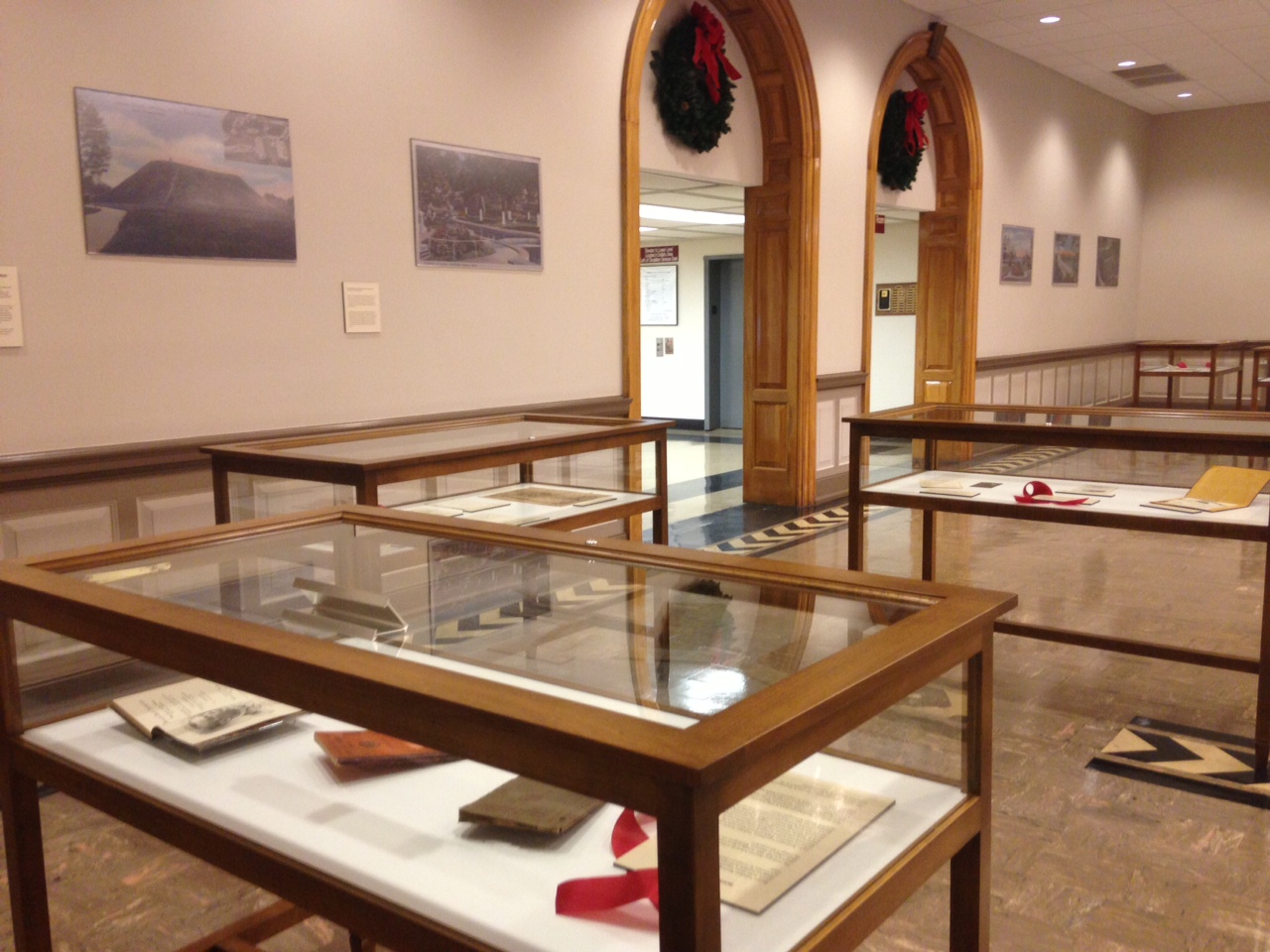
Editor’s Note: The James McClung Sieg journal currently is on display in the reading room of the W.S. Hoole Library. Visit these reading room display cases for a rotating gallery of our most recent acquisitions! 

With the recent acquisition of a portion of the daily journal of James McClung Sieg, the Special Collections Library has added a significant piece to its collection of materials on the life of William Henry Sheppard, one of the most remarkable men of his time—a man who “stood before kings, both white kings and black kings.”  Sheppard has strong local connections: though he was a Virginian by birth, he was trained for the Presbyterian ministry at the Tuscaloosa Theological Institute, forerunner of Stillman College;  his name is memorialized in the Sheppard Library at Stillman and in the name of the central Alabama Presbytery of Sheppards and Lapsley.  His wife, Lucy Gantt Sheppard, was a native of Tuscaloosa.

Sheppard-Image2

From Pioneers in Congo (1900)

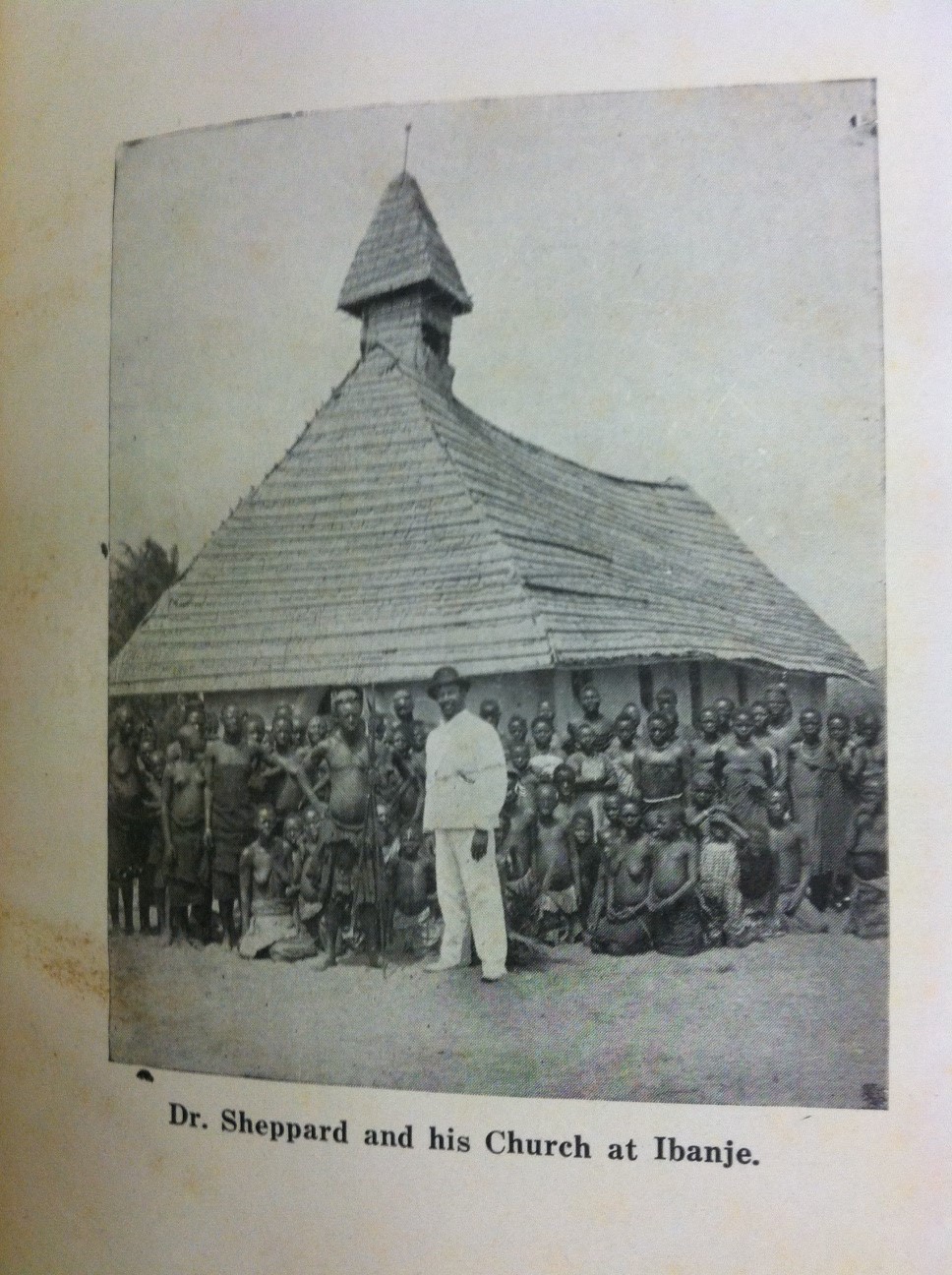
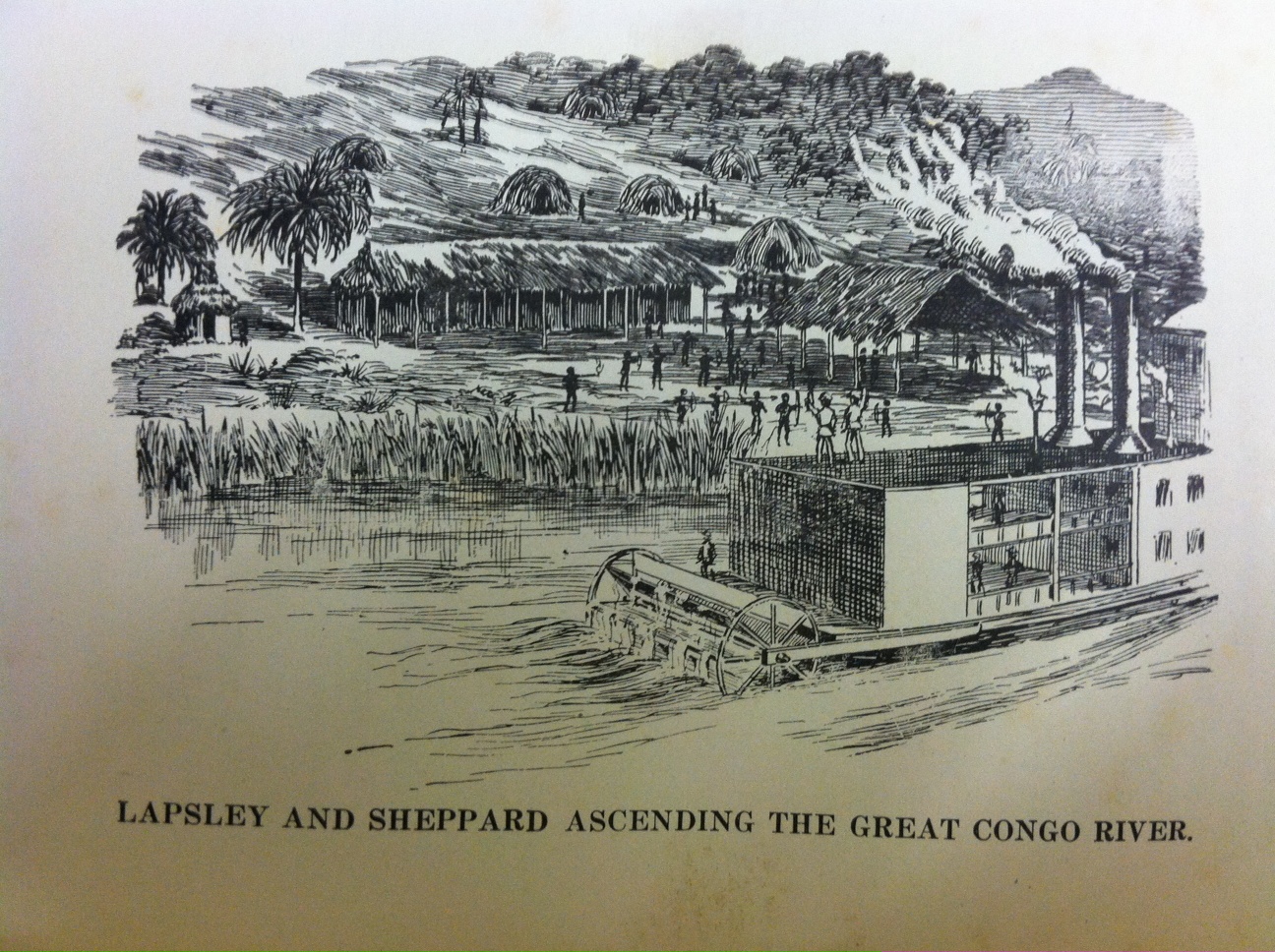
Special Collections owns two copies of Sheppard’s memoir, Pioneers in Congo(published by the Pentecostal Publishing Company in 1900) in which he recounts his early years in Africa, where he spent the better part of twenty years. He went out to the Congo in 1890, with Alabama Presbyterian minister Samuel Lapsley, and they established a mission compound near the Congo River.  Both conducted religious services and schools, but otherwise they divided the work;  Lapsley handled the accounts and dealt with the colonial officials;  Sheppard learned the local dialects, hunted and fished for food, and developed a strong rapport with the people of the surrounding villages.  Both were frequently ill with tropical ailments;  Sheppard was strong enough to throw off his twenty-two attacks of malaria, but Lapsley died after only two years.  Sheppard, joined by several other missionaries (including Sieg), was able to continue the work, and for the next seventeen years he was the leader among the missionaries and a towering presence among their African neighbors, who called him “Shoppit Monine,” “the Great Sheppard.”

Sheppard’s memoir is primarily an account of his travels among the villages, by river and on foot through the bush.  He was explorer as much as missionary;  he learned local languages and gathered as much information as he could before he set out. He was usually met with hospitality and curiosity (hundreds of people would gather to see him and hear him preach), but the Bakuba king had sent out word that outsiders would not be allowed into his country.  Sheppard set out to go to this forbidden land, learning as much about it as he could.  He described the trip to his men:  “I told them, from the information that I had, that the trails which had been made by elephant, buffalo, antelope, and Bakuba natives were many and they led over long, hot, sandy plains, through deep dark forests, across streams without bridges, and through swamps infested with wild animals and poisonous serpents” (91).  Sheppard and his men worked their way through the bush into the capital of the land of the Bakuba,  where Sheppard was able to convince the king that he was not an enemy but a man to be trusted.  He was thereafter well received.  In his descriptions of his travels Sheppard describes in detail the lives of the people he meets; he was an explorer in the best sense of the word, studying distances, routes, watercourses, animal patterns and other natural features;  for his work he was granted membership in the Royal Geographical Society of  Britain. In particular he reveals his appreciation for the artefacts of the area; he is recognized today as one of the first American collectors of African art.  Pioneers in Congo is illustrated with photographs made by Sheppard himself;  he was known for his photography.

Sheppard was deeply concerned about the colonial treatment of the Africans;  they were cruelly terrorized into  producing large amounts of rubber for European trade, causing them to neglect their farms and live in poverty.  Toward the end of the nineteenth century Sheppard and other missionaries spoke out strongly against these abuses;  Sheppard made several trips through the bush to investigate conditions and used his Kodak camera to make pictures of the ravages of people and villages. In 1907 he published an article in a missionary journal accusing the trading companies of mistreating the Africans.  He was charged with libel and threatened with prison, but the charges were dropped after a dramatic trial.   Sheppard became an international celebrity; he was received at the White House by President Theodore Roosevelt.  In 1910 the Sheppards retired from the African work and he served as a pastor in Louisville, Kentucky until his death.

Sheppard-Image1

From Pioneers in Congo (1900)

Sieg’s diary covers the years 1907-08 and part of 1910. By this time the mission was well-established; several missionaries lived in the compound (made up of several buildings) and traveled around the countryside to visit various churches and schools.  The manuscript gives a striking picture of a community isolated in a foreign culture, made up of a small group of like-minded people working for a common cause. Maintaining a semblance of their own lifestyle lifestyle seems to have required constant effort;  Sieg reports that he is called on for handyman projects like building and painting.  On trips through the bush he goes hunting for food;  he reports killing his first hippo, “shooting it between the eyes with the Winchester.”   Most impressive is the fact that this was a racially integrated community made up of white Southerners like Sieg (a Virginian) and black Southerners like the Sheppards. There is a strong sense of the unity of the group in Sieg’s narrative; this is significant because the group is racially integrated.  He makes no difference between blacks and whites; he refers to all his fellow missionaries formally, as “Mr.”, “Mrs.” and “Miss,” although for a Southern white to refer thus to African-Americans was practically unknown at the time.  The missionaries live on equal terms; they socialize frequently, help each other with projects, cooperate in the work. At this point Sheppard is clearly the group’s leader.  Sieg describes Mr. and Mrs. Sheppard as “extremely hospitable”; they often entertain the whole group for a meal (including Christmas dinner), followed by phonograph music.  Mrs. Sheppard and the other women are partners in the work, though usually described as involved with children and women.

Although most of Sheppard’s own papers are held by the Presbyterian Historical Society in Philadelphia, the University of Alabama Special Collections has a collection of materials that will support research on this important figure in American and African history and culture of the late nineteenth and early twentieth centuries.

Symbols of liberty

The Wade Hall Sheet Music collection features a great deal of music from the first two decades of the 20th century, especially music related to World War I. Maybe because America took so long to enter the war, it seems to have had a lot of time to consider what the war was about and what it might mean to eventually fight in it. Over the next year, as WWI reaches its centennial, we’ll be regularly featuring some of this music.

While a lot of WWI music is directly addressing one side of the war or other, consoling France or threatening Germany, much of it is directed at Americans, appealing to their patriotism. Today, we look at two prominent symbols of freedom featured in the cover art — and sometimes even the lyrics — of the WWI sheet music in our collections. Click any of the images below to see the full-size version.

First, the Liberty Bell.

More common are images of the Statue of Liberty. Because it was given to us by France, our eventual ally in the war, it was an especially potent symbol of why America was considering entering the conflict.

Bryce Hospital: An Introduction

By: Ellie Campbell, JD and University of Alabama MLIS graduate student

Bryce Photos

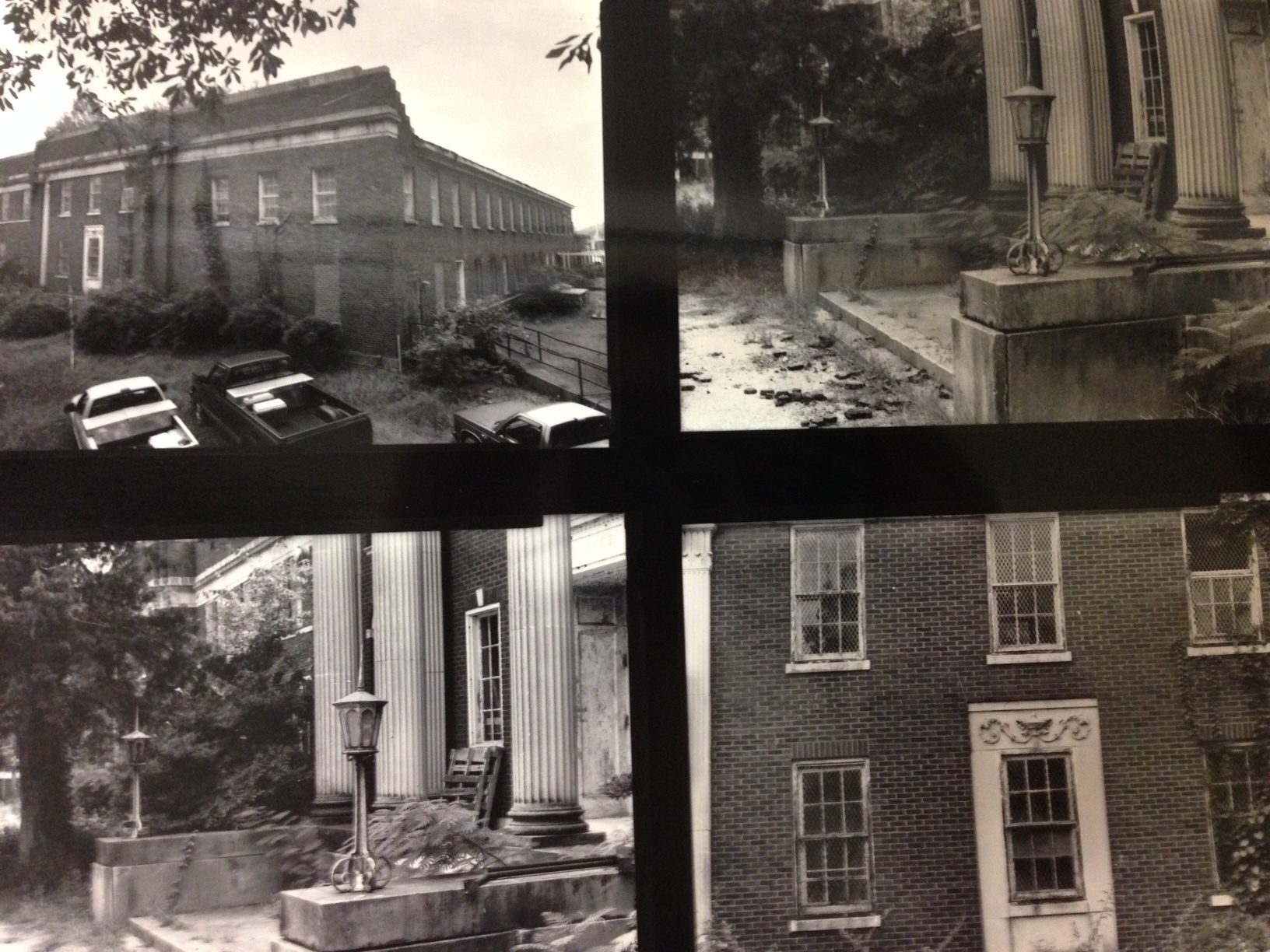
Bryce Hospital

In 1861, Bryce Hospital opened in Tuscaloosa, Alabama. The hospital provided for the care of the mentally ill in Alabama, and was inspired by the ideas and activism of Dorothea Dix, a reformer who studied their care in Great Britain and across the U.S. Dix believed that government should play a direct role in social welfare, and she lobbied many state governments and the U.S. federal government to create asylums to care for the mentally ill.  Prior to her efforts, treatment for the indigent and mentally ill across the U.S. was virtually unknown, with those who lacked resources or family to care for them confined to local prisons or almshouses. Support for a state hospital in Alabama began in the 1840s, and plans for Bryce were confirmed by the state legislature in 1852. Dix recommended Dr. Peter Bryce, a psychiatric pioneer from South Carolina, as the head of the new facility. Originally named the Alabama Insane Hospital, it was later renamed for Dr. Bryce.

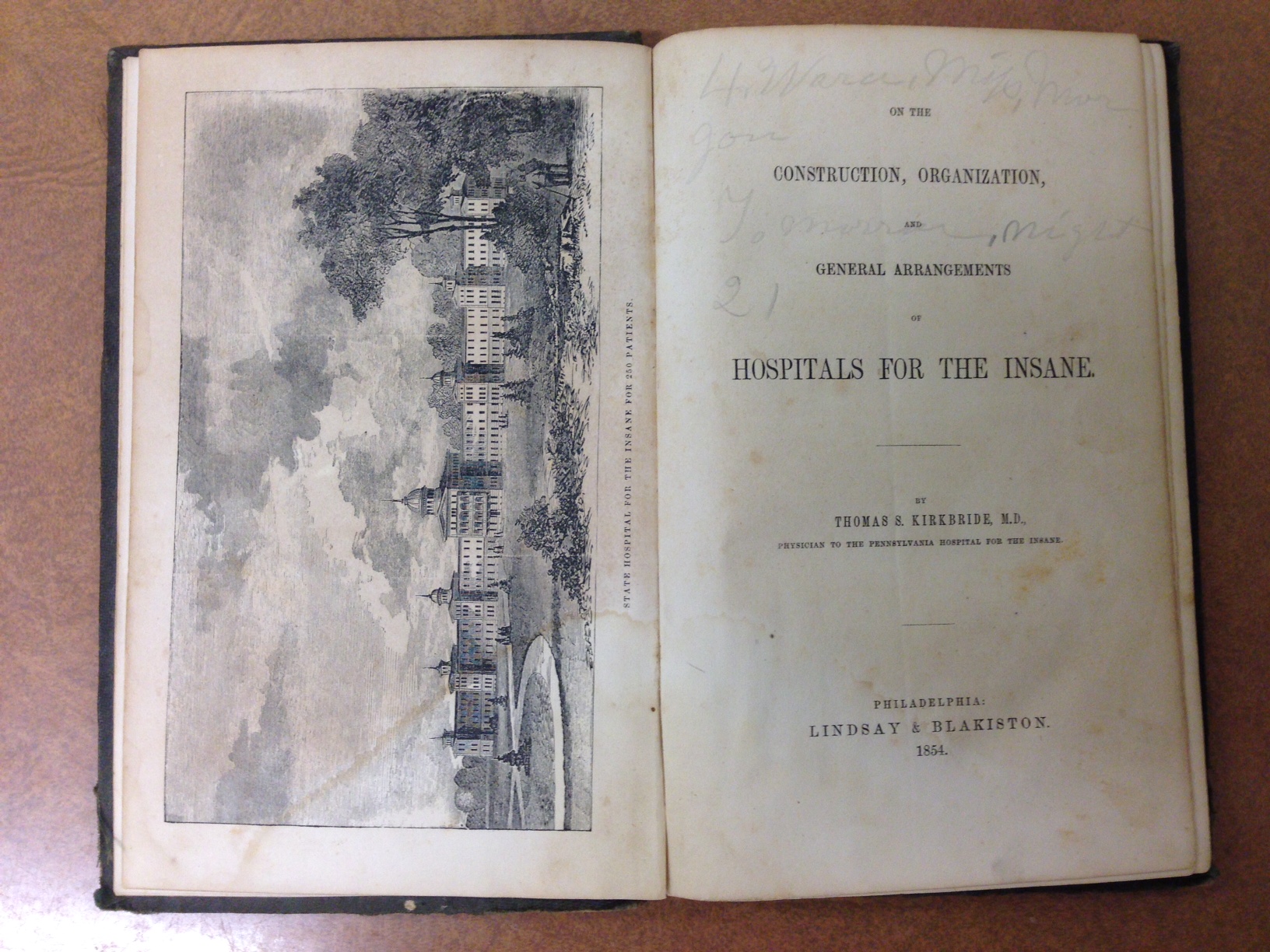
For The Insane

Hospitals for the Insane (1854)

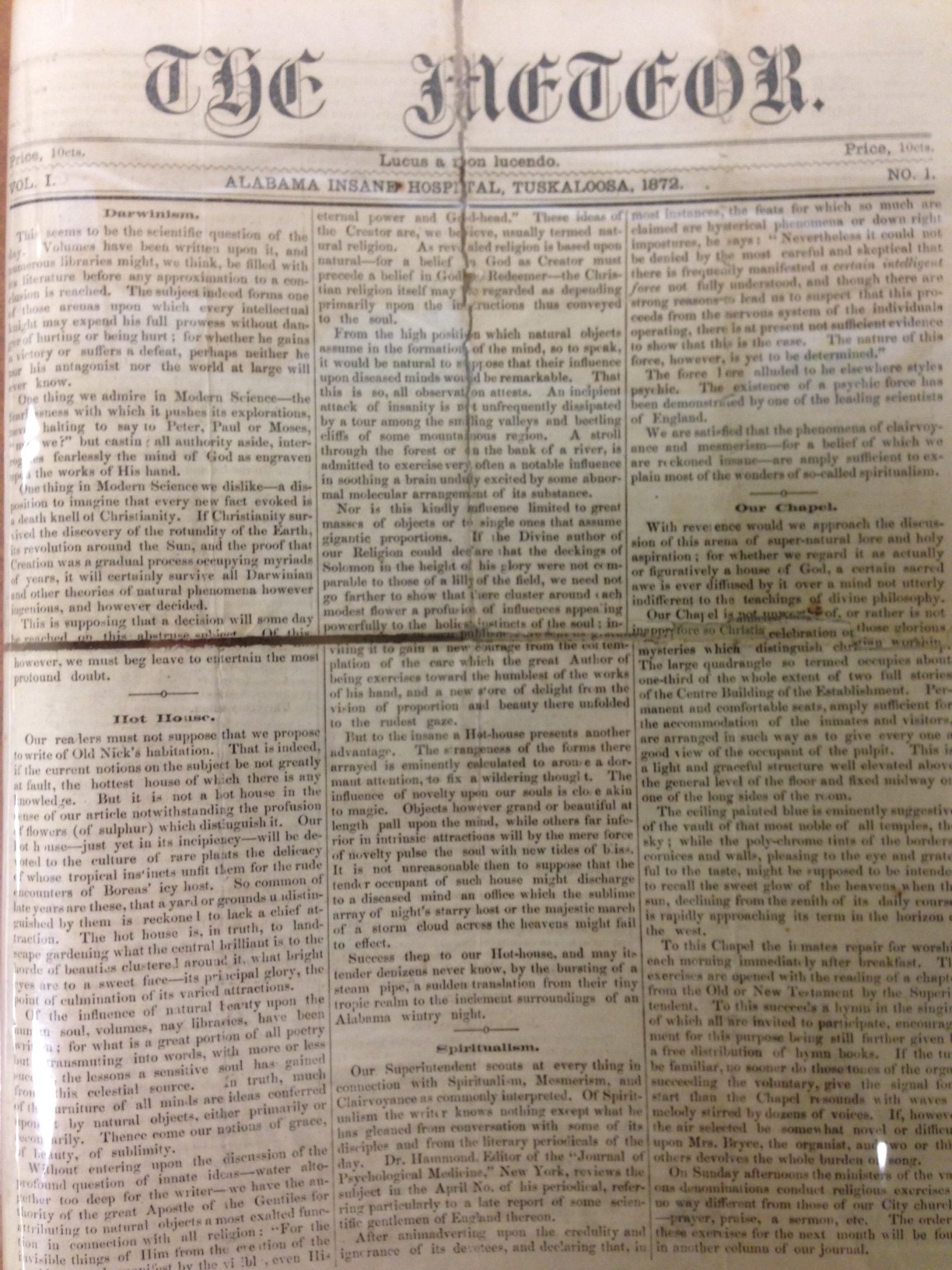
Bryce Hospital’s founding and early years, governed by the leadership of Dr. Bryce, were marked by a progressive approach to the treatment of the mentally ill. Bryce Hospital’s architecture utilizes the Kirkbride Plan, a building design created by Philadelphia psychiatrist Thomas Kirkbride, another mid-nineteenth century mental illness reformer. Like Dix, he advocated for the humane treatment of the mentally ill, and designed plans for asylums and hospitals to provide for their comfort and privacy. These institutions, including Bryce Hospital, often featured extensive grounds and farmland to be worked by patients for physical exercise and therapy. The hospital also emphasized occupational therapy and humane, respectful treatment of patients. Bryce Hospital was the first in the U.S. to unshackle patients and discourage the use of straitjackets. It also promoted work programs, and patients even published their own newspaper, The Meteor, from 1872-1881.

The Meteor

The Meteor

Unfortunately, Bryce Hospital’s progressive approach and scant funding from the legislature could not cope with the sheer number of people who needed treatment. By 1875, Dr. Bryce noted that the hospital had become more of a warehouse for the mentally ill and less of a rehabilitative center. The late nineteenth century also brought the rise of the new “science” of eugenics, a body of thought that supports improving the human race through encouraging the reproduction of people with desirable traits and discouraging the reproduction of people with undesirable traits. In practice, these beliefs resulted in forced sterilizations, support for racial segregation and the segregation of the mentally ill, forced abortions or forced pregnancies, forced euthanasia, and genocide.

To reduce mental illness, eugenicists in Alabama advocated restrictive marriage laws, sexual isolation, forced sterilization, and restricted immigration for the mentally ill. In the early twentieth century, James Searcy, the superintendent of Bryce, and his chief assistant William Partlow, were regional leaders in the eugenicist movement. Partlow sterilized all patients released from the hospital for fifteen years, and lobbied the legislature to pass a compulsory sterilization law.

During the 1930s, the Alabama legislature did pass a law giving superintendents of state mental institutions discretion to sterilize a wide range of patients, including those “habitually and constantly dependent upon public relief or support of charity.” The law did require some evidence of degeneracy, but it did not provide for judicial review. The measure was supported by several major Alabama newspapers and the mental health community, including scientists at the University of Alabama. It was opposed by a group of strange bedfellows, including organized labor, Catholics, leaders in the Baptist community, and the Alabama Supreme Court, which issued an advisory opinion that the law violated the due process of the U.S. Constitution. Fortunately for the state, Gov. Bibb Graves vetoed the law, mostly due to pressure from religious groups.

Meanwhile, conditions at Bryce and other mental hospitals in Alabama continued to decline over the course of the twentieth century. By the 1960s, patients received virtually no treatment in facilities that were overcrowded, filthy, understaffed, and underfunded. Daily food allowances came to less than fifty cents per person.

A class action lawsuit, Wyatt v. Stickney, was filed in 1970; circumstances were so bad that even mental health professionals who were being sued testified on behalf of the plaintiffs. The U.S. Attorney for the case, Ira DeMent, toured Bryce and found that beds lacked sheets, patients slept on floors, shower stalls did not work, human feces were caked on toilets and walls, and one small shower stall served 131 men and another 75 women. At the time, state appropriations for the mentally ill averaged less than seven dollars a day, half the rate of adjacent states. The legislature attempted to pass reform but could not.

After their failure, Judge Frank M. Johnson, Jr., issued his landmark opinion in Wyatt v. Stickney in 1971, ruling for the first time in American legal history that mentally ill and handicapped patients have a constitutional right to minimum standards of care. The case was upheld by the U.S. Supreme Court, but the legislature still dragged its feet in implementing the new care standards, complaining of federal judicial activism.

Federal health officials did not begin monitoring Bryce and other hospitals for compliance until 1977, when forced field labor, which has since been billed as a type of work therapy, ceased. The state did not sign a consent decree to provide adequate care until 1986. The state was finally declared in compliance with the new standards in 2003.

The University of Alabama acquired Bryce Hospital in 2009, and patients were moved to a new facility elsewhere in Tuscaloosa. Now, Bryce Hospital is the focus of a historic preservation project and the Alabama Department of Mental Health released a fact sheet summarizing the hospital’s history.

For further reading, see:

Flynt, Wayne. Alabama in the Twentieth Century. Tuscaloosa: University of Alabama Press, 2004. Especially p. 212-218.

Larson, Edward J. Sex, Race, and Science: Eugenics in the Deep South. Baltimore: Johns Hopkins University Press, 1995.

Tuscaloosa, The Nineteenth Century City (HY 300) Film Debuts

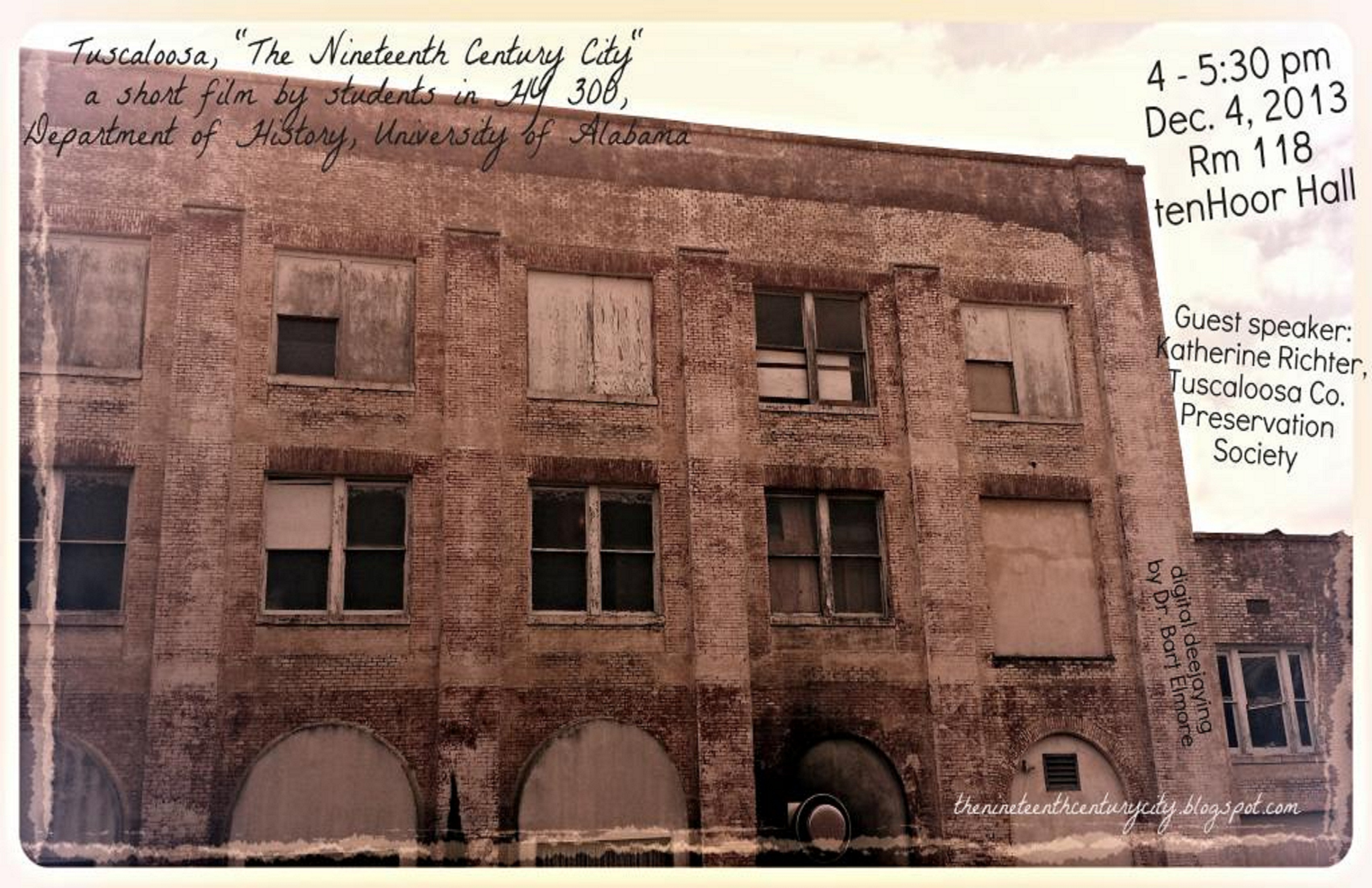
movieposter 11 x 17

The Nineteenth Century City

By: Amy Chen, CLIR Postdoctoral Fellow

This semester, History professor Dr. Sharony Green taught “The Nineteenth Century City” (HY 300) about the development of urban culture in the United States. As a final class project, her students developed a film about nineteenth century buildings in Tuscaloosa, which can be seen at the end of this post.

In order to conduct their research, the class visited Hoole Library back in August, seeking information on Bryce Hospital, First National Bank (now the Italian restaurant DePalma’s), Hunter Chapel AME Zion Church, Christ Episcopal Church, St John the Baptist Catholic Church, the Collier-Boone House, the Jemison Mansion, the Peck House, and the Kennedy-Foster House. Additionally, the class investigated The University of Alabama’s nineteenth century buildings, which include the Round House, Woods Hall, the President’s MansionManly Hall, and the recently-demolished Kilgore House.

Hoole Library prepared a handout for Dr. Green’s class on the best resources for studying these structures, which can be seen here as a PDF: The Nineteenth Century City_KMedit

Below is Sydnia Keene Smyth’s 1929 MA thesis on local architectural styles. This thesis is a great resource for afficianados of local history and is featured on the teaching guide created for “The Nineteenth Century City.” One of the most interesting aspects of this thesis is that Smyth’s original photos are pasted into the text.

Smyth2

Sydnia Keene Smyth’s MA Thesis (1929)

Yesterday, on December 4, Dr. Green’s students screened the film that resulted from their research. Afterward, Katherine Richter of the Tuscaloosa County Preservation Society spoke on the Society’s efforts to maintain, promote, and preserve these structures.

“Tuscalooasa: The Nineteenth Century City” represents the type of innovative project that results when University of Alabama students, faculty, and staff collaborate alongside members of the local community.

Augusta Evans Wilson, novelist and Confederate patriot

In the 19th century, more and more women became not just occasional novel writers but full time authors. Hoole Special Collections Library houses the papers of Georgia native Augusta Jane Evans Wilson, who published nine sentimental novels, including Beulah, the popular Confederate war novel Macaria, and St. Elmo, a novel so popular it spawned a parody (source: Wikipedia).

The digital collection includes two dozen letters Wilson wrote to her friend Rachel Lyons Heustis, covering personal matters as well as discussion of her writing and of the Civil War, topics which for Wilson were usually heavily entwined.

*

In a letter dated October 17, 1859, Augusta discusses her novel Beulah. Apparently, Rachel had some objections to it, for Augusta writes: “Most especially do I appreciate and prize the affectionate candor which impells you to acquaint me with the various objections urged against my book. Verily, there are numbers to flatter me, but very few sufficiently my friends to tell me honestly of my faults.” Wilson’s response to those questions can be seen below:

letter excerpt, October 1859

In a letter from around the same time, Augusta writes to Rachel upon hearing that she was planning to marry a Jewish doctor. The man was a friend of Augusta’s — she says, “I have no friend whom I should be so glad to see happily married, as Dr. Heustis” — but she follows that up by saying, “I must tell you, that I was very much astonished to find from your letter, that you had no informed your parent of your engagement!” She admonishes Rachel to do so, then she asks:

letter excerpt, circa 1860

She later adds, “If you love Dr. Heustis, no one has the right to forbid your marriage.”

In July of 1860, Augusta, unmarried herself, writes to Rachel about women writers and marriage. Apparently, there was a rumor that Rachel had written a novel herself, but Augusta was sure she hadn’t. She says, “I have often wondered why you did not write! Of course you know you could if you would; and my darling you have such a glorious field stretching out before you” — that is, her husband’s Jewish heritage. “Rachel write a Jewish tale; and make it a substratum on which to embroider your views of life, men, women, art, literature.”

Of women writers she has much to say:

letter excerpt, July 1860, part 1

letter excerpt, July 1860, part 2

(Though she claimed she would never marry, she did so in the years after the war.)

In a letter dated November 13, 1860, Augusta encourages Rachel in her plans to write: “Elaborate the plot, brace clearly to the end your grand leading aim, before you write a line and then you will find no trouble I think, in…the details.” She mentions George Eliot’s novel Adam Bede as a model, calling it “the most popular book of the age.”

She also talks of the impending war:

letter excerpt, November 1860

By the letter of February 2, 1861, the Civil War was just over two months away. Augusta speaks of the ladies of Mobile filling sand bags for nearby Fort Morgan,on Mobile Bay. She says: “My Father and both my Brothers belong to the garrison of Fort Morgan and you can readily imagine, how restless their constant exposure to attack renders me.” She also longs for the secession of other southern states:

letter excerpt, February 1861

On October 3, 1861, she writes of her expectation that the South will win the war:

letter excerpt, October 1861

She goes on to say: “In the thoroughly demoralized and panic=striken condition of the Federal Army subsequent to the battle of Manassas, one bold, vigorous, Napoleonic stroke must have decided the war; and the flames of Washington and Philadelphia, would have furnished light to write the terms of Peace.”

Later, she compares the Civil War to the ancient Second Punic War, picturing the South as Rome and the North as the eventual loser of that war, Carthage. She says, “Rachel, I am haunted by the fear that our leaders lack nerve; that we have No Scipio to carry the war into Africa. For months, the burden of the Southern press has been, delenda est Carthago [Carthage must be destroyed]!” She hopes that they are not, indeed, the Carthage of this conflict, the winner of a major victory but not the war: “I pray Almighty God, that future historians may not record of this our war of Independence, that, Manassas Junction was the Cannae of the Confederate Army.” Unfortunately for the South, it was.

In a letter dated January 22, 1862, Augusta discusses working in a hospital near her home: “Oh! My darling if I could tell you of all I have witnessed, and endured since I became a hosptial nurse!” They treated illnesses like Typhoid Fever and pnuemonia with brandy, ammonia, and quinine.

In September 12, 1863, she updates Rachel on the progress of her newest novel, Macaria, which was eventually a popular work in both the North and South. She also makes many comments on General Beauregard, including the following: “God grant that Beauregard may hold Charleston successfully. If any human being can, he will.”

In a letter dated May 1, 1864, she discusses the reception of Macaria, saying that some have “pronounced it superior to Beulah.” But she seems to still want Rachel to serve as a sounding board for her work: “I trust when you have carefully read it, you will give me your opinion frankly concerning its merits and defects.” The letter also returns to the subject of Rachel’s marriage, Augusta’s hopes that Rachel’s parents have accepted their new Jewish son-in-law:

excerpt of letter, May 1864

*

For more on Augusta Jane Evans Wilson, see her entry in Encyclopedia of Alabama.