Cool@Hoole

Flashback to Emphasis ’68: Strom Thurmond

Continuing this week’s look back at Emphasis ’68, we deal with an archival reality — sometimes, things don’t survive long enough to be archived, but they often leave interesting traces behind.

Thurmond_photo (Image from the 1969 Corolla yearbook)

Senator Strom Thurmond was one of the noted speakers at Emphasis ’68. We know this because we have written evidence from newspapers and other media of his visit and speech. What we don’t have is the speech itself. That reel of tape didn’t find its way into the box along with the others when the material was originally drawn together.

What we do have is pretty interesting on its own, though. Thurmond did a forty-minute Q & A session, and his audience didn’t pull any punches, addressing the U.S.’s involvement in Vietnam as well as recent Civil Rights-related violence in his home state of South Carolina (see this Wikipedia article on the Orangeburg Massacre).

You can listen to the Q & A in Acumen. But before you do that, you’re not left high and dry about the speech:

Click on the image below to read a preview from UA’s student newspaper, The Crimson-White, in its Emphasis ’68 Special:

Thurmond_article

You can also read a transcript of the prepared speech Thurmond gave to the press in advance of the event.

And below you’ll find a follow-up article from the March 25, 1968, edition of The Crimson-White:

Thurmond_report

Flashback to Emphasis ’68: John Kenneth Galbraith

We continue our look at Emphasis ’68 with a speech from John Kenneth Galbraith, who is introduced as an “antenna and synthesizer” of economics and social theory.

Galbraith was a prominent economist and author, and he served in important posts under several Democratic presidents, including as U.S. Ambassador to India under Kennedy. At Emphasis ’68, he spoke on the topic “The Impact of Vietnam on American Life.” He discussed the evolution of the U.S.’s foreign policy from WWII up to the Vietnam War –namely, its strategies of dealing with Communism — and called for a change in approach. He also took several questions on current events and public figures.

Galbraith_photo
(Image from the 1969 Corolla yearbook)

Click on the image below to read a brief preview from UA’s student newspaper, The Crimson-White, in its Emphasis ’68 Special:

Galbraith_article

Go to Acumen to listen to his hour-long speech: part one and part two. The speech concludes very briefly in part three, which is devoted to a half hour session of Question & Answer.

Click on the images below to read the follow-up article from the March 25, 1968, edition of The Crimson-White:

Perhaps even more interesting than the news recap is a letter to the editor from the April 1, 1968 edition of The Crimson-White. In it, Vietnam vet Tim Nall discusses the impact Galbraith’s speech had on his thinking — it didn’t change his views, but it made him think about why he holds them. Click on the images below to read the letter:

This kind of reassessment seems like just what Emphasis was designed for, to get students and others in the UA community to thoughtfully explore the issues of the day.

Flashback to Emphasis ’68: Roy Wilkins

Forty five years ago this week, The University of Alabama began its second annual symposium on contemporary issues. Known as Emphasis, it ran from 1967-1971, with varying degrees of success. This week, we revisit some of its more memorable speeches and speakers, as chronicled in various Digital Collections here at UA.

Emphasis ’68 was the high water mark of the program, drawing prominent thinkers and politicians who spoke on a variety of hot-button issues. The slate of speakers included Robert F. Kennedy, who had only days before announced his bid for the presidency and who would be killed just a few months later. Hear his speech here.

On March 21, 1968, the first day of the program, Roy Wilkins, the Executive Director of the NAACP, spoke for about an hour on the topic “Race Relations at the Crossroads.”

Wilkins_photo
(Image from the 1969 Corolla yearbook)

For background on Wilkins and a preview of his speech, click on the image below to read an article from UA’s student newspaper, The Crimson-White, in its Emphasis ’68 Special:

Wilkins_article

You can listen to the audio files in Acumen here.

Or for an overview of the speech, click on the image below to read the follow-up article from the March 25, 1968, edition of The Crimson-White:

Wilkins_report_1Wilkins_report_2

Free Digital Preservation Webinars!

After a series of very successful ASERL webinars on introductory digital preservation in the spring of 2012, a survey of librarians and archivists indicated that the most important topics for successive webinars centered on metadata selection, extraction, creation and storage as well as planning ahead. Based on this feedback, ASERL is hosting a new series of four 60-minute digital preservation webinars this April to aid librarians, archivists and others in learning practical steps to addressing digital preservation issues. All sessions are free, and further updates can be found here. Each one is approved for one Archival Recertification Credit through the Academy of Certified Archivists!

The first webinar will be presented by Lisa Gregory of the North Carolina Department of Cultural Resources, and is entitled “Preservation Planning and Overview of PREMIS for Beginners.” Designed to help participants begin formulating a digital preservation plan for their digital collections, the topics to be covered also include first steps for implementation, and a basic introduction to PREMIS, the Data Dictionary for Preservation Metadata.

DATE: Tuesday, April 2, 2013, 11:00 AM – 12:00 PM EDT
Register here!

The second webinar, presented by Chris Dietrich of the National Park Services, is entitled “Forbearing the Digital Dark Age: Capturing Metadata for Digital Objects.” Chris emphasizes the importance of metadata for both discovery and long-term accessibility, and will discuss categories of metadata, standards for different asset types, capture strategies and software tools. The formats addressed include digital photos, documents, audio-video, tabular data, and GIS data.

DATE: Tuesday, April 9, 2013, 11:00 AM – 12:00 PM EDT
Register here!

The third webinar will focus on the hot topic of “Management of Incoming Born-Digital Special Collections,” and is presented by Gretchen Gueguen from the University of Virginia. She will cover basic techniques and practical suggestions on how to assess a collection, develop a management plan, and set up an accessioning workflow and basic policies. Simple tools, guides and resources will be reviewed as well.

DATE: Tuesday, April 16, 2013, 11:00 AM – 12:00 PM EDT
Register here!

The final webinar covers “Using FITS to Identify File Formats and Extract Metadata” and will be presented by Andrea Goethals of Harvard University. After an introduction to file formats and technical metadata, Andrea will demonstrate the use of the File Information Tool Set (FITS). She will explain what it does, how it differs from other format tools, how to use and customize it, and how Harvard uses this tool. No prior experience with FITS is necessary.

DATE: Tuesday, April 30, 2013, 11:00 AM – 12:00 PM EDT
Register here!

The Lecture that Never Was: Eleanor Roosevelt and the Death of President Foster

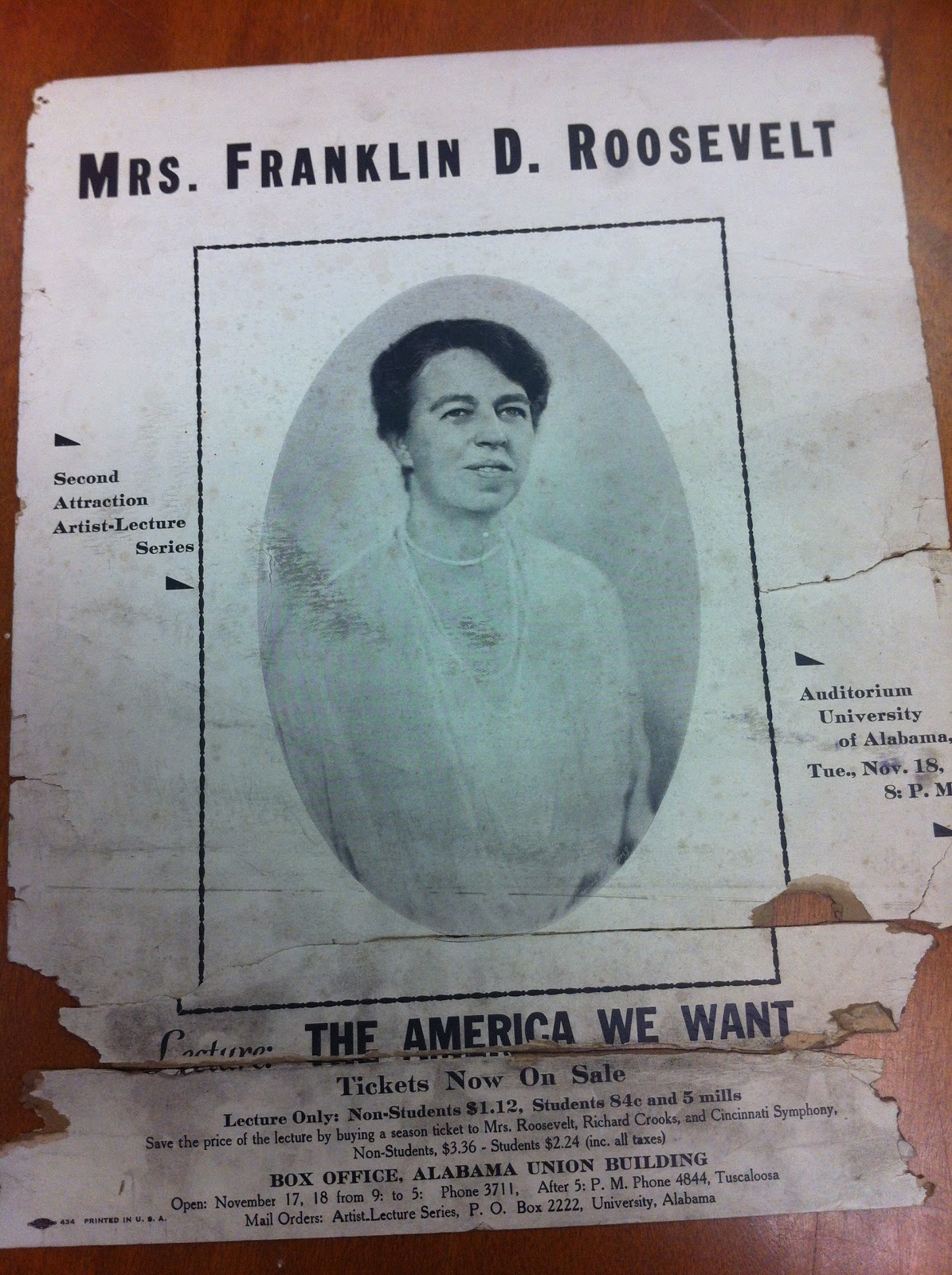
On the back of an unassuming phys ed grade chart, the discovery of a lecture that never was has come to our attention and to our collections, thanks to Ken Gaddy and the staff at the Bryant Museum. 

On November 18, 1941, Mrs. Franklin D. Roosevelt, first lady of the United States, was scheduled to deliver a lecture entitled, “The America We Want” in The University of Alabama auditorium.

The lecture was never to be.  According to Mrs. Roosevelt’s “My Day” column for November 19, 1941, she was asked to cancel her engagement at The University of Alabama because of President Richard Clarke Foster’s illness. “After my lecture last night, in Greenville, we returned home, for, unfortunately, the President of the University of Alabama, where I was to lecture tonight, was taken seriously ill, and they asked me if I would cancel the lecture. To find myself at home with two unexpected days of leisure is something really to rejoice over, though I am sorry the cause had to be somebody’s illness.”

Sadly, the sudden illness that struck President Foster took his life.  He passed away on November 19, 1941.  He was much beloved on campus, and in addition to an immediate fund drive to purchase the Richard Clarke Foster Memorial Iron Lung for Druid City Hospital (his sudden illness brought to light the immediate need for such a machine), the very auditorium where Mrs. Roosevelt was to speak was named in his honor soon after.

Foster Auditorium, in its newly renovated glory, served as the site for countless dances, pep rallies, performances, basketball games, class registrations, as well as the very place where integration finally came to pass at The University of Alabama.  While many may remember hearing of Mrs. Roosevelt’s lecture that never was, and know of Dr. Foster’s sudden and untimely death, might not realize how these two events were connected.


Campus Rewind: Woods Hall

Woods Hall has a long history on the UA campus, longer than most other buildings.

Built right after the Civil War, it was still a landmark over a hundred years later, when student protests halted its demolition. It was renovated in the 1970s, and today it houses the Department of Art and Art History. Let’s take a look at the building’s use over the years.

*

If you peek through the trees, you’ll see the building, circa 1874. There are still ruins of Civil War destruction in the foreground.

Woods Hall 1874
UA Photo Collection

In the late 19th century, the building housed cadets. Here they are practicing their drills.

Woods Hall 1890s
UA Photo Collection

In the 1910s, folks arrived on campus in horse and buggy.

Woods Hall 1910s
The UA Encyclopedia

The building saw the calm 1950s…

u0001_2007001_0000661_2048
UA Photo Collection

…and well as the turbulent 1960s.

Woods Hall 1960s
Education Media Photo Collection

Here it is, filled with students, in 1969.

Woods Hall 1969
The UA Encyclopedia

In 1975, the building was under renovation.

Woods Hall 1975
The UA Encyclopedia

Here it is later that year, after the renovation was complete.

u0001_2007001_0000851_2048
UA Photo Collection

u0001_2007001_0000849_2048
UA Photo Collection

James Hood

On any given weekday, you will see a variety of students from different ethnicities, religions and socioeconomic classes wandering the quad, dorms, and halls. As an institution, we have come to reflect and embrace these differences, but the University of Alabama has not always been open to the idea of diversity. Just fifty years ago, there were riots and protests to keep individuals who did not share the same skin complexion out of the classroom here at The University of Alabama.

James A. Hood
In 1963, James Hood was one of the first African Americans to attend the University of Alabama. Could you imagine having to be escorted by the National Guard just to enroll because your presence is not wanted due to the color of your skin? Accompanying him on his journey was another student named Vivian Malone. Governor Wallace was against integrating the university and such and stood at the doors of Fosters Auditorium. Despite Wallace’s attempts at keeping Hood and Malone from registration, they were later enrolled and attended classes soon after. Hood eventually switched to Wayne State University in Detroit, where he graduated, although he later came back for graduate studies here at the University of Alabama. As Governor Wallace ran for presidency, he was shot, which left him disabled, and Hood visited him a few times. It was said that Wallace and Hood became friends and Wallace apologized for his actions in the prior years.
James Hood was laid to rest in January of 2013. He will always be remembered as a courageous man who contributed to paving the way for individuals, like myself, to attend the University of Alabama. We have come a long way in 50 years.

When patterns attack

Up until about a month ago, I’d never heard the term moiré pattern, but I’d definitely seen them in action. You probably have, too. It might’ve looked something like this…

moire_color

…or maybe this…

moire_swirl

A moiré pattern, which may appear as shimmering lines or dots or even swirls, can manifest itself when two similar but not identical patterns are superimposed or two identical patterns are superimposed at an angle. (It’s the visual equivalent of what happens when you’re driving in the car, listening to music, and you hear the song’s beat begin to sync up with your turn signal…but just for a moment.) In images, what causes the interference is not easy to spot — because one of the patterns in question comes from the workings of the camera itself.

A digital camera has a particular pattern to how it senses color. Reds, greens, and blues are captured and translated into pixels in a grid-like Bayer filter pattern. When that sensor grid in the camera lines up in a certain way with a pattern in the object you’re photographing — the pattern on someone’s shirt, for example, or simply the pattern of dots that manifest in offset printing — strange things can happen.

The following images show a black grid partially laid over a Bayer filter pattern.

Black grid of same scale as the Bayer pattern:

bayer_and_1to1_offset_mask

Black grid a bit larger in scale.

bayer_and_off_interval_offset_mask

We’ve found that moiré patterns don’t creep into our camera-based digitization very often — they wouldn’t show up in handwritten materials or photographs, the bulk of the archival material we capture — but when they do, they can be a real problem.

We’ve developed some methods of dealing with the psychedelic-looking color patterns intruding upon our workflow. There are actions we take during the capture process that normally combat the problem pretty well, but we also have a couple of tricks up our sleeves for correcting the problem in post-production. Full disclosure: we exclusively run into problems based in the color channel, rather than the brightness channel (we get dot patterns rather than swirls), so that’s what these methods are designed to address.

During Capture

The front-line defense for making the pattern disappear while a digital image is being taken is to change the relationship of the object and camera. Hopefully, this will bring about a different relationship between the object’s pattern and the camera’s.

1. Orientation: Rotate the object until a test shot or preview shows that the pattern disappears. Here are the grids from example one above, set at a 45 degree angle from each other.

offset_rotation_45_degrees

2. Distance: Move the camera or the object so that they are at least a few inches closer or further apart.

After Capture

While it’s better to nip the problem in the bud before you take the picture, there are a couple of ways to improve — but not entirely fix — the image after it’s been made.

1. Photo editor tools: Use a moiré correction tool if your photo editor has one. We use Adobe Bridge’s camera raw editor to crop and rotate images, and we found that it has a Moiré Reduction tool suitable for dealing with minor cases.

2. Manual RGB manipulation in Photoshop: I won’t pretend to describe this process here, but it involves manipulating the values of the RGB channels, and it must be done on a case-by-case basis. It’s not something that makes sense for the average digitization project’s workflow.

There is no one simple fix for moiré interference patterns. As you photograph things with a digital camera, be on the lookout for that tell-tale shimmer of color, and see what you can do to re-position the object as you’re shooting it. Hopefully, you won’t have to bring out the big, complicated guns. Avoiding combat in this case really is half the battle.

The Other Black Art

Since we are two days away from Valentine’s Day, you’re probably expecting a blog about love and romance. Close, this blog is about the automation of repetitive tasks through the use of a scripting language, and who doesn’t love that?

Perhaps you find yourself working on a task that seems mindlessly repetitive. Maybe as you drift into a boredom-induced coma, you think to yourself that surely such a task is better suited for a tireless machine to slave away on, and not an easily bored human. I recently had a similar inner monologue, but instead of waiting for the age of reasonably affordable robots, I decided to use a bit of wizardry to make my computer complete this task for me. That is to say, I wrote a script.

Scripting languages are wonderful things, and share a lot in common with their two ancestors, genies and magic. In layman’s terms, scripts do stuff. Computer stuff. Stuff you don’t want to do. Any computer-based task which can be handled by a human (and doesn’t require any sort of creativity) can conceivably be handled by a script. Bill Gates is quoted as saying:

The first rule of any technology used in a business is that automation applied to an efficient operation will magnify the efficiency.

Scripts are especially well suited for the long, mindlessly repetitive tasks that leave most of us humans cringing. These tasks involve a set of actions controlled by a specific set of rules, like say only moving files with certain filenames, or changing one specific file type to another. These actions and rules need to be explained to the computer in a language the computer understands. Computers are basically dumb; they can only count to 1. You could write your programs in zeros and ones if you wanted to (I don’t) or you could use a higher language that interprets your commands into zeros and ones for you.

I am currently learning two scripting languages, Perl and Python (In my spare time I’m also trying to pick up a little AHK and a micro-controller language, but that’s neither here nor there). Of these, Perl is quickly becoming my favorite for a number of reasons. I like the way variables and arrays are easily distinguishable by their leading “$” and “@” signs respectively. I enjoy not having to call variables, and of course there’s CPAN (an online database of pre-written code, which I’m sure will prove helpful in the future). On the other hand, Python doesn’t require the trailing semi-colon or curly brackets which is nice, though it’s really just a lateral move when you consider Python’s force indent policy. In the end, it doesn’t matter what scripting language you choose, just choose one and learn it. You don’t have to master every aspect of the language in order to write useful scripts; you’ll be surprised what you can accomplish with just some basic working knowledge.

The task I wanted to automate involved moving files from one directory to another, while creating unique folder names based on the first 21 characters of the file names, and then moving said files into said folders. Not a particularly difficult task when there are just a few files, but when you would need to routinely accomplish this for a large quantity of files it becomes time consuming. Thankfully, it’s also immanently script-able. So I wrote a script in a Perl, tested it, and when it was fully functional made it available to the rest of my team. Another co-worker, who happens to also possess programming know-how, wrote a graphic user interface for my script which added to the script’s usability. I went back in and changed the color scheme to his interface which added to the script’s prettiness. But the important part is, my script will save me and my co-workers a little time every day, and that’s time and energy that can be put towards other tasks. Tasks better suited for us humans.

-Austin Dixon, Digitization Technologist | Hoole Library

Please Write Soon

We often think of Valentine’s Day when we think of February, but that month can be hard for people separated from their loved ones.

Whether at home or abroad, soldiers have always found it difficult to be days, weeks, months away from their sweethearts, connected through the postal service or, at best, a telephone. This week, we take a look at some letters written to and from soldiers in various wars, all during the month of February.

Civil War

Writing to his wife Alice in Eutaw, Alabama, John Meriwether shows her how much her letters mean to him.

u0003_0002217_0000107_0001_2048

Meriwether is stationed at Vicksburg, Mississippi, in February 1863, when he writes, “How happy I was yesterday evening when our Regt mail boy brought me another precious letter from you announcing that our little darling Juliet was again well and able to take a long walk with her mother. Oh, Alice you have no idea how blue it makes me when I hear that you or Juliet are sick. And language can not express my joy & happiness when I hear that all of you are well and enjoying yourselves.”

The next year, John Boatwright writes to his wife in Columbia, South Carolina, from his location in Georgia.

u0003_0001645_0000005_0001_2048

Boatwright has a more flowery style than Meriwether, and he uses it to pour out his loneliness: “I am very unhappy, and do you not think I ought to be having all the dear ones far behind me and coming to this land of strangers. Oh! that I could spend one sweet hour in the presence of her whom I love above all things. When with you my darling, (it seems when I leave you) that I do not appreciate you enough, and when in some of my gloomy feelings, I am sure I can say I am the most unhappy of mankind.”

WWI

It seems like most of the WWI soldiers in our collections write to friends and family, but at least one writes with regularity to his wife and children. Dr. Alston Fitts wrote several letters from France in 1918 and 1919, including this one, that begins, “How I long for you to-night!”

u0003_0000520_0000020_0005_2048

He goes on to describe what it’s like in his tent, so that they can picture him there and imagine how he must be feeling. In another letter, he images himself with them, as they’re curled up reading his letter:

u0003_0000520_0000022_0004_2048

“Don’t see how I ever brought myself to the point of leaving you and the children so far behind, but we will look forward to a happy meeting when this horrid war is over. So now, nestle up close, while I kiss you all good night.”

WWII

While Meriwether, Boatwright, and Fitts write to their wives, Fred Lindsay’s correspondent is his sweetheart, Helene Phillips. He sends her letters by V-mail from his position in the South Pacific.

In February 1944, he tells her about his work in the chaplain’s office, as well as the kind of thing the men have been doing to entertain themselves. He talks of a “swimming meet” with the Australians, with each man “in his birthday suit,” attempting to win, among other things, cigarettes.

u0003_0002256_0000011_0001_2048

But, clearly, Lindsay is also worried about his girl, because he admonishes her, “please take good care of yourself.” That was something Phillips was apparently not good at doing, as evidenced in one of her letters to him.

Here, she says she’s concerned about him, too — “Under the circumstances I worry when I don’t hear from you” — and she later admits, “Instead of taking care of myself I continued to work until I just fell apart.”

u0003_0002256_0000023_2048

She closes by saying, “I guess I just can’t take these hours after two years of this stuff. Please write soon.”