Cool@Hoole

Transcribe our letters!

UA Libraries has installed web-based transcription software (Omeka and Scripto) to enable anyone to transcribe old letters and documents online.  I’ve uploaded a box of correspondence from the Cabaniss collection (about a wealthy landowner who wanted to free his slaves via his will — many of whom were his own children) — and another box of correspondence from the William Gorgas collection.  Gorgas was famous for his work in discovering  a cure for yellow fever.

;
;

Take a look!!  And tell your friends!  Your transcriptions will enable us to make it easier to find content, as the words you entered will be used to support search and retrieval for scholars everywhere.  Thank you in advance for your participation!

1920s Advertising

This week’s post is the beginning of a series of blog posts looking at vintage advertising. We are starting with advertising from the 1920s. These ads have been pulled from The Rammer Jammer, a student publication of the university from 1924 to 1956. During the 1920s, the Rammer Jammer’s target audience was young men, as evidenced by these ads.

An ad for Saks Department Store from 1924

An ad for Langrock Fine Clothes reflecting the style in 1925

An ad for Arrow Shirts featuring a stylish golfer in 1925

An ad for Lime Cola from 1925

An ad for the new Charlie Chaplin movie, "The Gold Rush," in 1926

An ad for Prince Albert tobacco from 1926

A Chevrolet ad from 1926

A Coca-Cola ad, using the same logo the company uses today, from 1927

An ad for Badham and Company Clothing, featuring another stylish golfer in 1927

Digital Services is hiring!!!

Digital Services at the University of Alabama is hiring for two new positions:
Digitization Technologist and Digital Repository Manager!

For more information, or to apply, please go to http://staffjobs.ua.edu and search in the Working Title field.

Digitization Technologist

The Digitization Technologist will analyze technical problems and devise
solutions, as well as seek out methods for new and better functionality.
Research into improved methods of delivery and preservation support is
expected.

The Digitization Technologist position requires an individual who is
self-motivated, curious, and eager to learn and explore. The successful
applicant will have a good base of understanding of a variety of
technologies related to digitization and digital libraries, and will be
capable of quickly processing and integrating new technical information
and developments. This position requires strong analytical problem-solving
capabilities and technical expertise. Command-line scripting capabilities
are expected.

The Digitization Technologist will be involved in developing software
support for digitization, preservation and delivery work flows.
Additionally, this position will be responsible for capture, quality
control, optimization, gathering of administrative, technical, structural,
and descriptive metadata, and tracking, archiving and storage of resulting
digital objects.

The Digital Repository Manager

The Digital Repository Manager will be focused on the management and
support of our growing repository of content, as well as development of
support for new and better functionality. This person will research
software developments in the field and potentially modify those we adopt
to meet our own needs. He or she would be deeply involved in
infrastructure development and support for long-term access. The Digital
Repository Manager will analyze technical and work flow problems and
devise and implement solutions.

This Digital Repository Manager will be involved in developing and
managing software support for digitization, preservation and delivery work
flows. Additionally, this position will be responsible for capture,
quality control, optimization, gathering of administrative, technical,
structural, and descriptive metadata, and tracking, archiving and storage
of resulting digital objects.

Please share this information with qualified people who may be interested!
Yea, Alabama!

Right now is an exciting time for the University of Alabama’s football team. And most Bama fans would agree that football games just wouldn’t be the same without hearing Alabama’s fight song, “Yea, Alabama!” This song was penned in 1926 in response to a competition held by the university’s student magazine, the Rammer Jammer, to replace the current fight song being used, “Swing,” which was owned by Washington and Lee University. The winner of the competition was an engineering student and the editor of the student newspaper, the Crimson White, Ethelred Lundy (Epp) Sykes. Sykes won a $50 prize for composing the tune.

We have a number of copies of Rammer Jammer available online, including the issue that features the new fight song, from May 1926. Below are images of the pages that contain the music and lyrics for the song. Notice that the original version has an extra verse placed before where the fight song is traditionally begun now.

The Battle of Lookout Mountain

This Thursday, November 24, is not only Thanksgiving Day, but also marks the 148th anniversary of the Battle of Lookout Mountain, a major turning point in the Civil War. The defeat of General Braxton Bragg’s Confederate Army of Tennessee at Lookout Mountain allowed Major General Joseph Hooker’s Union army to assist at the Battle of Missionary Ridge the following day. Bragg’s army was again defeated, which lifted the siege of Union forces in Chattanooga, and opened the gateway into the Deep South.

Within our digital collections we have the Meriwether Family Papers. These papers contain a great deal of correspondence from John Samuel Meriwether to his wife Alice while he was serving in the 38th and 40th Alabama Infantry Regiments during the Civil War. John was stationed at Lookout Mountain during this battle and wrote to Alice about his experiences. Included are some excerpts from his letters here, but there is much more to be found throughout the Meriweather Family Papers about the life of a soldier in the Civil War.

Excerpt from a letter written from John to Alice from Lookout Mountain, November 13, 1863, 9 days before the Battle of Lookout Mountain:

Our brigade is still in advance of the camp grounds some there on four miles. I am staying at the camps with the sick. I said that the Brigade was in advance, I should have said on the left about three miles from me and a little in advance. None of us can advance any nearer the Yankees than we are unless we camp with them. The Yankee pickets and camps are in sight of me at this time. Our pickets and the Yankee pickets exchange papers and chat with each other every day, nothing but a little creek divides them. They will not fire at each other if they stay on their side of the creek. Our cannon are shooting every day from the top of Lookout Mountain. I sat in my camp yesterday and watched them firing for an hour. I don’t know what damage was done if any. I am listerning every day for something to turn up. If we do have a fight here it will be a desparate one.

Excerpt from a letter written from John to Alice from the foot of Lookout Mountain, November 17, 1863, 7 days before the Battle of Lookout Mounain:

Well my dear I thought that we would have a genarl fight this morning. Just about daylight I heard the signal gun fire on the mountain and in a few moments a perfect volley of musketry was heard some distance off on our right-wing. It lasted about fifteen minutes and then ceased. While that firing was going on four or five brigade passed right by my tent – going on to the left. It struck me at once that Bragg had made a […] on the right and would make a general attack on the left. But it seems that I was mistaken as everything is perfectly quiet along the line, except now and then the report of a cannon from our guns on the mountain and a reply from the guns of the enemy. There is a great stir among the troops, and I would not be at all surprised to hear of a general fight all along the lines at any moment. We are compelled to have a bloody fight at this place I think. It is one of the most important points of defence that we have and we can not give it up without ruining ourselves and injuring our cause very seriously indeed. I think on the course of two weeks we shall hear something and know something with regard to our situation at this place. If I had the controlling power I should end this thing without any more blood being lost. But I […] the wise heads of the Confederacy will carry on the affair much better than a man of my sense can. Therefore I shall not give myself any more trouble about it than I can help. I will say this much, that I do wish the war would end and end right now, never to be renewed.

Excerpt from a letter from John to Alice from Dalton, Georgia, November 28, 1863, 4 days after the Battle of Lookout Mountain:

It will not doubt to appear a little strange to you to see my letter headed Dalton. Well my little darling I’ve have had two days heavy fighting on the 24 & 25th. We were compelled to retreat and this far we have gotten. On the first day Bestor  poor fellow was taken prisoner, not wounded. He was on picket when taken, on the 25th. Wilkes was severely wounded in the left breast. I sent him on to Marietta GA, to the hospital the night he was wounded. I am fearful his wound will prove fatal. John was slightly wounded in the left fore finger. Jim, Fred and I are all of our crowd at this time unhurt. I sent John on to the  hospital with Wilkes. I would have written and would have telegraphed to you long ago, but the telegraph offices would not allow any dispatches to be sent. So in the rain this morning I am writing in a hurried manner to let you hear from us. We are fighting the Yakees every day in our rear. On the 26th we gave them a fight at Chickamauga and repulsed them on the 27th we fought them at Ringold and repulsed them today I expect we shall fight them near this place. We have had not orders to fall back any further from this place yet. It is raining and cold as […]. My dear take this affair in a philosophical manner. Don’t let things of this kind trouble you any. More than you can help, “The will of God will be done, ” so we must learn to bear these things.


Come tag our photos!!

We haven’t yet branded the interface — but we have loaded the first 3 collections of images into Steve-Museum tagging software for experimentation. These are images for which we have very little description — or none at all! We are hoping to involve our patrons in describing these pictures in their own words. This will help us develop better search and retrieval in Acumen… and it will also help us better understand how you look for things!

You need not register or log in to tag (although you can if you want to)!! To go directly to tagging click on the “start tagging” link and select some images that you’d like to describe. If you don’t like the selection, click “refresh images” at the bottom of the page.

Here’s a couple sample images:
ugly face

young men

man and woman in field

baseball player

Intrigued? Give it a try! Tag some pictures for us! We plan to rotate collections through here to add variety.

Soon we hope to ALSO add a transcription software for handwritten documents in the hopes that our patrons will enjoy transcribing old letters and such. Stay tuned.

Great Literature in Different Packages: Moby-Dick

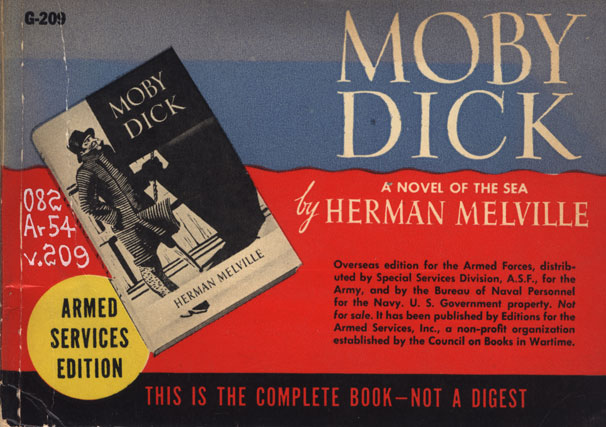
Moby Dick by Herman Melville. Armed Services Edition
New York : Council on Books in Wartime, 1944
AC 1 .A7 G-209

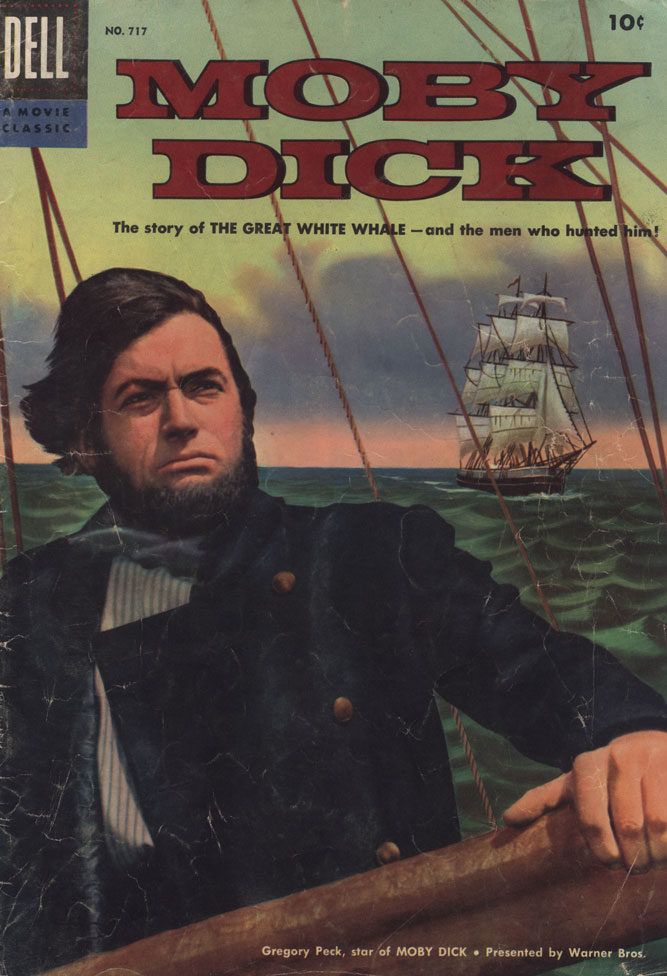
Moby Dick Comic. Authorized Edition
New York : Dell Pub. Co., 1956.
Hoole Library Harold E. Selesky Comic Collection
On November 14, 1851, one hundred and sixty years ago this week, the great American novel Moby-Dick was first published in a single volume in the United States by Harper and Brothers.

Though the novel had very limited success during Melville’s lifetime and beyond (he died in 1891), it stands today as part of the Western canon, and one of the most important American novels.

The “Melville Revival” began around the time of World War I, when the novel found new relevance in the wake of the Modernist movement. The book continues to speak to readers, with complex metaphors representing good and evil, power, and class. Literary critic Nick Selby said, “Moby-Dick was now read as a text that reflected the power struggles of a world concerned to uphold democracy, and of a country seeking an identity for itself within that world.”

These two examples of Moby-Dick shown here represent interesting examples of the rethinking and repackaging of great American literature. The first, an example of an Armed Services Edition, offers a compact version of the novel to American servicemen. These small paperbacks were distributed widely during World War II and exposed soldiers to a variety of great works of both the 19th and 20th centuries, along with a variety of other materials. The Hoole Library holds nearly a complete collection of Armed Services editions, one of the most complete collections held in libraries.

The second image is the cover of the 1956 Dell comic edition of Moby-Dick, based on the 1956 film starring Gregory Peck (best known by fans great Alabama literature as the beloved Atticus Finch in the film version of Harper Lee’s To Kill a Mockingbird) as the tyrannical Captain Ahab. Though this is a far cry from Melville’s dense prose, it is a welcome introduction to the great American authors, perhaps inspiring children to take the leap from comics to great American Literature! But there is room for every form and interpretation of this epic tale.

Veterans in our Collections: William March and Many More

From our collections, the “dog tags” of William March (né William E. Campbell), Alabama author and a highly decorated United States Marine.

William March saw action in World War I, and received the French CroixdeGuerre, the American Distinguished Service Cross and the Navy Cross for his service. March went on to write several novels and short stories, his first being Company K (1933, Smith and Haas), first serialized in Forum magazine from 1930-1932. Company K is a series of 113 vignettes that capture the individual experiences of the men of a fictional company in World War I. Its brutal and frank portrayal of the war experience has made it one of the most significant literary representations of the Great War.

William March Campbell (1893-1954) in his Marine uniform, 1919.

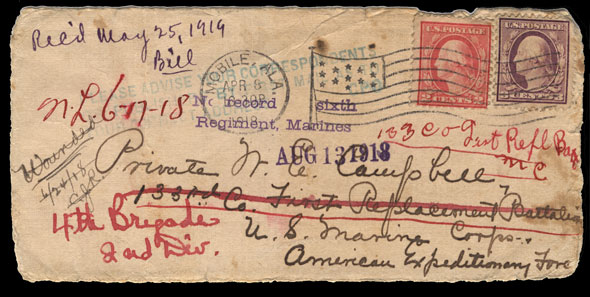
A well-traveled envelope sent to William March while he served in WWI, 1918.

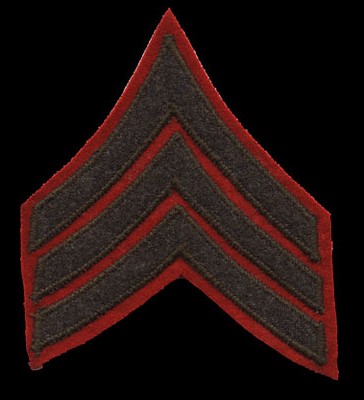
William March’s stripes

WM_sgt_stripes_4-12-18

The W.S. Hoole Special Collections Library holds significant materials that illustrate the daily life and experiences of the men and women of the United States Armed Services in the 19th and 20th centuries. Some of the collections are of well-known future authors such as William March and William Bradford Huie (who participated in D-Day and served as an aide to Vice Admiral Ben Moreell of the renowned Seabees), and still many more are of regular men and women who served their country both overseas and on the homefront.

Photographs, letters, diaries, scrapbooks and other personal materials are important tools in researching and understanding this important aspect of our history and culture.

For more information about our holdings relating to American servicemen and women, please contact us!


Valentine J. Oldshue Papers

Today is Veterans Day, a day in which we honor our military veterans. This day began in 1919 as Armistice Day, a day to commemorate the yearly anniversary of the end of World War I. In 1954, the day was expanded to honor veterans of all wars and given its current name.

In honor of both our veterans and the anniversary of the end of World War I, today we are featuring the Valentine J. Oldshue Papers. Oldshue was a historian and journalist from Pittsburgh, Pennsylvania, who served as an ambulance driver in World War I, a Red Cross relief coordinator, a correspondent for the American Legion in Paris, and a member of the Public Utility Commission. The collection contains newspaper articles covering the peace negotiations in Paris after World War I, Memorial day ceremonies at American cemeteries in the 1920s, letters, photographs, and postcards from France and Albania, press credentials, Oldshue’s diary and his dog tags (pictured above).

Happy Birthday John Philip Sousa!

Sunday, November 6, marks the 157th anniversary of the birth of John Philip Sousa. Sousa was an American composer and conductor and is well-known for his American military and patriotic marches. Because of his proficiency writing these types of pieces, Sousa would come to be known as “the March king.”

Sousa was raised in Washington, D.C., during the Civil War, and was exposed to military music on a regular basis during a time when military bands provided not only entertainment, but where also used to accompany soldiers into combat. After becoming the director of the Marine Band in 1880, Sousa began to make a name for himself as a composer of the patriotic style of music he’d been hearing since his childhood. In 1892, he formed the Sousa Band, which traveled internationally and was led by Sousa until just before his death in 1932.

We have two of Sousa’s marches represented in our Digital Collections, as part of the Sheet Music collection of the Wade Hall Collection of Southern History and Culture.

The first is the “El Capitan March,” published in 1896 from and operetta composed by Sousa entitled El Capitan. The sheet music we have is an arrangement for only piano.

The second is likely Sousa’s most famous piece, “Stars and Stripes Forever.” It was also composed in 1896, but the arrangement in our collection, again for piano, was published in 1897. In 1987, an act of Congress named this piece the National March of the United States of America.