Reflection on “Becoming Critically Reflective”

Reflection on “Becoming Critically Reflective.”

Stephen D. Brookfield, Becoming a Critically Reflective Teacher. San Francisco: Jossey-Bass Publishers, 1995.

This chapter discussed how to become more critically reflective and how being more critically reflective can change someone as a teacher. The author looked at four ways of becoming more critically reflective: reflecting on our “autobiographies” as teachers and learners; gathering input from students; discussions with colleagues; and reading theoretical literature on teaching and higher education. What struck me about this aspect of the reading were the limitations of each option. For example, it’s always difficult to examine your own practices because of your own assumptions and biases, students might be afraid to really say what they feel (and I would add that on teacher examinations students will often mail it in by choosing the median answer on each question, for example the teacher was “pretty good” or “good” on each topic), and when discussing teaching with other colleagues the author points out that we’ll often seek out like-minded colleagues. I think the author’s point to some extent is that because of these limitations it’s best to use a variety of methods in order to become more reflective.

The author also points out some of the consequences and advantages of being more critically reflective, some of which resonated more with me than others. For example, the author points out that more critically reflective teachers will be more likely to try to build a more “democratic” classroom experience, but I didn’t always see the connection. I think many teachers would like to build a more democratic classroom experience (we definitely don’t want to just be talking to a group of bored, unresponsive freshman English comp students), but I thought the author could have gone into the relationship between the two a bit more. What resonated the most to me was that more critically reflective teachers will be more likely to not see themselves as the finished product, so to speak. If you are constantly trying to examine yourself, your methods, assumptions, etc., then you will probably be more likely to evolve and grow as a teacher.
Looking to Session 2

This week’s challenge is to create active learning activities to use in Session 2.

Here at The University of Alabama, our instructional program for First Year Writing Students is separated into two sessions. The first is Finding and Using Search Terms and the second is Evaluating Sources. Louise, Alex and Karlie have been challenged each week to design activities to use in the sessions, with a narrow focus on one aspect of these topics.

Our sessions focus on narrow learning outcomes. We try to limit the learning outcomes to 3 for each session. Our departmental outcomes for session 2 are:

  • Distinguish difference types of resources in order to select relevant and reliable sources
  • Locate articles and books in print and electronic format in order to retrieve diverse types of sources.

When we talk to students about evaluating sources, there are two conversations that we have with them.

We talk about setting standards- what are the standards that a source has to meet in order to be included in your body of research? What caliber source do you need in order to support your argument? Will you need to use scholarly articles? Primary sources? Or are popular sources good enough?

The other conversation is about a source itself- how do you critique or measure the value of a source? How do you review your source? Who is the author? Do you need to do some background research on them to make sure they know what they’re talking about? What gives them ground to talk about this topic? And what is the source origin? Is it peer reviewed? Did it have publication and editorial standards? What kind of reputation does it have?

So far, we’ve been seeing a lot of creative activities. Anything from small group work to game show style games. I am looking forward to seeing what comes out of this challenge, and I hope the activities will be blogged about afterwards!

The Courage to Teach

This week’s reading came from chapter one in the book The Courage to Teach. The chapter was entitled “The Heart of the Teacher: Identity and Integrity in Teaching.” The chapter’s primary focus was on the fact that technique alone does not make a good teacher. Factors like integrity and the identity of the teacher help to promote good teachers. For the author those two factors appear to be some of the most important.

In reading this chapter, I found myself once again looking at myself internally. The chapter touched on one of my biggest fears about teaching: Teaching is all based on technique and if you do not have that foundation then you will be doomed in the classroom. This idea formed throughout my K-12 school years as I watched my former teachers use various techniques that they had learned to teach us the information we needed to know. Upon entering college, my eyes were opened when I meet many professors who had no formalized training in teaching but bravely went into the classroom each day. In those early days, as I sat in these classes my fears were reconfirmed that good teachers were only those who were trained in the techniques. Luckily, this perception changed as a moved into my upper level major classes. I began to see that years of experience, the level of comfort in the subject area, and a natural affinity to teaching also factored into the formula, along with technique, to make a good teacher. My fear however remained. I realized that I could attained the first two points, but the third was very elusive and something that was very personally internal.

Today I have been put in many situations where I have had to over come my fear of not being a good teacher. I have conducted classes where I have been very well paired, not prepared at all, and gone into classrooms on a wing and a prayer hoping for the best. In reading this chapter, I found myself confronting that old fear that I thought I had mastered. The premise of the argument I had encountered before listening to other teachers, however; the chapter had a profound effect on me especially the section that talked about learning to listen to ourselves internally. This was something that I had never truly done and I began to equate that with the realization that I did not trust myself in the classroom. I realized that I believed that without a formal technique to guide me that I would not be a good and effective teacher. This internal reflection also made me reevaluate my past teaching moments in a new light as well and I came to realize that what the author was arguing for was in many ways absolutely true. I began to remember classes where I was the student and the class was strictly driven by technique. I also remembered classes where all three aspects of technique, content, and the identity were balanced. These were my favorite and most effective classes.

From all this internal reflection, I came to the conclusion that I have many times before when I have thought about teaching: it is a balancing game! A balance of technique, knowledge, and personality rolled into a consumable form for students to digest makes, what I believe to be, one of the best teaching environments for students to learn.

Game Changing

Having given some thought to the way my first “dry run” went, I decided to make some adjustments.  I also had a gratifying and validating discussion about these changes with one of our fearless Jedi leaders, Sara.  I determined that I had allowed my natural, convivial manner to overrun the lesson plan I had chosen, and that I needed to concentrate on what was lacking (steering the direction of the exchange) my being more didactic in my approach and lend more of a lecture style to my instruction.  While not abandoning my “authentic self” as I so lauded in my response to “The Courage to Teach” article to which we responded, I wanted to challenge myself to  distance myself somewhat from the conversation in order to meet the goals of my lesson plan.  Also taking a suggestion from our meeting that followed the initial session, I decided to make a rigorously organized lesson plan (even if it does only cover ten minutes).   I had also determined that the practice of technique would require narrowing my focus as closely as possible, so I chose to focus on a lecture based format that would only cover a small facet of what we will actually be attempting to convey.  I also resolved (this time) to go entirely low-tech.  Using Scout and speaking at the same time was more of a challenge than I had previously anticipated.  This is certainly a balance I want to address, but first I prefer to move out of my comfort zone on a more personal basis. I realize that I enjoy technology not only as a useful tool, but am also tempted to use it a buffer, and tend to get bogged down in technical rabbit holes.  This is fine for exploratory sessions, but for the purposes of our experimentation, I think it is most important for me to get ahold of time management and sticking to the subject intended for the session.

As a side note I greatly enjoyed today’s  observation of Karlie and Brett’s wonderful co-teaching session.  They set the bar high.

Full Swing

Library Instruction season is in full swing at The University of Alabama! All of us are scurrying around, meeting with class instructors, planning lessons, and meeting with students in classrooms and one on one. There is a lot of energy in the air! Karlie, Louise and Alex presented some very narrowly focused and informative searching modules this morning, and without any prior discussion, each of them highlighted a different aspect of the searching process. Karlie has had her first co-teaching experience as of yesterday, and the other two will begin next week. I think they’re ready. They’re doing so well.

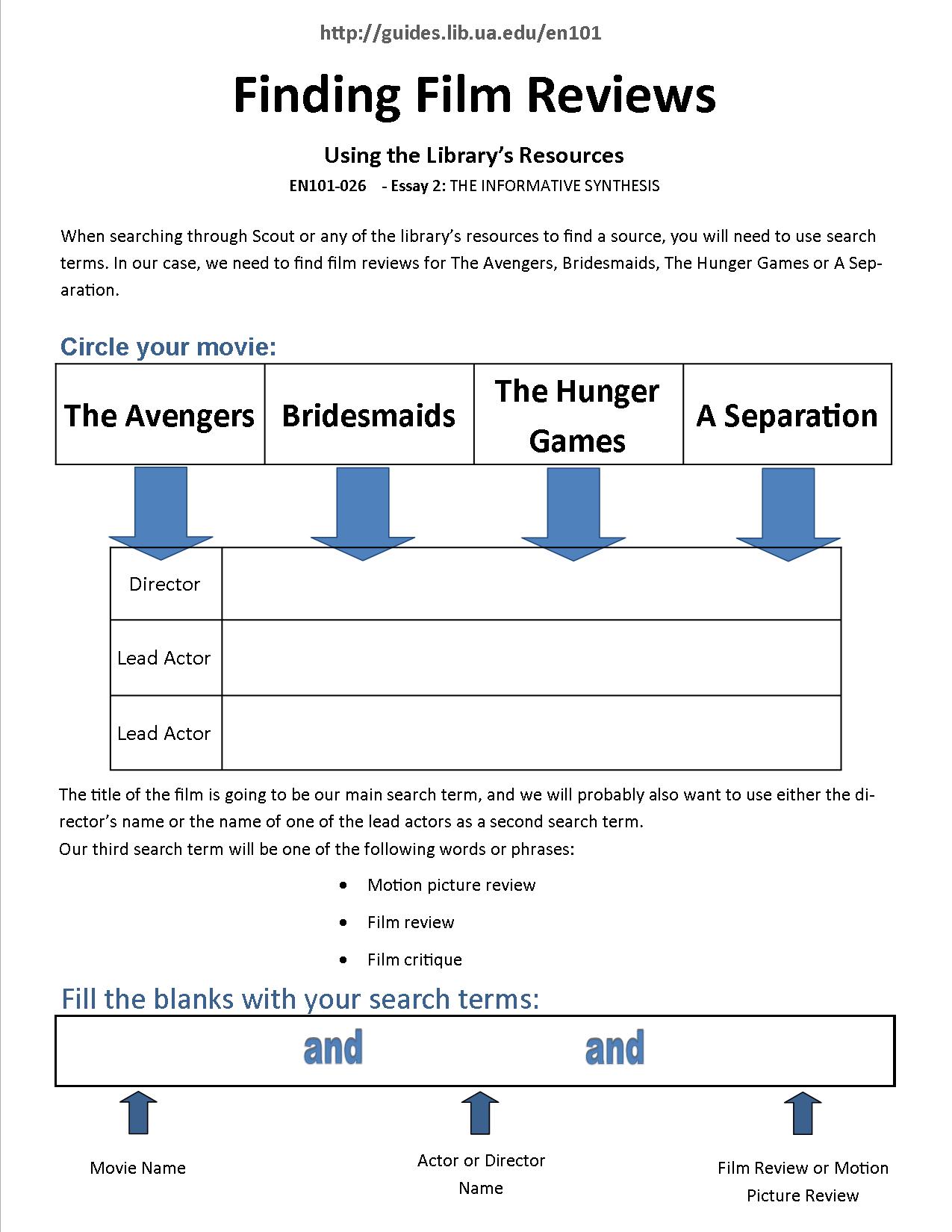
This afternoon, I’ve been prepping something a little different from our normal EN102 classes. I am going to a EN101 class to talk to them about their Informative Synthesis paper, which will be on film reviews of The Avengers, Bridesmaids, The Hunger Games, or A Separation. The movies are pre-selected, and the students will actually be finding 4 reviews of one movie, and synthesizing those reviews for their paper. It’s a really fun assignment. But the question becomes how to teach them to find the specific sources that they need? They don’t need to learn how to do general searches, and I only have 20 minutes to present to them.

This is what I’ve decided to do. I have outlined a search formula for them to follow, and in my LibGuide I’ve linked to several databases that they can use this formula in to find the reviews that they need. I think this will give them a fail-safe way to search for the specific information that they need without steering them towards any of the greater conceptual issues that we will be addressing with them in the future. This assignment’s important objective is for students to learn to synthesis multiple sources, and this activity will facilitate that objetive nicely!