Mapping curricula and employ-ability skills

As always, I get used to receive knowledge passively as a student but the transitional point comes when I get this internship. To work with instructional libraries on mapping curricula makes me think about curriculum design actively at the point-view of curriculum developer.

In the project, a comprehensive process of mapping consists of establishing learning goals and assessment. Learning outcomes are increasingly tended to focus on employ-ability skills as a result of broader skilled needed by graduate employees.

According to Oliver’s article, I know the process of mapping curricula goes through five phases from initial request to course changes approved and course learning outcomes consist of several units. (2007) Learning outcomes are aligned with employ-ability so that the curriculum engages students to develop work-readiness.

However, there are a lot of complications and challenges around this pedagogical philosophy. Academic staffs are too busy to do extra work on reviewing curriculum. Also, changes in a wide variety of courses will largely affect the teaching system, which may pay costs. Nevertheless, in my point of view, the quality of learning is worthy to invest time and money. With employ-ability embedded, employment of graduates are improved which will widen the intake of universities, creating a virtuous cycle.
Things I learn from reference work

How time flies these days! I do not even recognized most time of the internship has passed. What I also don’t realize is my remaining hours of internship will be changed to spent in reference work at the information desk. I’m so excited and surprised because I have only sit in the library as a student, but never sit as a consultant. Based on the true experience of helping students, I learn some fundamentals of how to provide excellent consultant work as a qualified librarian. I’m very honored to be assigned this glorious task as whether or not the reference service is of high quality affects the image of the whole library.

From this work, I find the role of librarians has a change. Traditional librarians are just information providers who spend all day sitting in the middle of the library and provide services to readers. However, as a modern librarian, he/she should evaluate, collect, and distribute information more actively. Some tasks are just seemingly easy but have to be accomplished very carefully. For example, in the simple action of answering the phone and scanning the file, there are plenty of truths and mysteries waiting for us to explore. To transfer the call accurately and quickly, I have to memorize many phone numbers and their associated departments. It took me a lot of efforts to find that only when the paper is placed on the top left corner of the scanner, it can be scanned in full.

In the coming days, there are a lot I have to learn and improve. I’m expecting to learn something new everyday and enjoy feel connected with students. Happily, an increase in collaboration with colleagues also emerged as a result of seeking guidance from them.

Qualitative Research

By way of introduction, much of the first half of my curriculum mapping internship with GIS has involved some data collection and a good bit of data transformation. The data transformation process involves creating a structure for what will become a visual tree, and transferring much of the data collected by various instruction librarians into Excel in such a way that it can be visualized. Seeing what these trees look like has helped structure some of the more complex academic departments.

The second half of the summer will largely be focused on using NVivo to do qualitative data analysis of syllabi. This is a project to which I am looking forward. I believe that NVivo will be a valuable software to learn. And qualitative research is the type of research I am most interested in performing during my library career. Some of the aspects of qualitative research I enjoy are: the group nature of the research, the inductive approach, the open ended aspects of the research, the more flexible nature of the research process, and the iterative approach, among others. I am looking forward to learning how NVivo works, and seeing what we will find in our qualitative analysis.

Curriculum Mapping and Me

As a student in the School of Library and Information Studies program here at UA we are provided with the opportunity for an internship; my internship this summer is with Gorgas Information Services. Working with the Instruction Coordinator Librarian I am assisting with the Curriculum Mapping project with which the library has been involved. This project involves assisting in data collection on required courses, data transformation of information collected by other librarians, and other projects as assigned.

As part of our weekly reading we read an article by L.H. Charles—“Using an Information Literacy Curriculum Map as  Means of Communication and Accountability for Stakeholders in Higher Eduction” (log-in required)—to examine the connection between the map and information literacy, and the benefits the curriculum map had to the wider university community; especially the university administration.

The reading was also helpful as I prepare to move to my first professional library position this August; I hope to do some basic curriculum mapping for that school—likely more like the way that it was discussed in the Charles article than the more detailed mapping that we are doing here at UA. The themes in the article, and my work with UA’s data collection and transformation, will couple together nicely with some initial mapping work for the school to which I am going.

The use of curriculum mapping facilitates the communication among educators

The experience of participating in the project of curriculum mapping is a little tedious but very learning. Through a process of collecting and transforming a large number of data, I familiarized my self with how a subject is structured hierarchically, what factors should be considered when a new curriculum is implemented, and the use of curriculum mapping. I do not expect that, besides functions I already know, the use of curriculum mapping can even increase the collaboration among stakeholders at universities.

For me with no experience in this area , in the beginning I had no idea just “mechanically”removed curriculum records to extract data. Afterwards, a lot of duplicated information in different disciplines aroused my attention. If each subject is organized like a tree where many terms group beneath a term from upper level of the tree, branches of different subject trees are intertwined and overlapped with each other. From this, I find data collected on curriculum mapping allows us to identify the inter-sectional parts of different courses where pedagogical cooperative relationship can be built among different departments. This link is the fundamental element of sharing education resources and unified management.

During the creation and implementation of information literacy curriculum map(ILCM), because librarians and faculty make great effort toward the same direction, they have many opportunities to collaborate. On one side, mentoring librarians are responsible for creation of curriculum. On the other side, instructors hold introduction sessions to library service and figure out what skills students should master in their discipline. In addition, at some colleges, the office of assessment works with faculty and academic departments to investigate learning situation of students for adjusting the curriculum. Thus librarians , faculty, and rating agencies are agreeing and build a perfect teaching system.(Charles, 2015)

In conclusion, curriculum mapping is the catalyst for communication among educators .

Reference

Charles, L. H. (2015). Using an information literacy curriculum mas as a means of communication and accountability for stakeholders in higher education. Journal of Information Literacy, 9(1).

How The Citation Project Helps Librarians Promote Fair Use

As I think about Fair Use this week, I find myself reflecting on a conversation that I had several years ago with a writing instructor friend. We are at The University of Alabama, and a student of hers wanted to know if he needed to find a source to support a statement that he considered common knowledge– Bear Bryant coached alabama football and won several national championships. This anecdote brings up a more complex question for many students: what is “public knowledge” and what needs to be cited? How do I know the difference?
The Citation Project has given us a lot of information about the patterns of student writing that are typically classified as “plagiarism. ” Through the data they have collected, we gain insight into how students are engaging with sources, and we can examine plagiarism cases through a more complex lens. The exciting thing about the Citation Project’s work is that it helps educators take advantage of the teaching moment. It helps us examine these wayward “plagiarism” cases as formative assessments, allowing us to adjust our pedagogy to reflect the confusion that a student has about fair use of sources, and the ethics of writing. The Citation Project’s usefulness is not limited to the writing instructor. Librarians can use the information provided in the data gathered to help support the ethical use of information through conversations about the iterative nature of research (coaching them away from what Bartholomae calls “dogmatic writing”). By convincing students to write about what they learn while researching rather than researching for a preconceived idea, we can perhaps help them gain a better understanding of what needs to be cited, and we further them along the road to informed citizenship.

Fair use, Library Instruction, and First-year Students

Association of Research Libraries
Fair Use/Fair Dealing Week- 22-26 February 2016

“Fair Use/Fair Dealing Week is an annual celebration of the doctrine of fair use and fair dealing. It celebrates the important role fair use plays in achieving the Constitutional purpose of intellectual property rights in the US.” – Association of Research Libraries

In this series, bloggers from within the libraries and from the UA campus community talk about Fair Use, and how it applies to our lives as citizens and scholars.

The Framework for Information Literacy states that “Scholarship is a Conversation– Communities of scholars, researchers, or professionals engage in sustained discourse with new insights and discoveries occurring over time as a result of varied perspectives and interpretations.” Without the fundamental right of fair use, the scholarly conversation would be impeded, and student engagement with new and unfamiliar ideas would be stymied. Through library instruction, we have the opportunity to facilitate a student’s engagement in the scholarly conversation, and to encourage fair use of information- the analysis of a visual artifact, the use of a quote as evidence, and even the provision of information through the libraries’ collections– in order to provide the environment and the resources for a rich and deep learning experience.

Some of the many skills we hope to teach our students during their college experience are finding, evaluating, and using sources to support their research. While students have had some experience with academic writing and research in their high school experience, many of the skills and expectations introduced to them in these first two semesters are completely different from anything that they’ve done before. Through our  partnership with First-year Writing, the University Libraries help to educate new students in these very skills, which enable them to exercise their fundamental right of fair use. From newspaper articles, to personal blogs, to a student taking their first steps in engaging in the scholarship in their chosen discipline, librarians partnering with first-year writing instructors to teach students to engage with sources and keep track of their research. Engagement through fair use comes in the form of summary, paraphrase, and quotation, and is an integral part of teaching source engagement. As students move on to life after graduation, they retain these skills, allowing them to participate as active citizens in a world filled with information.

Me… a teacher. (Part 2 of 2)

By the end of the semester, I’d learned how to plan effective information literacy sessions. What I had not expected to learn was how much I enjoyed seeing students actually get what I was saying. Freshman aren’t always the easiest bunch of people to teach. They come from so many different backgrounds and they are entirely new to the college game–they have to write different, begin thinking more critically, and think about the direction they want to go in for the rest of their college career. Researching is a big part of that, and for them to finally have it all click and look relieved that it was one less thing off their shoulders, it was a huge win for me. When one of them told me that they loved one of the activities I had them do in class, I fist pumped so hard after class that I nearly pulled a muscle–because to learn, you don’t necessarily have to enjoy something. But having that extra little encouragement made me believe that I was making a difference.

Me? A Teacher? I could be. What kind of teacher? One who wants to connect with students and let them connect with the information by using stories and interesting things that reveal research as something that could be interesting and fun, not just something they had to do. It’s hard to achieve in the information literacy classroom, but the simple engagement of their minds with stories, interesting sources, and pop culture could enable me to interact with the information they grab from the internet instead of just using it and discarding it. Each source has the potential to teach them something and inform them about a topic they find interesting… allowing them to see that research as something engaging and intriguing would be my job as a library instruction teacher.

Me? A Teacher? (1 of 2)

Asking at the beginning of this semester, I would have answered this as a hard no. Not a soft “well maybe I could get interested” no or a middle-of-the-road “maybe not at this point in my life” no… it would have been a bent over at the waist with laughter, shaking my head and asking you if you were kidding kind of no. I thought to myself that this internship would be to answer the question if I could teach or not. What I didn’t know was that it would teach me that I could be a teacher.

Being a teacher and teaching are often two things that seem like they should go together but often don’t. While a teacher teaches, teaching could be done without a teacher. Effective teaching has to be done by someone who cares, but it could be done by someone who doesn’t. The difference between a teacher and a person who teaches is that earnest intent of someone who wants their students to learn and grow in the classroom and the person who’s just there to collect a paycheck. This is something I learned by listening to people talk about teachers who honestly didn’t care and looking back at my own experiences with teachers and professors. The people who taught me did their job well, I’m a graduate student and about to attain my Masters. Without them, I wouldn’t be here. But, there were some people who taught me that did not make me want to learn and did not make everything they taught interesting and engaging. The teachers I remember the most were my dynamic teachers. They engaged with me and encouraged me to interact with the material. They went the extra mile to be interactive and make sure that, while learning, the class was engaged with the information. In other words, they did more than just teach. They were real teachers.

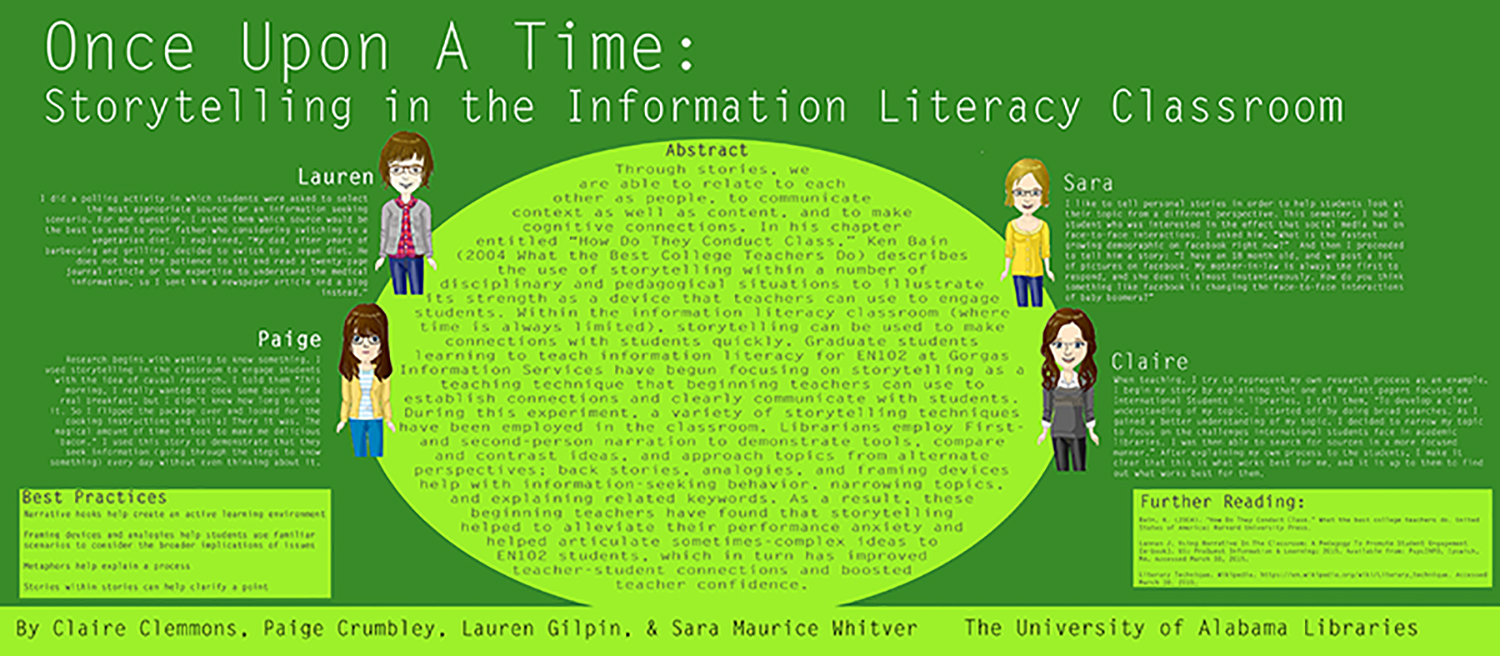
Once Upon a Time: Storytelling in the Information Literacy Classroom

Once Upon A Time small

On April 9th, Lauren, Paige, Claire and I presented a poster at Alabama Library Association’s annual convention in Point Clear, AL. It was the perfect way to end a semester of hard work and dedication for these excellent SLIS graduate students.

For more information about our poster, please check out the documents I have attached below: