Game Changing

Having given some thought to the way my first “dry run” went, I decided to make some adjustments.  I also had a gratifying and validating discussion about these changes with one of our fearless Jedi leaders, Sara.  I determined that I had allowed my natural, convivial manner to overrun the lesson plan I had chosen, and that I needed to concentrate on what was lacking (steering the direction of the exchange) my being more didactic in my approach and lend more of a lecture style to my instruction.  While not abandoning my “authentic self” as I so lauded in my response to “The Courage to Teach” article to which we responded, I wanted to challenge myself to  distance myself somewhat from the conversation in order to meet the goals of my lesson plan.  Also taking a suggestion from our meeting that followed the initial session, I decided to make a rigorously organized lesson plan (even if it does only cover ten minutes).   I had also determined that the practice of technique would require narrowing my focus as closely as possible, so I chose to focus on a lecture based format that would only cover a small facet of what we will actually be attempting to convey.  I also resolved (this time) to go entirely low-tech.  Using Scout and speaking at the same time was more of a challenge than I had previously anticipated.  This is certainly a balance I want to address, but first I prefer to move out of my comfort zone on a more personal basis. I realize that I enjoy technology not only as a useful tool, but am also tempted to use it a buffer, and tend to get bogged down in technical rabbit holes.  This is fine for exploratory sessions, but for the purposes of our experimentation, I think it is most important for me to get ahold of time management and sticking to the subject intended for the session.

As a side note I greatly enjoyed today’s  observation of Karlie and Brett’s wonderful co-teaching session.  They set the bar high.
Full Swing

Library Instruction season is in full swing at The University of Alabama! All of us are scurrying around, meeting with class instructors, planning lessons, and meeting with students in classrooms and one on one. There is a lot of energy in the air! Karlie, Louise and Alex presented some very narrowly focused and informative searching modules this morning, and without any prior discussion, each of them highlighted a different aspect of the searching process. Karlie has had her first co-teaching experience as of yesterday, and the other two will begin next week. I think they’re ready. They’re doing so well.

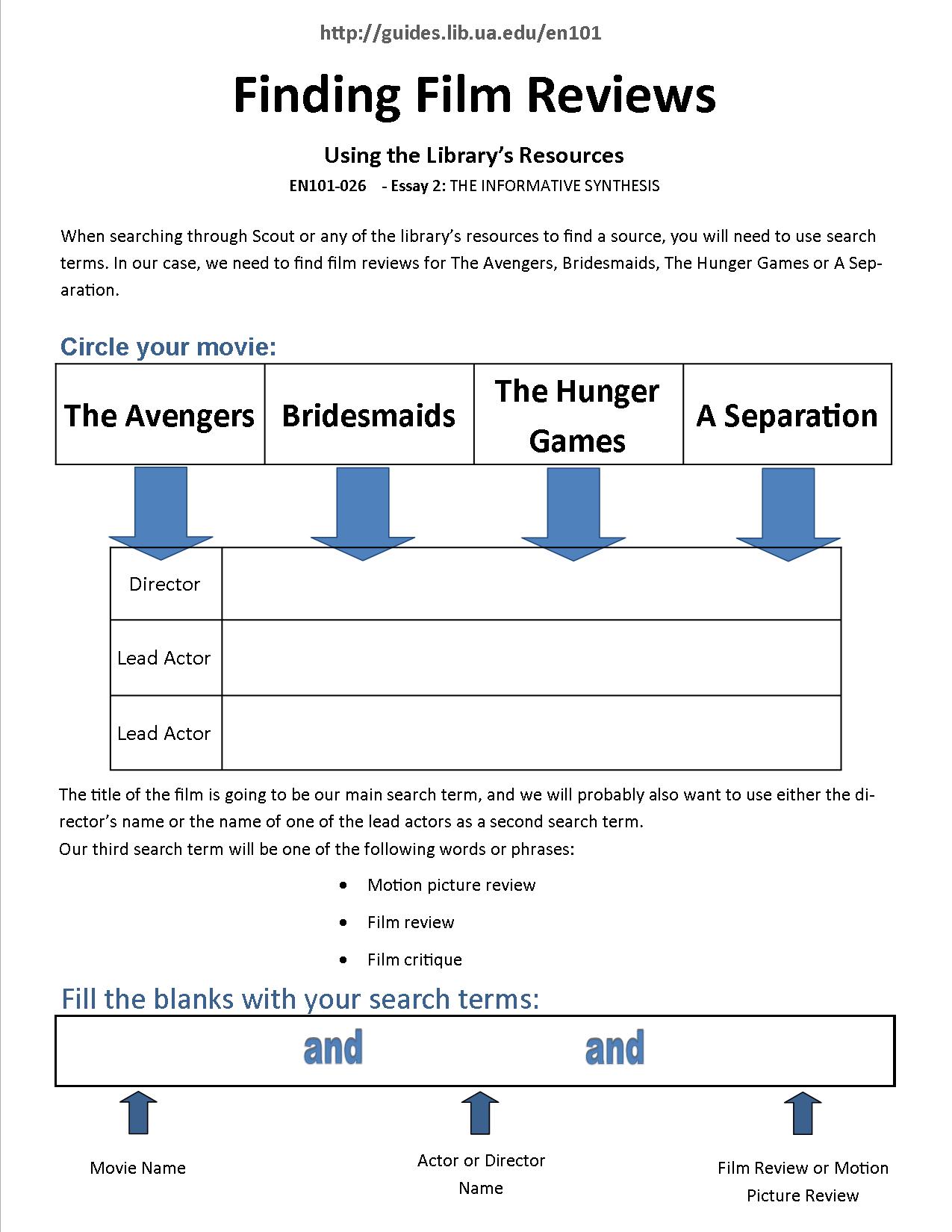
This afternoon, I’ve been prepping something a little different from our normal EN102 classes. I am going to a EN101 class to talk to them about their Informative Synthesis paper, which will be on film reviews of The Avengers, Bridesmaids, The Hunger Games, or A Separation. The movies are pre-selected, and the students will actually be finding 4 reviews of one movie, and synthesizing those reviews for their paper. It’s a really fun assignment. But the question becomes how to teach them to find the specific sources that they need? They don’t need to learn how to do general searches, and I only have 20 minutes to present to them.

This is what I’ve decided to do. I have outlined a search formula for them to follow, and in my LibGuide I’ve linked to several databases that they can use this formula in to find the reviews that they need. I think this will give them a fail-safe way to search for the specific information that they need without steering them towards any of the greater conceptual issues that we will be addressing with them in the future. This assignment’s important objective is for students to learn to synthesis multiple sources, and this activity will facilitate that objetive nicely!

How Do They Conduct Class

I have always considered interal and external reflection to be an important part of my growth and development as a person. The tools that prompt this self reflection have throughout my life have been quite varied so I should not have been surprised when this article became such a tool. The truth was, however, that surprise was mild in comparsion to the reflection that this article created within me. It was more on the level of eye-opening that had me reassessing some of my core ideas about teaching as well as reflecting back to my earlier academic influences.

My academic background has been heavily influenced by lecture based classes and in my heart of hearts I always believed that this would be the way I would conduct my own classroom. However, eight years have passed since I was a freshman and since that time some my ideas have evolved as I have grown as a student. I thought about ways I would change this or tweak that, but it was all centered around a lecture and discussion type format. Upon entering into the MLIS program, I realized that teaching pedogogy had shifted somewhat in a new direction with learning outcomes and some teachers calling for moving away from lecture based classes. This put me into somewhat of a tailspin about my original ideas on teaching. I was intrigued by the new shift and eager to learn more, but the more I learned the more muddled my internal ideas became. It was upon reading this article that a cord was struck with me and I felt that I began to gain some clarity.

The clarity I derived from this article came in two parts. The first part that I was focused upon was that teachers all had various teaching styles and one particular method was not better than another. This revelation was like light shining for me into a dark room. I knew on a certain level that this was true but when I looked back some of my best teachers almost all of them used the lecture based approach. Upon entering into my MLIS program, many of my professors had wonderful but varying teaching styles. This is where the waters got muddled in my mind because I was not sure which path I should follow. Reading this article however made my realize that I was not alone in this confusion.

The second part that I derived from the article was the concept of balance and this point right here cleaned up my internal traffic jam. The article gave examples of some of the best practices of teachers using various methods in a hybrid fashion. From this, I realized that I did not have to fore go my plans of using lecture but I also did not have to just be restricted by it either. The knowledge that I could have a hybrid teaching method not only thrilled me but made me realize once again that not everyone learns in the same way. Knowing now that when I go into a classroom I could possibly have a teaching method that could reach students on various levels is thrilling to my internal core.

Reflection on The Courage to Teach

While I was reading this article I couldn’t help comparing and contrasting it to the “How do they Conduct Class” article. While that article didn’t definitively claim that one method of teaching (lectures, group discussions, etc.) was the right way of doing things, it was more specifically concerned with methods and techniques. This article is more about what it means to be a teacher than it is about how to teach; the central premise of it is that “good teaching cannot be reduced to technique; good teaching comes from the identity and integrity of the teacher.”

I took a number of different things from both of these articles. I wouldn’t say that teaching methods and techniques are unimportant, or that working on improving your instruction style is unnecessary (and I don’t think that’s what the author of this article is trying to say). I’ve had some teachers that seemed to love what they were doing and were very enthusiastic about teaching that, for a variety of reasons, I didn’t consider to be especially great instructors. On the other hand, I agreed with the general premise of this article. To be a good teacher it seems like you would have to have a strong sense of identity as an instructor, a willingness to put yourself out there so to speak (the article spends a good bit of time discussing a teacher’s vulnerability in class), and an interest in working with students to help them develop intellectually (instead of simply trying to show them how knowledgeable you are).

Reflection on How do they Conduct Class?

The main thing I took from the article “How do they conduct class?” is the importance of getting students actively involved in class. There isn’t necessarily one right way of encouraging active learning; the teacher could use a “traditional” lecture style, moderate discussions, assign group work, etc. The main thing seems to be to encourage students to think critically, whether that is as part of a lecture, group discussion, or class project. To do so the instructor needs to quickly get the attention of the students and keep them involved.

The question then is how do we try to make sure that we get the students’ attention and keep it? How do we make sure that the students are actively involved? The article talks about how many professors try to quickly get their students attention by starting class with a “provocative” question. I personally am struggling at the moment to think of what might be called a provocative question related to one of my presentations, but regardless there seem to be some fairly clear ways of keeping the class actively involved in the session. We can frequently ask questions of the group, get them involved in coming up with keywords or search terms, have them work in groups in order to build searches, etc.

The last thing I took from this article was how even experienced teachers practice at being an instructor in order to get better at what they’re doing. Some videotape their own sessions, some practice in front of a mirror, and some simply spend a few minutes before class going over what they want to get across to their students. I was a bit surprised by that in some ways; I’ve had some teachers that seemed so relaxed and at ease as instructors that I have a hard time imagining them practicing their enunciation before class. But it does make sense, there are inevitably going to be people that are more naturally gifted teachers than you, but you can always work at improving the way you do things in class.

Dry Runs

Today, Louise, Alex and Karlie were able to do their first dry run of an instruction session during our training meeting. Brett and I asked them to conduct a 10 minute module, teaching some small aspect of Scout (The University of Alabama’s EDS). The purpose of this exercise was to discover things about themselves when they try to explain something to an audience. Each did a fantastic job.

I have issued a challenge to them to do some search analysis using Scout, so that they have a better practical understanding of how it works, and cautioned them about drawing focus during their sessions from their key points by trying to explain jargon and technicalities in too much detail. And we all have to continue to find a balance between being a fallible human who makes mistakes and drawing too much critical attention to one’s self at the cost of distracting from our message.

Time is something that I have been struggling with in the past week or so. I never have enough time to cover everything I plan. This semester, I have been focusing on reducing the quantity of my session content in order to more deeply address the strategy of choosing search terms and developing search strings, and I find that the deeper I go, the less time I have. Twice so far this semester, I have not left enough time to complete the exercise that I planned to do with my students. For my sessions next week, it’s my goal to pace myself better, and to recognize if I am spending too much time on one thing. If I feel I am spending the correct amount of time on each component during my sessions, perhaps I am still trying to accomplish too much and I need to cut something out! In this process I find both frustration and motivation. I want my freshmen to be equipped with adequate skills for finding the best sources for their research when they leave my classroom, but if I try to teach them too much I risk over-saturation.

Next week we are going to repeat our dry runs, and I think we will perhaps implement some peer review into it. The following week, we are going to develop active learning components for our classes. I look forward to seeing these three budding instructors grow more confident and find their voice through these exercises. Great job, everyone!

Reflection on The Courage to Teach

This was a splendid and inspirational article.  It jives very well with my personal interpretations of Taoist philosophy, particularly in its emphasis on the value of integrity as an intersection of authentic, realized relationships.  This point is particularly salient in bringing together the ideals of courage born of compassion and vulnerability with techniques that thereby “reveal rather than conceal” our character as instructors.

What captured my attention most was the section on mentoring.  It got me to thinking about my own mentors and how they (as the reading says) appeared at crucial times in my life and changed my personal and professional trajectories in ways I could not have imagined at the time.  I spent some time remembering my first mentor, a third grade English teacher Claudia Isaacs.  I was shy and easily embarrassed then, and when we had to give our book reports in class I remember being petrified.  I was also sure that the other kids would see my terror and make fun of me.  But I got through it, and afterward she complimented me.  Again, after class she called me to her desk to discuss my reading choices (I had given a report on The Last Battle by C.S. Lewis) and she encouraged me, saying I had a gift for writing.  No one had ever told me so before, but she seemed so wise and spoke sincerely to me, and then gave me an “extra credit” assignment to write about another book I loved.  Rather than seeing the extra work as a punishment or a burden, suddenly it became an opportunity as well as a compliment.  I do not remember much of the content that was covered in that class (well, hopefully I remember the content but I don’t recall the occasion of it being taught).  But her kindness and enthusiasm became a part of me that day, and I probably did pay closer attention in all my classes because of it.  I have been blessed with several other great mentors since that time, some of whom dazzle me with their intellect, others who impressed me with their sheer delight in teaching and learning.  It is humbling and fills me with a deep sense of respect and responsibility in my interactions with others as I try to learn the techniques of teaching.  It reminds me of another old Taoist analogy:  That a voice coach can teach all the exercises to overcome impediments and imbue the voice with discipline, but in the end each singer has to sing his or her own song.

Welcome to a New Semester!

I think we’ve gotten off to a great start. Our Interns Louise and Alex, and our GTA Karlie are all settling into their new schedules, and are beginning their special projects. We are having some great conversations in our training sessions.

This week, Brett and I both shared examples of times when we failed pedagogically. Reflecting and sharing those experiences is what allows us to grow as teachers. Everyone read an article called “How Do They Conduct Class,” and we talked about finding our teaching style and allowing ourselves to experiment. We also talked about not being hard on ourselves if something doesn’t work out the way we hoped. We can only improve if we are willing to try new things, and sometimes new things don’t work, but that doesn’t mean that they aren’t worth trying! We learn something new through the experience of trying, and that new knowledge is ours regardless of the success of our experiment!

Welcome, Alex, Louise and Karlie! Let’s have a great semester!

-Sara