Solo Session

I have completed 8 of my sessions. I did my first solo session on Wednesday. I had an unexpected brush with nerves halfway through the tour, but I think I did pretty well on the tutorial on Scout. I am glad to be finished with my first go around. I have two more week after next. I expect that they will be better. 

Lizzie and I have been working on our tutorials. I am looking forward to seeing them as a full piece. I think that we have mapped out a pretty good theme for our videos. We were going to originally use Bigfoot, but there aren’t very good results from the searches we need, so we decided to switch to zombies. We had even found a cute little Bigfoot for a graphic, but I will survive. 

Lastly, I found and have included this link to a talk by Neil Gaiman about the importance of libraries. Gaiman is well known for his support of libraries. I think that he said some amazing things in this talk. 

Session 2 Experiences and Reading

This week I taught my back-to-back session 2’s. I was able to control my nerves and deliver my content. During my active learning activity involving evaluating sources, I was fortunate enough to learn from my students! I chose an academic journal article that was related to my topic but not exactly relevant, and a student pointed this out. I had students that accurately described how they would use these sources for their papers–to describe a company’s official position and to source first-hand accounts, for example. I thought this was really encouraging. 

The reading on podcast efficacy as used in a flipped classroom setting was very interesting. I think the authors are right in that podcasts have a lot of potential and free up instructors to engage in active learning exercises and discussion with their students. However, in my experience the podcasts need to be pushed by the class professors in order to be effective. It seemed that only the most studious of the class completed the podcast assignments, while others ignored the assignment. 

One-on-One Instruction

On Thursday I observed Michael doing the second session of an EN 102. On Monday I co-taught the same section. Since there was not as much time between seeing it and doing it, I was nervous, but I think Monday’s was a success. I felt comfortable with the way that I explained the differences between popular and scholarly sources. There was some trouble with the activity, but I have been more concerned with how I explain something. I am glad that I was able to properly describe the difference in these sources. I think that the topics covered in the second session of the class are quite applicable to public library instruction. While most public library patrons will not be writing formal research, they will be using information accessed from several sources, mostly internet, Google results style. I think that being able to help a patron learn how to evaluate information will be very important. 

An interesting thing that I have learned about lately in my User Instruction class is one-on-one instruction. I know that we are largely speaking to a group, but most session have a time slot set aside for individual searching. During this time I feel that I do the best work because I am able to figure out what the individual needs and how to help them. Since everything that an instructor says will not automatically file itself away into the student’s brain, the one-on-one time will allow for an instructor to address the ideas presented that the student is weak in. 

Job Searching

On Friday I finished my first job application. I am interested in public libraries, especially with reference and instruction. I know that there are fewer opportunities for these positions, but I found one that I really like. I know that perhaps they are interested in hiring before my graduation, but I feel good about doing my application because I was able to create a resume and cover letter for what I think is the perfect job. I used the opportunity as an exercise in defining my goals. I was happy to be able to put solid experience with instruction in my application. I had to complete a personal statement of sorts for the application, and I was able to explain why I have chosen to do the jobs and internships that I have. I am still overwhelmed by job searching, but I feel I am off to a good start. 

Standards and Proficiencies Reading

Reading the Standards and Proficiencies reading for tomorrow, I was struck by the standardized ‘Principles and Performance Indicators’. These indicators, particularly the ‘Institutional Effectiveness’ indicators, strike me as vaguely similar to the sort of outcomes I might present to a class before we begin our session. They are goals which we ideally are striving to meet. Such goals or objectives are important. They keep us on task and pointed in the proper direction. They guide us. 

At an institutional level,  Standards and Proficiencies are also durable. Employees may come and go, but standards last and help keep organizations consistent. As an information services department, it is also important to show department progress and effectiveness. One important way to do that is by having defined Standards and Proficiencies to measure your department against. Are we achieving these standards? What areas do we need to improve upon? 

In a classroom, creating objectives that reflect your broader standards and proficiencies supports your departmental and institutional objectives. They also help you measure your success as an instructor. Using assessment tools, we can measure our success in implementing class objectives. 


Reflections on Teaching

Teaching two classes back-to-back two weeks ago was an experience I won’t soon forget. Before my first class, a level of panic set in that I had never experienced before. I couldn’t believe it–I have taught over a dozen sessions and still I get so nervous! Before my first class, I was looking for a way out. I can’t do this, I thought, they’ll hate me, they’ll rebel, my head will end up on a stick outside Gorgas as a warning to other librarians–“bore us and you will pay!”

I found Brett Spencer and, sweating, I confided my nervousness to him. I told him “I don’t know what I will do!” and mopped my brow for the 10th time. Brett promised to stay and watch my session for moral support, and I was grateful. As soon as I started talking, though, I calmed down and stopped sweating. I went on with the session, implementing my ‘active learning’ lesson plan. I designed two active learning activities for the students to complete, thinking that lecturing less and putting the learning into the hands of the students would lead to more engaging sessions. I was half-right: the session went better this way, but I forgot to ask the students to pair up and talk about what they thought. I wish I had done this, because I believe that when students get to speak with one another, they become even more engaged. 

Overall, I am proud that I overcame my nerves and delivered instructional sessions with clear goals and multiple active learning exercises. While working individually with the students, I noticed they were implementing what I had taught them, which was satisfying to see. I still would like to get over my nerves so I can focus exclusively on teaching during the sessions. I may never get completely there, but I am working on it. 

Becoming Critically Reflective

“Becoming Critically Reflective: A Process of Learning and Change” is also a great re-read. Teaching sometimes forces us along a linear path–tomorrow there are more classes to be taught, more lesson plans to be made, and who has time to reflect? We must make the time to reflect. We need to find some way to re-evaluate ourselves. What are we doing right? More importantly, what are we doing wrong? 

These questions make me grateful that librarian Josh Sahib taught us how to upload materials and quizzes into UA Blackboard Learn course shells. Using this method, we can assess what level of information literacy students bring into their first library session as well as what level of information literacy they leave the session with. Assessment can force us to be reflective–it’s hard to ignore hard data. 

Larry Sheret and John Steele in their 2013 article, “Information Literacy Assessment,” confirm that it is most advantageous to conduct information literacy assessment as part of the students’ normal class activities. Using UA Blackboard Learn supports this idea–the materials and quizzes are located in their normal Blackboard course shells. Really anything we can do to take the burden off of the professor and make their library visits as seamless as possible is a great benefit, which is what this method of assessment does. I’m excited to see how it will work out.

*This post was mis-published on 9/12 into another blog and found 10/3.

Think/Pair/Share

In our Jedi Council on Friday, we discussed active learning and the effectiveness of having a “messy classroom.” Brett made a very interesting point comparing Sesame Street’s format of short segments focusing on different subject using different deliveries to how a college classroom can be, too. I did not like active learning when I was introduced to it during the end of my high school years. I was used to a lecture based format. I have tried to develop other ways to appeal to as many learners as possible. For the last active learning module I created an activity that would appeal to me as a learner. When I am introduced to a new idea, it takes me a while to analyze and work through the applications of it. By choosing to do a think/pair/share format, I feel like I appealed to learners like me. If I have a moment to myself, I can come up with things to talk about with others. If I have to immediately answer or discuss something without adequate thinking time, I freeze, my brain freezes, and I can get nervous. I am going to start including think/pair/share activities in my repertoire so that I can include as many students as possible in engaging with the content.

Week 6: Popular vs. Scholarly

This week we were asked to work on an active learning exercise to teach students about the differences between scholarly and popular articles/journals.  I like the idea of giving the students two articles and having them evaluate them on the spot before giving them any sort of lecture on the difference between popular and scholarly (much like Mark did in the class I observed a few weeks back).  This approach, in my opinion, gets the students to think critically about some terms they are already familiar with (“popular” and “scholarly”) and apply them to a research/library setting.  This way, the instructor can talk the students through the reasons why they decided “Article A” is scholarly and why “Article B” is popular.  After all, these are concepts they are already familiar with (at least in the abstract).  We’re just giving them the tools/knowledge to help them apply those concepts to their research.

In addition, I have also created a Sporcle quiz* that could possibly work as a quick little assessment after the article evaluations.  It does not look quite like I want it to, but it is a nice start.  If anyone knows of a Sporcle alternative or quiz generator that is a little easier to use/format, please let me know.

*Here is the bitly for the quiz:

http://bit.ly/popvschol

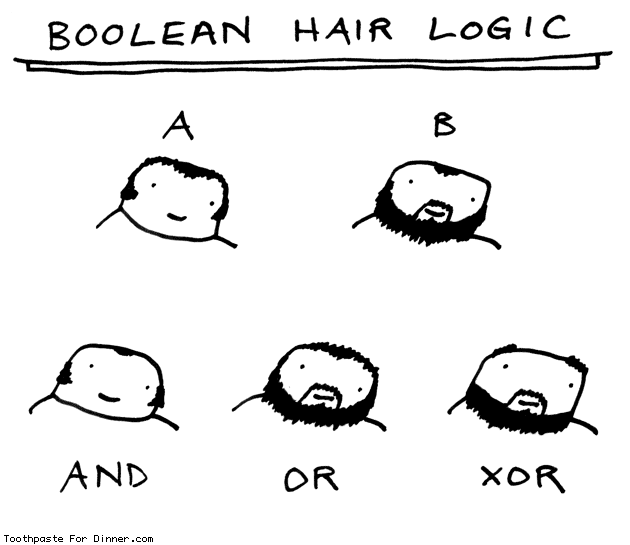
Also, here is a pretty sweet photo I found on the interwebs:

AND/OR/NOT

Image

This week we are developing active learning modules about Boolean operators. I have had some trouble designing an activity that describes this subject adequately. Most of the examples I have seen are illustrations of a Venn diagram describing AND, NOT, and OR; or using playing cards. Boolean logic is not a simple topic and can be difficult to explain to a group quickly. This subject has been one of the parts of the information literacy classes that I do not automatically have the words to explain. This week I observed Josh’s EN 102 session one class, and I finally understood a way to show students Boolean operators. He uses the advanced search options in Scout to search using the keywords already developed earlier in the class. Since the search is structured with the AND/OR/NOT between boxes to type in, it is a natural approach to stringing together the search terms. It was a smooth transition and was logical in the class. The students seemed to understand it well.

While researching ways to explain Boolean logic, I found several blogs by librarians with posts discussing this topic’s relevance in information instruction. Several instruction librarians emphasized that the topic is not nearly as important as many librarians assume it is. Also, the posts blamed this as a part of librarianship that creates barriers between new and infrequent library users and libraries. Perhaps this is a topic that will eventually be less important, but for now using AND and OR still seem important to me.

As for this week’s readings, I was quite glad to read something that takes seriously the true attitudes of college students and their approaches to information literacy. The best way to truly understand how to teach students is to be practical about the motivations and habits of the less interested students.